49 works in this view — arrow keys or swipe to move between them.
Dance in Art
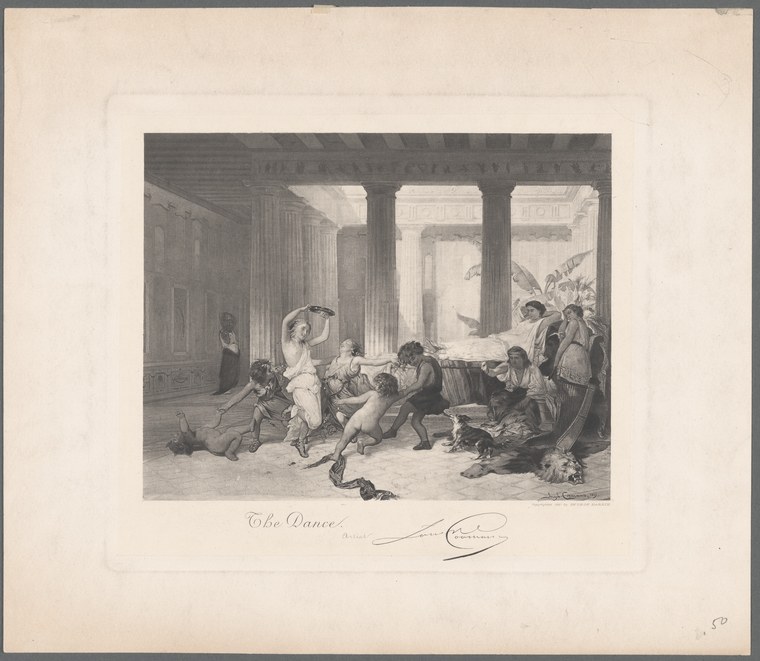
The Dance
Unknown artist
- Medium:
- Source:
- New York Public Library
- Rights:
- Public domain — free to use, share and adapt.
- Recorded as:
- public_domain
This work documents the neoclassical fascination with reconstructing or imagining ancient Greek and Roman festivity as a critique of—or escape from—contemporary formal dance. It shows how the 18th century used classical sources not to prescribe behavior but to celebrate spontaneity and sensuality as virtues of the ancient world.
What you are looking at
A neoclassical interior with Corinthian columns frames an Arcadian dance scene. In the foreground, a group of figures in loose, flowing drapery moves together in a woodland celebration. The figures are arranged informally around the composition's center, with some seated and others in active motion. A satyr or bearded man kneels or crouches in the lower left, while musicians or attendants stand to the right, one holding what appears to be a lyre or stringed instrument. The setting combines architectural grandeur—tall fluted columns and a coffered ceiling—with pastoral elements: a potted plant and landscape visible through the colonnades suggest an idealized outdoor sanctuary. The light is soft and even, typical of neoclassical prints, with careful tonal gradations creating depth. The overall mood is one of leisurely, uninhibited festivity, neither violent nor formally choreographed, but rather a moment of communal pleasure.
The dancing
The bodies are loosely arranged rather than paired or in formal lines. Several figures lean or recline, their weight distributed low. At least one central figure has an arm raised in a celebratory or expressive gesture. The satyr figure in the foreground adopts a crouching pose that suggests spontaneous movement rather than trained technique. No couple is in a closed ballroom hold; instead, the figures seem to move within a loose group, some touching or supporting one another, others independent. The overall posture is relaxed and unstructured, with flowing garments that obscure precise footwork.
The dance depicted
This appears to depict Bacchanalian or Dionysian revelry—a classical mythological scene of celebration rather than a specific named dance form. The satyr, musical instruments, flowing drapery, and informal group movement all point toward ancient theatrical or ceremonial celebration. This is not ballroom, not ballet, not folk dance, but rather the artistic representation of ecstatic or orgiastic festivity as imagined by neoclassical artists. The scene reflects 18th-century fascination with classical antiquity and particularly with the uninhibited pleasures of the ancient world. The dance, if it can be called that, is conceived as natural, spontaneous, and antithetical to the formality of contemporary salon dance.
How it was made
This is an engraving or etching, as evident from the fine parallel lines (hatching and cross-hatching) used to model form and create tonal values, and the precision of the line work. The technique allowed for reproducible prints that could circulate widely among an educated, affluent audience. The formal framing—centered composition, classical proportions, careful perspective—and the refinement of execution suggest this was a high-quality reproductive print, likely after a history painting or a painter's design. The print was designed for collectors and those with leisure to study neoclassical imagery in detail.
About this work
This engraving depicts a neoclassical fantasy of ancient Bacchanalian celebration, combining architectural grandeur with Arcadian informality. The work belongs to the 18th-century cult of antiquity and reflects artists' and patrons' idealized vision of how the ancients danced and reveled. The print circulated among educated elites as both an artwork and a document of aesthetic taste.
In the context of dance imagery, this work represents an important divergence: it celebrates movement that is neither trained nor ballroom, but rather the opposite—natural, ecstatic, and liberated from contemporary social constraint. For historians studying how neoclassical culture represented the body in motion, and how artists positioned ancient dance as a foil to the stiffness of their own era, this image is valuable evidence.
How to look at it
Observe how the artist has suspended the moment just at the height of uninhibited activity, without capturing violent excess or transgression. The bodies are arranged to suggest movement and energy (the raised arm, the forward-leaning figures) while remaining balanced and pictorially stable. Notice how the architectural setting—the columns and the formal interior—frames and contains the wild subject matter, creating a productive tension. The flowing drapery is essential: it allows the bodies to move freely while maintaining the modesty and aesthetic refinement expected of neoclassical art. The artist has chosen the moment of festivity itself, not the prelude or aftermath, inviting the viewer into the celebration.
The period
The late 18th century saw a surge in neoclassical history painting and classical subject matter across Europe, fueled by archaeological discoveries and the aesthetic theories of Johann Winckelmann. Dance in this era was undergoing its own transformation: while the court and salon still prized formal, ornamental dance (minuet, contredanse, gavotte), there was growing Romantic interest in the primitive, the natural, and the ecstatic as alternatives to aristocratic restraint. Classical mythology offered a cultural license to depict movement that was passionate and unregulated. In parallel, choreographers like Jean-Georges Noverre were advocating for 'ballet d'action'—narrative ballet that moved beyond pure ornament toward emotional expression.
This print likely dates to the 1770s–1790s, a period of intense neoclassical artistic production. The subject matter—Bacchanalian revel—was popular in high art partly because it allowed artists to explore the body in a state of pleasure and abandon while sheltering under the authority of classical antiquity. For audiences of the time, such images functioned both as entertainment and as philosophical commentary on human nature and civilization.
Where it lives
The work is held by the New York Public Library and comes from their collection of historical prints. The catalogue record provides minimal attribution or dating; the image itself must serve as the primary evidence of its style, period, and content.
Dance in this work
Questions about this work
Is this depicting a real dance form?
Not a contemporary one. This is a neoclassical fantasy of ancient Bacchanalian celebration—how 18th-century artists imagined the ancients danced and reveled. It is a history painting or classical narrative composition, not a record of ballroom or theatrical dance of the period.
What is the satyr figure doing?
The satyr—the bearded, crouching figure in the lower left—is a stock character of Dionysian mythology, suggesting wilderness, lustfulness, and uninhibited pleasure. His posture suggests he is participating in the revelry, not observing it.
Why is this in a formal interior with columns?
The artist has juxtaposed architecture (order, civilization) with Bacchanalian subject matter (chaos, ecstasy) to create a productive visual and intellectual contrast. It may also reflect the neoclassical fantasy that such celebrations occurred in sacred groves or temples rather than in unrefined wilderness.
How was this print made?
It is an engraving or etching—a printmaking technique that allowed for precise, fine-lined images that could be reproduced and distributed. This made it affordable for wealthy collectors and accessible to a broad educated audience.
More dance artwork