49 works in this view — arrow keys or swipe to move between them.
Dance in Art · 1963
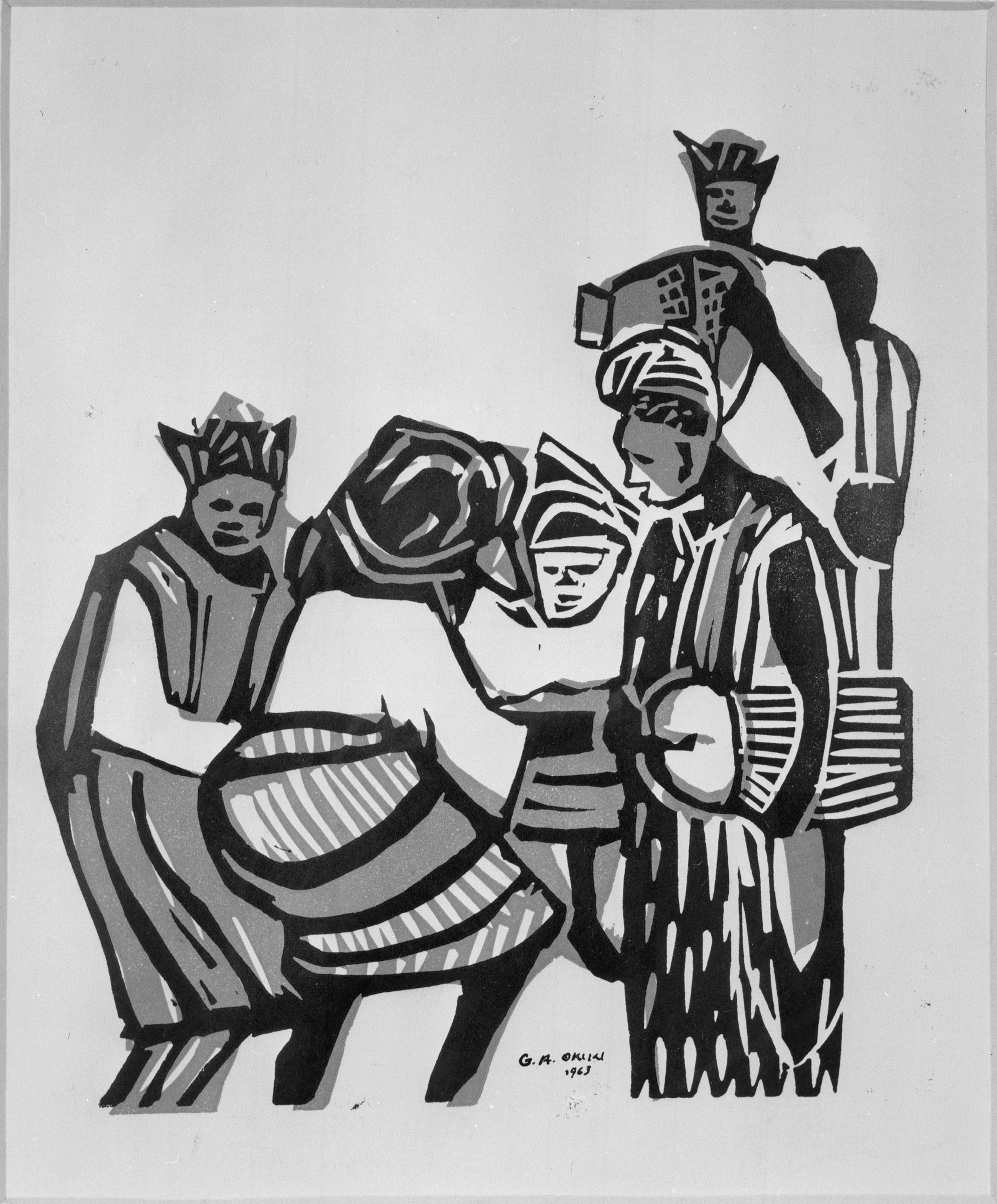
"Dance to the Talking Drum", 1963 - NARA - 558973
Godfrey A. Okiki
- Medium:
- Oil Painting
- Source:
- Wikimedia Commons
- Rights:
- Public domain — free to use, share and adapt.
- Recorded as:
- Public Domain
This work documents a specific African musical and dance tradition—the centrality of the talking drum to community gathering and spiritual practice—at a moment when African artists were asserting their own visual languages and rejecting colonial framings of African culture. Okiki's use of modernist formal vocabulary (geometric abstraction, high contrast, simplified figuration) to represent African dance challenges the false divide between 'traditional' African art and 'modern' artistic innovation, showing these as continuous and inseparable.
What you are looking at
Five figures in striking geometric costumes dominate a composition rendered in bold black-and-white linocut. The figures wear elaborate headdresses with angular, fan-like or crown-like elements, and their bodies are clothed in patterned garments featuring bold stripes, hatching, and geometric panels. The leftmost figure wears a cape-like draped garment; the central figures are dressed in wrapped, sculptural forms with strong contrasts of black and white. All figures are positioned in dynamic relation to one another, leaning and gesturing toward a large drum positioned in the foreground—a substantial, striped cylindrical form that anchors the lower half of the composition. The drum's central placement and prominent scale signal its cultural and ceremonial importance. The figures' body language suggests active engagement with music-making and dance, their gestures reaching toward or around the instrument. The stark, high-contrast printing technique creates visual energy through silhouette and pattern, with no background setting—the figures exist in a void, their attention unified on the drum.
The dancing
The five dancers are arranged in an informal, clustered grouping rather than a formal line or rigid formation. Their bodies lean inward toward the drum with arms raised, extended, or gesturing in varied directions—some reaching forward, others bent or angled. The postures suggest active, rhythmic engagement rather than held positions; the weight appears distributed and mobile. Several figures stand at different heights in the composition, creating a sense of movement and shifting positions. The lack of a closed ballroom hold or symmetrical pairing suggests social or celebratory dancing rather than partner work, with individual bodies responding to the drum's pull.
The dance depicted
The title *Dance to the Talking Drum* and the visual prominence of the drum identify this as depicting African drum-led ceremonial or social dance, most likely from West or Central Africa where talking drums (pressure drums that can be modulated to approximate speech) hold sacred and social significance. The 1963 date and the artist's Nigerian name (Okiki) suggest this represents Yoruba or broader Nigerian dance tradition, where drums are central to ritual, celebration, and community gathering. The figures' varied postures and the absence of prescribed steps indicate participatory social dance rather than a codified theatrical form—the kind of response to drumming that is fundamental to African dance cultures. The talking drum itself is the true protagonist, and the dancers are shown as its respondents.
How it was made
This is a linocut print, not an oil painting as the catalogue record states. The technique is evident from the bold, high-contrast black-and-white forms, the use of negative space, and the characteristic angular cuts that define both outline and interior pattern. Linocut is a relief printing method suited to bold geometric composition and mass production, making this work accessible and repeatable—appropriate for an artist documenting and celebrating African cultural practice in the early 1960s. The technique's directness and graphic power align well with the modernist and Pan-African artistic movements of the period, when linocut and woodcut were favored by artists seeking to combine formal innovation with social and cultural documentation.
About this work
This 1963 linocut by Godfrey A. Okiki captures a moment of dance centered on the talking drum, a West African percussion instrument of ceremonial and social importance. Five figures in geometric, patterned dress lean and gesture toward the drum, their varied postures suggesting spontaneous, communal response to rhythm rather than choreographed movement. The work celebrates African cultural practice through modernist formal means—bold contrasts, geometric patterning, and simplified figuration. Okiki's choice of the linocut medium allowed him to create bold, repeatable imagery that could reach broad audiences while honoring the visual and social power of the subject. The composition centers the drum as the source and focus of the dance, elevating an instrument and a cultural practice often marginalized in Western art historical narratives.
How to look at it
Look first at the drum: Okiki places it at the visual center and largest scale, signaling that this is not a neutral setting but the protagonist of the scene. Then trace how each of the five figures relates to it—their gestures, their angles, the direction of their gaze and reach. Notice that no two figures occupy the same posture or relation to the drum; this suggests dancers responding individually to the same rhythmic source, rather than moving in unison. The geometric patterning of their dress—the stripes, hatching, angular segments—echoes the visual energy of the drum itself, creating formal unity between instrument and body. The linocut's high contrast and bold cutting create a sense of immediacy and vitality; this is not a still moment but a frozen instant in ongoing motion.
The artist
Godfrey A. Okiki (dates unknown) was a Nigerian artist working in the early-to-mid twentieth century. His practice centered on African cultural forms—music, dance, ceremony—rendered through modernist printmaking techniques. The 1963 date places this work in the period following Nigerian independence (1960), when Nigerian artists were actively reclaiming and celebrating indigenous cultural practices as expressions of national identity and artistic sovereignty. Okiki's work belongs to a broader Pan-African artistic movement that used formal modernism as a means to document, celebrate, and elevate African cultural knowledge.
The period
In 1963, the early independence era in Nigeria and across sub-Saharan Africa, there was intense artistic and intellectual energy around cultural reclamation and the assertion of African artistic agency. In the visual arts, African artists were experimenting with modernist techniques—abstraction, expressionism, printmaking—as vehicles for African subjects and aesthetics. In dance, the period saw growing documentation and celebration of African dance forms as worthy of serious artistic attention; however, these forms remained largely marginalized in international art institutions. Okiki's linocut sits at the intersection of these movements: using a medium associated with avant-garde and politically engaged European art to represent an African cultural practice, thereby asserting African modernity and artistic authority.
Where it lives
The work is recorded in the National Archives and Records Administration (NARA) under accession 558973 and appears in Wikimedia Commons. The source and current holding collection are not specified in available metadata.
Dance in this work
Questions about this work
What is a talking drum?
A talking drum is a West African (particularly Yoruba) pressure drum whose pitch can be modulated by hand to approximate the tones of speech, allowing it to 'speak' or convey messages and narratives. It holds ceremonial, social, and communicative significance in many African cultures and is often the centerpiece of gatherings, celebrations, and rituals. The talking drum's cultural importance makes it a natural subject for artists documenting African cultural life.
Why did the artist use linocut for this subject?
Linocut is a bold, graphic medium well-suited to both modernist formal innovation and social documentation. Its high contrast and repeatable nature made it popular among twentieth-century artists seeking to create powerful, accessible imagery. For Okiki in 1963, the medium allowed him to celebrate African cultural practice using a contemporary artistic language, asserting that African subjects and African modernism were inseparable.
Is this a specific dance or a general representation?
The title and visual emphasis on the talking drum suggest this represents the kind of drum-centered, participatory social or ceremonial dancing that is fundamental to many West African cultures. Rather than depicting a specific named dance, it captures the essential relationship between drum and dancer that characterizes African musical cultures more broadly.
What does the geometric patterning represent?
The bold stripes, hatching, and geometric panels in the figures' dress serve both formal and representational purposes. They reflect actual patterning in African textiles and dress, while also creating visual rhythm and energy that mirrors the drum's rhythmic function. The geometric language unifies the composition, making the dancers' bodies and the drum visually continuous.
More dance artwork