49 works in this view — arrow keys or swipe to move between them.
Dance in Art
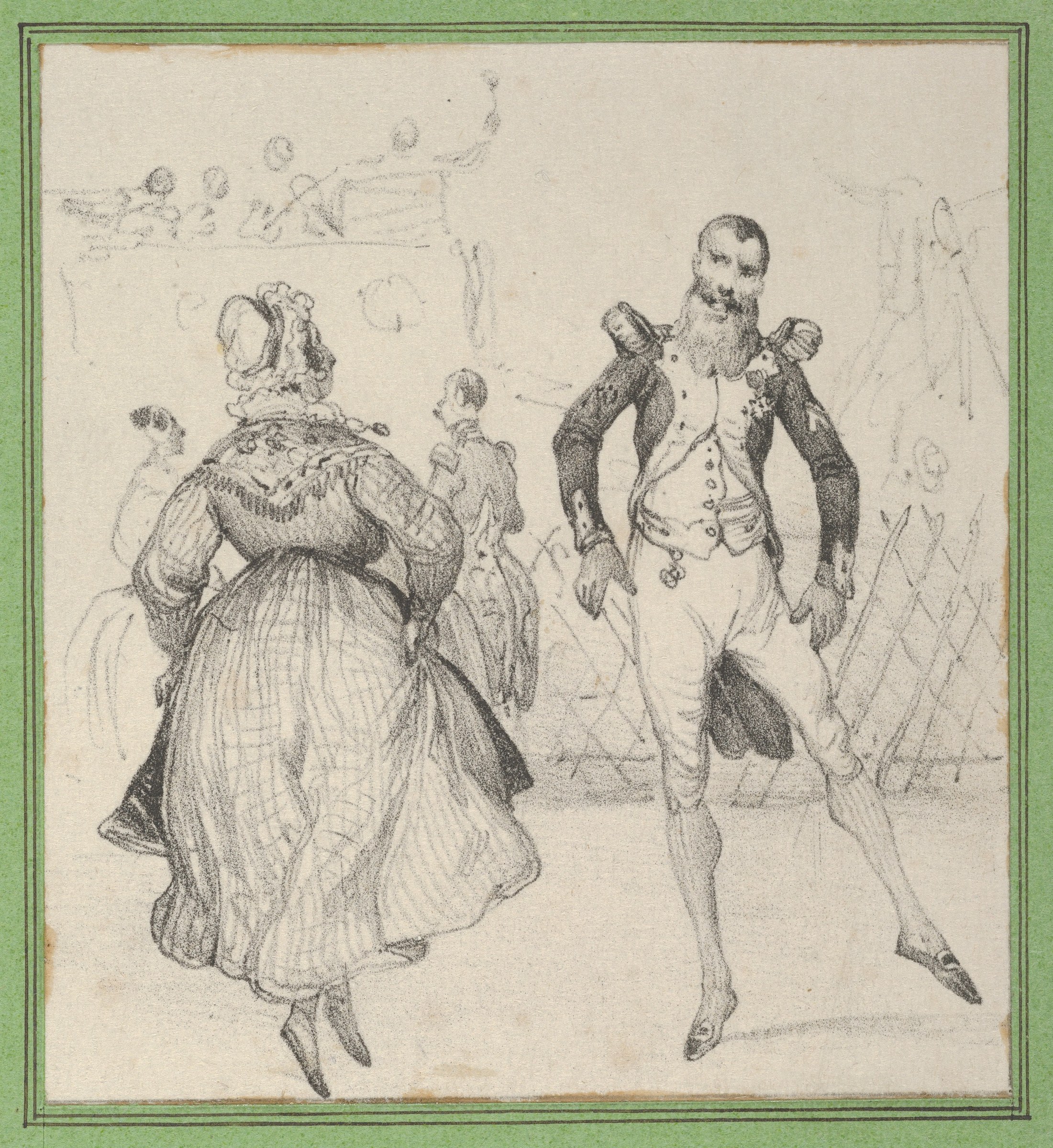
A soldier and a woman dancing MET DP841198
Victor Adam
- Medium:
- Oil Painting
- Source:
- Wikimedia Commons
- Rights:
- Public domain — free to use, share and adapt.
- Recorded as:
- CC0
This image preserves specific visual evidence of waltz technique and ballroom etiquette at the moment when the waltz was transitioning from scandalous innovation to established social norm. For dance historians, it offers precise documentation of hold, posture, and the relationship between partners in early nineteenth-century European ballroom practice.
What you are looking at
A military officer in dress uniform dances with a woman in an elaborate gown in what appears to be a formal salon or ballroom setting. The officer, bearded and wearing a dark coat with ornate buttons and epaulettes, holds the woman's hand and arm in a ballroom position while she turns away from him, her voluminous skirt billowing outward in a bell shape characteristic of 1830s-1850s fashion. Her dress is richly decorated with horizontal pleating and bands of ornamentation; she wears a bonnet or headdress with feathers or plumes. Other figures are visible in the background—additional dancers or attendees—suggesting a formal social gathering. The composition captures a moment of energetic movement, with both figures poised mid-step. The drawing style is fine and detailed, with careful attention to textile patterning, facial features, and the physical relationship between the dancers.
The dancing
The two principal figures are in a closed ballroom hold with the officer's right arm supporting the woman's back and their hands joined at an angle consistent with Regency and early Victorian-era ballroom dance. The woman's weight appears to be shifting or stepping, her body angled away from her partner, her left arm extended gracefully. The officer's posture is upright and formal, with his left leg bent in what may be a step or chassé. The positioning suggests a waltz or similar turning dance popular in mid-nineteenth-century European salons.
The dance depicted
This appears to depict a formal ballroom dance, most likely a waltz or cotillion, danced in a European military or aristocratic context. The woman's elaborate ball gown and the officer's dress uniform place this in the early-to-mid nineteenth century, when such dances were central to courtship rituals and military social life. The energy and positioning are consistent with the waltz, which had only recently become acceptable in polite society by the 1820s-1830s. The presence of other dancers in the background confirms this as a formal ball rather than an improvised or folk dance.
How it was made
This is a finely executed sketch or print, likely an engraving or etching, rendered in graphite or black ink with careful cross-hatching and line work to create texture and shadow. The technique allows precise rendering of costume detail and facial expression while maintaining a clarity suited to reproduction and wide circulation. The fine lines and careful modeling suggest this was either a finished work intended for publication or a preparatory study for a larger composition. Such prints were common as illustrations for literature, social commentary, or costume studies in nineteenth-century Europe.
About this work
This work documents a moment of formal ballroom dancing in the early Victorian era, capturing both the physical grace of the dance and the elaborate social rituals it embodied. The pairing of a military officer with a fashionable woman suggests themes of courtship, social status, and national or regimental identity. As a detailed study of period costume and ballroom posture, it serves as both an artistic record and a historical document of how educated Europeans danced and dressed in the 1830s-1840s.
How to look at it
Note the precise moment the artist chose: the woman mid-turn, her skirt caught in a spiral of motion, suggesting the continuous rotating action of the waltz. Observe the formal clarity of the hold and the physical distance maintained even in close connection—this was how respectable couples danced at the time. The careful rendering of the woman's face in profile and the officer's direct gaze suggests an interest in capturing psychological as well as physical grace. The fine cross-hatching conveys both the texture of fabrics and the sense of ballroom lighting.
The artist
Victor Adam (1801–1866) was a prolific French artist, lithographer, and illustrator specializing in social and satirical subjects. He was known for his detailed costume studies, military scenes, and satirical prints of Parisian social life. His work often documented contemporary fashion, manners, and social types with wit and precision, making him a valuable source for understanding nineteenth-century visual culture.
The period
This work dates to the era when the waltz was revolutionizing European ballroom culture. Introduced from German-speaking regions in the 1810s, the waltz's close hold and rapid turning initially provoked moral anxiety in conservative circles, but by the 1830s it had become standard in aristocratic and military balls. This period also saw the codification of ballroom etiquette and the emergence of the polka and other popular dances. Visually, the 1830s-1840s were marked by the Romantic era's idealization of emotion and movement, alongside precise documentary interest in contemporary dress and social ritual.
Where it lives
This work is held in the collection of the Metropolitan Museum of Art (accession DP841198) and appears to have been digitized and made available through Wikimedia Commons. The catalogue record identifies it as a print, though the exact printing technique is not specified in the available metadata.
Dance in this work
Questions about this work
What dance is this?
This most likely depicts a waltz, the defining dance of the early nineteenth-century European ballroom. The hold, the woman's spiraling motion, and the formal setting are all consistent with waltz practice of the 1830s-1840s. It could also be a cotillion or quadrille variant, but the two-figure focus and turning motion strongly suggest the waltz.
Why is the man in military dress?
The officer's uniform indicates this is a military ball or a formal social gathering where military officers were prominent. Military balls were major social events in nineteenth-century Europe, and officers were expected to be skilled dancers. The uniform also signaled status and provided visual drama and prestige.
What does her dress tell us?
The woman's gown with its bell-shaped skirt, horizontal pleating, and ornate bonnet is characteristic of 1830s-1840s high fashion. Such dresses were designed to show off the wearer's wealth and taste and to display movement when dancing. The voluminous skirt was essential to the visual effect of the waltz's twirling motion.
Who was Victor Adam?
Victor Adam was a French artist and lithographer (1801–1866) celebrated for his detailed social and satirical prints. He specialized in costume studies and scenes of contemporary Parisian life, making him an important visual documenter of nineteenth-century fashion and manners.
More dance artwork