49 works in this view — arrow keys or swipe to move between them.
Dance in Art · 2013
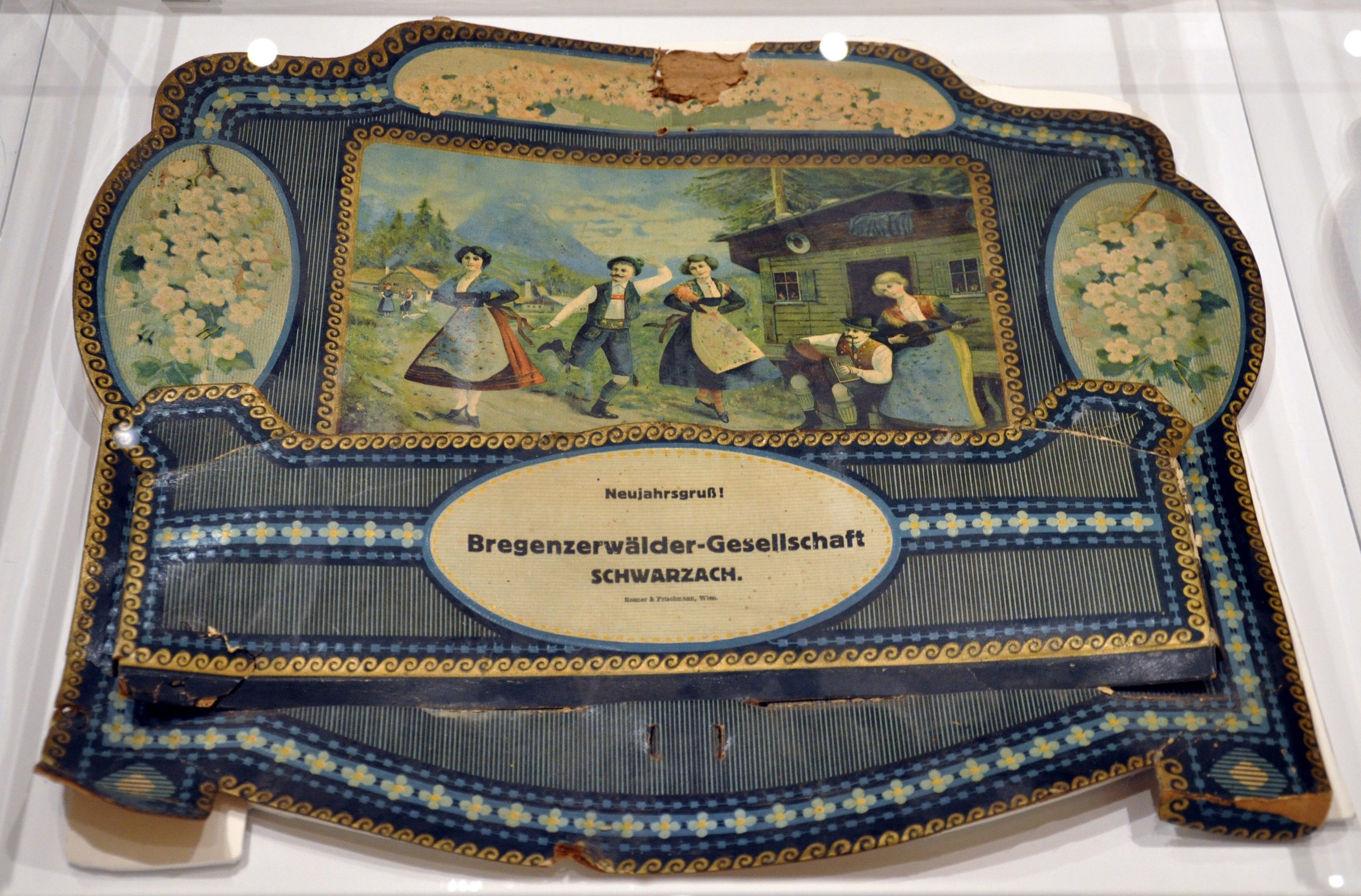
Bregenzerwäldergesellschaft Neujahrsgruss VLM
Photo: Andreas Praefcke
- Medium:
- Ink
- Source:
- Wikimedia Commons
- Rights:
- Public domain — free to use, share and adapt.
- Recorded as:
- Public Domain
This image provides documentary evidence of how a regional Alpine folk dance was performed and valued in its community of origin at a specific historical moment. It shows that folk dance was not museum practice but living social practice, worthy of commemoration on a holiday gift item. The work records the costumes, body positions, group structure, and celebratory context of a dance that had no written notation and might otherwise be lost to visual history.
What you are looking at
This is a decorated cardboard or wooden box lid, likely from around 1900, with a New Year's greeting from the Bregenzerwälder Gesellschaft (Bregenzerwald Society) of Schwarzach, Austria. The centrepiece is a domestic interior scene showing five figures in traditional Alpine costume engaged in a lively group dance or celebration. The setting is a rustic wooden cottage with small windows and a sloped roof visible through the open doorway at right. Three women in long, full skirts with patterned aprons and dark bodices stand with arms raised and extended, their bodies angled in dynamic poses; a man in dark breeches, waistcoat and hat faces them with one arm gesturing; a fifth figure, an older woman or man, sits or reclines at the right edge near the cottage door, watching the action. The palette is warm—ochre, cream, soft greens and blues—with decorative golden scrollwork framing the scene. The composition is energetic and informal, capturing a moment of festive social gathering rather than a formal, choreographed dance.
The dancing
The three standing women are the focal point, each with raised arms and bent or extended legs suggesting active movement—jumps, springs, or rapid turning steps. Their weight appears to shift dynamically from foot to foot. The man's posture is open and welcoming, one arm extended toward the women in invitation or encouragement. The seated figure at right observes passively, grounding the scene and suggesting this is a communal celebration watched as well as participated in. The bodies are upright and energetic rather than balletic; the movement is social and participatory, not trained.
The dance depicted
This depicts Ländler or an Alpine folk dance of the Bregenzerwald region (a mountainous area of Vorarlberg in Austria). Ländler is a turning, stamping couples' dance with roots in the 18th-century laendler tradition, performed at village celebrations and social gatherings. The raised arms, turning postures, and informal group setting are consistent with regional Austrian folk dance, where men and women danced together in a celebratory, often improvisatory manner. The image records not choreographed ballet or formal ballroom dance but the vernacular social dance of a specific Alpine community, likely performed at New Year festivities.
How it was made
This is a lithographed or chromolithographed box lid, a commercial printed object. The technique allowed bright, naturalistic colour and fine detail across a large surface, and the decorative border in gold and blue suggests a premium product—likely a confectionery or gift box intended for holiday distribution. The New Year's greeting and the name of the sponsoring society indicate this was a keepsake or promotional item with sentimental value, circulating within or beyond the Schwarzach community to advertise regional tradition and identity.
About this work
This is a chromolithographed greeting box lid, circa 1900, documenting a moment of Alpine folk dance celebration in rural Austria. It records the social dance culture of the Bregenzerwald region through the lens of a commercial holiday keepsake. The work sits at the intersection of vernacular documentation and commercial design: a printed object that preserves and promotes the regional identity of a specific community while serving as a gift or commodity. For dance historians, it offers rare visual evidence of how Ländler and Alpine folk dances were actually performed and socially embedded in the early 20th century.
How to look at it
Notice the raised arms and the varied, unsymmetrical postures of the three dancing women—they are not moving in unison or in a choreographed formation, but responding to the music and to one another's energy. The man's open posture and gesture suggest he is about to join or is encouraging the dance. Look at the cottage setting and the seated observer: this is not a theatre or concert hall, but a domestic, communal space where social dance belongs to everyday life. The artist chose to freeze a moment of momentum and participation, not a formal beginning or ending.
The artist
The catalogue record credits a photographer (Andreas Praefcke) for the digital image. The original lithograph is likely the work of a commercial printer or lithographic workshop, probably based in Vienna or another Austrian city, but no artist signature or attribution is recorded. The decorative border and lettering style suggest professional commercial design, not folk or amateur production.
The period
In the late 19th and early 20th centuries, Alpine folk dance and costume became symbols of regional and national identity across the German-speaking world, especially in Austria and Bavaria. Regional societies (Gesellschaften) were founded to preserve and promote local traditions. At the same time, chromolithography and colour printing made it economically feasible to reproduce images of folk life on commercial goods, turning regional culture into a commodity and a gift. This box sits at the intersection of romantic nationalism, commercial popular culture, and the documentation of disappearing or threatened rural traditions.
Where it lives
The catalogue record identifies this as held by the Vorarlberg Museum (Vorarlberg Museum, Bregenz), and the inscription on the box confirms it is a New Year's greeting (Neujahrsgruß) from the Bregenzerwälder Gesellschaft of Schwarzach. It is a printed ephemeral object—a holiday gift box—not a fine art print, and was likely produced in multiple copies for distribution.
Dance in this work
Questions about this work
What region is the Bregenzerwald and why does this dance matter there?
The Bregenzerwald is a mountainous region in Vorarlberg, Austria, famous for its distinctive folk costume and dance traditions. The Ländler and related couple dances were central to village social life and identity. By 1900, regional societies were working to document and preserve these traditions as symbols of local culture amid modernization and emigration.
Is this a painting or a print?
This is a chromolithographed or colour lithographed box lid, a commercial printed object. Lithography allowed the bright, naturalistic colour and fine detail you see here, and made it affordable to produce multiple copies. It is not an original artwork but a mass-produced keepsake.
Can you tell what kind of music they danced to?
The image alone does not show instruments or notation. However, the Ländler was typically danced to the music of a local trio or band (violin, accordion, and bass or clarinet). The turning, stamping character of the bodies and the couple-dance structure suggest the quick, regular rhythms typical of Austrian folk dance music.
Why is someone sitting down while others dance?
In communal folk dance, not everyone dances at once; musicians, elderly people, and those resting between dances typically sat and watched. The seated figure may be an elder enjoying the celebration, or someone waiting for their turn to dance. This reflects the participatory, inclusive nature of social dance in rural communities.
More dance artwork