49 works in this view — arrow keys or swipe to move between them.
Dance in Art
Bürkner Tanzliedchen
Unknown artist
- Medium:
- Oil Painting
- Source:
- Wikimedia Commons
- Rights:
- Public domain — free to use, share and adapt.
- Recorded as:
- Public Domain
The work documents the cultural context of dance in the early 19th century, when 'accomplishments' in music, singing, and verse were essential to feminine education and social standing. It provides evidence that dance knowledge and participation were framed as moral and social education for young women rather than as physical training or entertainment. The image shows the domestic and familial setting in which dance culture was transmitted.
What you are looking at
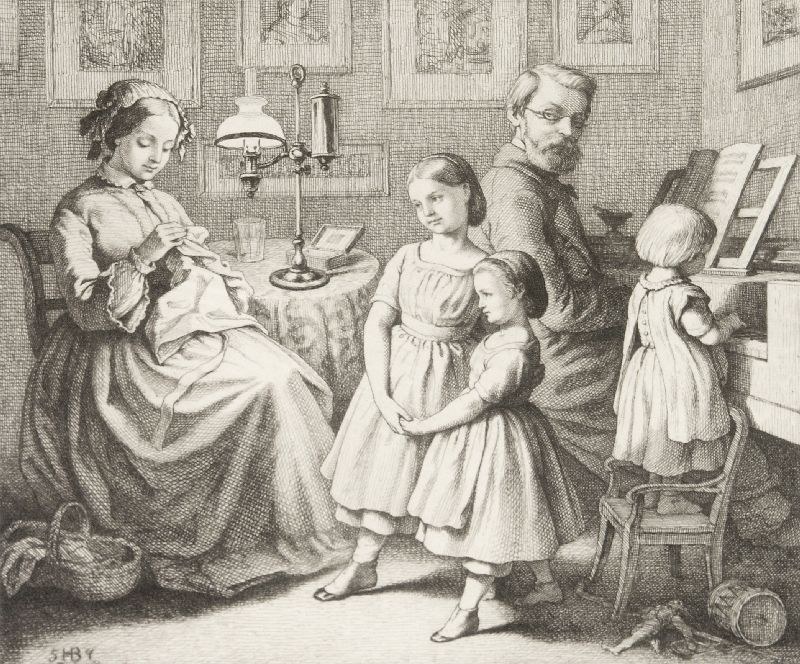
This is an engraved domestic interior, likely from the late 18th or early 19th century, showing a woman seated at left with needlework in her lap, attended by a bearded man (presumably her husband or tutor) who stands at right holding what appears to be a scroll or document. Three young girls occupy the center and foreground: two stand close together in the middle distance, while a third stands at the far right looking toward the seated woman. The setting is a well-appointed room with framed pictures on the walls, a desk or table with an oil lamp, books on shelves, and what appears to be a spinning wheel or similar domestic implement at the left. The floor is checkered in perspective. The figures wear the high-waisted, simple-draped clothing typical of Regency-era domestic dress. The composition emphasizes instruction and moral education within the family circle rather than formal dance instruction or performance.
The dancing
The standing girls show minimal purposeful movement; their postures are static and observational rather than athletic or performative. Their arms hang naturally or rest at their sides. The girl on the right turns her head toward the seated woman in a gesture of attention or deference. The woman at left sits upright in a chair, her posture formal and still. There is no evidence of closed holds, extended frames, or the stretched verticality associated with trained dance. The spatial relationships suggest a teaching or supervision moment rather than coordinated movement.
The dance depicted
This work does not clearly depict dance instruction or performance. The title 'Tanzliedchen' (small dance song) suggests the connection may be to the singing or musical recitation of dance songs or poetry rather than to the physical execution of dance steps. The scene appears to be a moral or domestic education tableau: the girls may be being read to, instructed in needlework or manners, or listening to recitation. If dance-related at all, it documents the cultural context in which young women learned through music and verse rather than choreographed movement. The image shows courtship, education, and family life rather than a dance lesson or social dance event.
How it was made
This is a finely detailed engraving, likely produced using burin and possibly etching techniques. The minute cross-hatching and parallel lines create tone and texture across the figures' clothing, the floor, and walls, characteristic of intaglio printmaking. The precision of line work suggests a professional reproductive engraving, possibly after a drawn or painted original. The technique allowed wide circulation as a print and suggests the work was intended for a middle-class audience interested in domestic moral imagery. The formal, restrained handling is typical of Regency-era educational and domestic prints.
About this work
This is a domestic moral-instruction scene rendered as an engraving, titled with reference to a dance song or musical form, but not depicting dance training or performance in any recognisable sense. The image shows three young girls in the care of an older woman and man, in a well-furnished interior, positioned in attitudes of attention and obedience. The work belongs to the Regency-era tradition of domestic instruction prints that depicted the education of young women in accomplishments, manners, and virtue. Its place in a dance art gallery depends entirely on whether 'Tanzliedchen' indicates that the girls are being taught to sing dance songs, recite verse, or participate in some form of rhythmic or musical performance—a reading not immediately evident from the visual content alone.
How to look at it
Attend to the hierarchy of figures and the direction of gaze: all three girls look toward or away from the viewer, their attention directed to the adults or inward. The seated woman's upright, composed posture establishes the standard of deportment the girls are presumed to be learning. The man's scroll or document and the books and lamp visible in the room emphasize instruction and literacy. The checkered floor and formal composition create a sense of order and propriety. This is not a moment of movement but of stillness, attention, and the transmission of knowledge.
The artist
The catalogue record provides no artist attribution. The style and technique are consistent with German or Central European reproductive engraving of the early 19th century. The signature or monogram visible in the lower left ('HBY' or similar) may identify the engraver, but without access to the original record this cannot be confirmed. The work's refinement and publication quality suggest it was produced by a professional workshop rather than an amateur.
The period
In the Regency and early 19th century, dance and dance-related accomplishments (singing, musical recitation, verse) were central to the education and social display of young middle- and upper-class women. Dance itself was increasingly professionalised and codified in this period, yet in the home and family context it remained intertwined with music, poetry, and moral instruction. Prints like this one documented the ideal of the educated, cultured family and the proper transmission of feminine accomplishments across generations. The emphasis on the supervising adults and the receptive postures of the girls reflects the period's view of female education as a matter of careful guidance and moral formation.
Where it lives
The work is sourced from Wikimedia Commons. The catalogue record provides no holding institution, accession number, or date. The printing technique, style, and subject matter place it in the early 19th-century tradition of German or Central European domestic instruction prints, but without further documentation its specific provenance and current location remain unknown.
Questions about this work
Is this actually a picture of dancing?
Not visibly. The figures are static and posed in an interior domestic setting. The title 'Tanzliedchen' (dance song or small dance song) suggests the image may document the singing or recitation of dance-related verse or music as part of young women's education, but the engraving itself shows instruction and attention rather than movement or choreography.
Who are these people?
The print does not identify the figures. They appear to be an idealized middle-class family: an older woman (possibly a mother or governess), a bearded man (possibly a father, tutor, or teacher), and three young girls. The scene depicts a moral or cultural education session rather than portraying specific historical individuals.
What is the woman with the needlework doing?
She is seated in a chair, engaged in needlework or embroidery—a core accomplishment for young women in this period. The younger girls gather around or near her in postures of observation and learning, suggesting they are acquiring the skill through supervised practice and example.
More dance artwork