49 works in this view — arrow keys or swipe to move between them.
Dance in Art
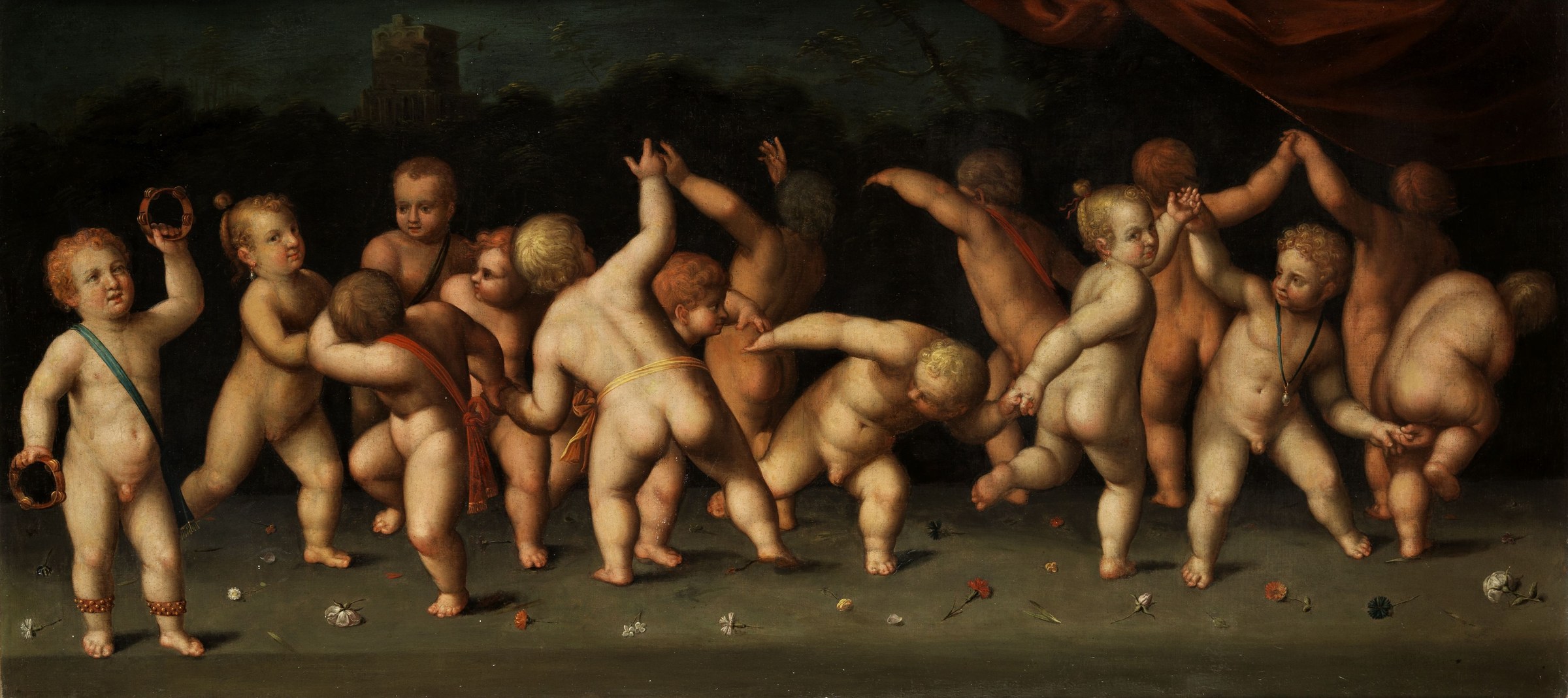
Denys Calvaert (attrib.) - Dansende en balgende kinderen
Denys Calvaert
- Medium:
- Oil Painting
- Source:
- Wikimedia Commons
- Rights:
- Public domain — free to use, share and adapt.
- Recorded as:
- Public Domain
This painting is one of the few early modern artworks that takes childhood movement and joy as its sole subject, rendering it with the same formal care and observational precision lavished on courtly or mythological dances. It challenges the assumption that all dance imagery in early modern art depicts formal choreography, showing instead how artists documented and valued the free, exuberant physicality of children at play.
What you are looking at
A group of approximately fifteen nude or lightly draped putti (cherubs) cavort across a dark, stage-like ground against a shadowy architectural backdrop. The children occupy the full width of the composition in a shallow, frieze-like arrangement. Some stand upright, others bend, leap, or reach overhead with arms extended in exuberant poses. A few wear delicate attributes—ribbons, collars, or chains—and scattered flowers and objects lie on the ground among them. The lighting is warm and golden, picking out the pale flesh of the figures against the murky background. The children seem to be in a state of joyful, unstructured play rather than formal choreography, though several grouped pairs suggest momentary connection or interaction.
The dancing
The figures display the characteristic proportions of putti—rounded bodies, smooth limbs, small feet. Their postures are highly varied and naturalistic: some dancers rise on tiptoe with arms reaching upward, others bend forward at the waist, and several tilt or stretch diagonally across the frame. There is no unified formation or hold; instead, each figure seems absorbed in independent play, jumping, stretching, or turning. The artist has observed and rendered genuine childhood movement—the ease, asymmetry, and spontaneity of uninhibited bodies.
The dance depicted
This does not depict a recognisable dance form but rather a scene of playful movement and celebration. The composition belongs to a tradition of paintings of putto festivals and celebrations that draws on both Christian iconography (putti as celestial attendants) and classical revels. The figures embody not formal dance but the freedom and joy of unselfconscious play—what might be called a *festive celebration* rather than choreographed performance. The emphasis is on movement as expression of exuberance rather than technique or style.
How it was made
Oil on canvas, as recorded. The dark, thinly glazed background and warm, selective illumination of the flesh are characteristic of Northern European painting in the sixteenth and early seventeenth centuries. The technique allows for naturalistic rendering of varied poses and delicate modulation of light across small bodies. The work would have circulated among wealthy patrons as a cabinet picture—a smaller, precious object for private devotion or display rather than a public altarpiece.
About this work
This is a celebration of childhood movement and play, rendered with remarkable observational detail. The painting captures not a formal dance but the spontaneous, joyful physicality of children at celebration—leaping, reaching, turning, clustering, and separating in the freedom of the moment. Such scenes of putto revels were popular in Northern European courts and collections of the sixteenth and seventeenth centuries, where they served as emblems of divine joy, fertility, and the innocence of childhood.
The work belongs to a rich tradition of Renaissance and early modern imagery in which putti embody celebration itself. Unlike courtly or folk dances depicted in the art of the period, this scene documents movement that is playful, unselfconscious, and uninstructed—the genuine physicality of children rather than the formal codes of adult performance.
How to look at it
Attend to the variety of poses and the artist's care in differentiating each child's movement: some reach upward in full extension, others bend or crouch, still others turn or lean. Notice how the poses seem to capture children in the middle of action—mid-leap, mid-reach, mid-turn—rather than in repose. The scattered flowers and objects on the ground suggest a moment of carnival or festival. The warm light and dark background create a stage-like intimacy, focusing the viewer's attention entirely on the children's animated bodies.
The artist
Denys Calvaert (c. 1540–1619) was a Flemish painter who trained in Antwerp and spent much of his career in Bologna, where he became a significant figure in late sixteenth-century Italian painting and headed an important workshop. He was known for religious works, mythologies, and allegories often populated by putti, which became a signature element of his practice. His paintings were collected by wealthy patrons across Northern Europe and Italy.
The period
In the sixteenth and early seventeenth centuries, celebrations of childhood and the figure of the putto underwent significant transformation. While putti had appeared in Christian and classical art for centuries, the late Renaissance and early Baroque periods saw an intensified interest in depicting them as agents of divine joy, fertility, and cosmic celebration. Court culture of the period also placed renewed emphasis on childhood as a distinct stage of life, and on the beauty and innocence of children. Simultaneously, the growth of private collecting and the cabinet picture created demand for intimate, jewel-like works on religious or allegorical themes that could hang in domestic spaces.
Where it lives
Source: Wikimedia Commons. The record does not identify a holding collection. Attribution to Denys Calvaert is noted as tentative ('attrib.').
Questions about this work
Is this a dance?
Not in the formal sense. The children are playing and celebrating rather than performing a choreographed dance. However, all movement captured in art is worth studying as a record of how bodies moved, and childhood play is as much a form of movement expression as any formal dance. This painting is valuable precisely because it documents joyful, uninstructed physicality.
Who are these figures?
They are putti—cherubs or cupids—traditional figures in Christian and classical art. In paintings like this one, they often represent divine attendants, agents of love and fertility, or embodiments of joy and celebration. Their nudity and childlike forms mark them as otherworldly rather than human children.
What is the artist depicting—a real celebration or an imagined one?
Both. While the gathering is allegorical and the figures are heavenly attendants, the individual poses and movements appear carefully observed from life. The artist likely sketched children at play and then transposed those naturalistic observations onto mythological figures, giving divine celebration the credibility of lived, embodied movement.
Why would a painter spend such care on childhood movement?
In Renaissance and Baroque aesthetics, childhood movement and the beauty of children's bodies were serious subjects worthy of the same artistic attention as mythological or courtly scenes. Putti in celebration also represented theological ideals—joy, innocence, divine abundance—making paintings of them both devotional and luxurious collector's items.
More dance artwork