49 works in this view — arrow keys or swipe to move between them.
Dance in Art
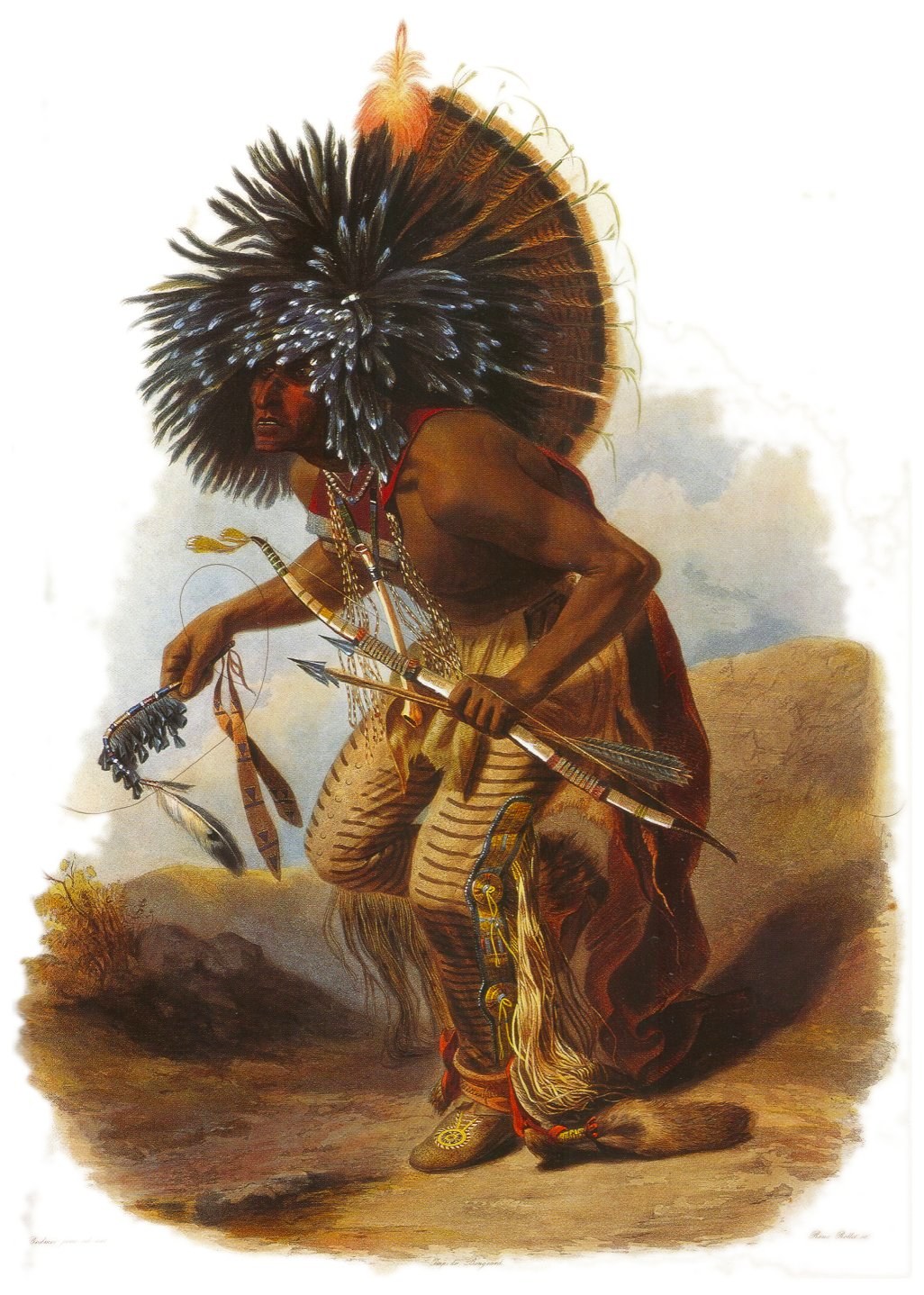
Moennitarri warrior in the costume of the dog danse 2
Unknown artist
- Medium:
- Oil Painting
- Source:
- Wikimedia Commons
- Rights:
- Public domain — free to use, share and adapt.
- Recorded as:
- Public Domain
This work documents a specific indigenous dance tradition and the regalia associated with it at a historical moment when many such practices were being suppressed or lost. For dancers and historians, it offers concrete visual evidence of Plains Indian ceremonial costume, bearing, and the material markers of status and society membership that cannot be inferred from written description alone. It also exemplifies how dance history is preserved unevenly: Western theatrical dance is recorded through notation and photography, while indigenous ceremonies are often known only through portraits, ethnographic notes, and the memories of communities themselves.
What you are looking at
A Moennitarri (Hidatsa) warrior stands in three-quarter pose against a hazy, indistinct landscape rendered in warm ochre and grey tones. The figure wears hide leggings decorated with geometric patterns in black and yellow, a red cloth or blanket across one shoulder, and multiple strands of beaded necklaces. The defining feature is an enormous headdress of black eagle feathers fanned vertically, with a single orange-red feather at the apex and what appears to be a carved wooden or bone ornament protruding from the top. In his left hand he holds a bow with arrows; in his right, what appears to be a small rattle or ceremonial object with feathered attachments. His posture is upright and dignified, with weight balanced, one leg slightly forward. The figure's gaze is directed upward and to the side, suggesting a ceremonial or spiritual focus rather than engagement with a partner or audience. The composition emphasizes verticality—the headdress towers above, anchoring the figure to a timeless moment rather than a narrative sequence.
The dancing
A single standing figure, not in motion with a partner. The body is stationary and frontal, with symmetrical weight distribution suggesting a pose or stance rather than active dancing. Both arms are engaged: one holds weapons (bow and arrows), the other a rattle or ceremonial object. The upper body is bare except for ornaments, allowing clear sight of the torso's alignment and posture. The legs are planted firmly; there is no visible indication of steps, hops, spins, or weight shifts. This is a portrait-stance within a dance context rather than a captured moment of kinetic activity.
The dance depicted
This image documents the Dog Dance (or Dog Band dance) of the Hidatsa, a warrior society dance and ceremony. The identity as a Dog Band member is confirmed by the catalogue record's reference to 'Pehriska-Ruhpa of the Dog Band.' The monumental headdress is the visual marker of rank and society membership, and the pose reflects the ceremonial stillness and spiritual focus that characterized many Plains Indian warrior society dances, which combined martial display, ritual regalia, and spiritual invocation rather than continuous rhythmic movement in the European ballroom sense. The upward gaze and the static, dignified bearing suggest the meditative or trance-like aspects of such ceremonies. Without moving documentation, the actual footwork and group choreography remain unknowable from this image alone.
How it was made
This is a hand-colored watercolor or gouache work, most likely from the early 19th century based on style and technique. The medium allows for the careful rendering of fine detail—the individual feathers of the headdress, the beadwork patterns, the textures of hide and cloth—while the translucent wash creates soft atmospheric depth in the background. The hand-coloring process, applied over what may have been an initial ink or pencil drawing, was typical of documentary ethnographic portraiture. Such works were often produced in series and circulated as scientific or artistic records of Native American peoples, typically reaching educated collectors, museums, and government offices rather than the general public.
About this work
This is a portrait of a Hidatsa Dog Band warrior in full ceremonial regalia for the Dog Dance. It records not a moment of active dancing but a formal display of the costume, insignia, and bearing associated with one of the Plains' most prestigious warrior societies. The work functions as both art and ethnographic documentation, capturing the material culture and spiritual authority signaled through dress and posture. The Dog Dance was a ceremonial and social dance integral to Hidatsa culture, performed during gatherings and at moments of collective spiritual or military significance. This image preserves visual evidence of that tradition at a moment when such ceremonies were under increasing pressure from colonization and forced cultural change.
How to look at it
Attend to the headdress first: its size and construction signal rank and achievement within the warrior society, and the labor required to assemble such regalia. Notice the posture—the slight upward gaze and open chest reflect the spiritual and ceremonial nature of the moment, not the exertion of dancing in a kinetic sense. Observe the beadwork, feather patterns, and hide decoration: these are not generic 'Native American' elements but specific to Hidatsa material culture and the protocols of the Dog Band. The artist's choice to present the figure in formal stance rather than mid-movement suggests that the significance of the Dog Dance lay as much in costume, status display, and spiritual focus as in steps or rhythmic movement.
The period
This work likely dates to the early 19th century, a period of intense ethnographic documentation of Plains Indian peoples, often associated with artists and naturalists traveling with fur trade expeditions or military surveys. The Dog Dance and other warrior society ceremonies were central to Hidatsa social and spiritual life before the smallpox epidemic of 1837 and subsequent forced removals dramatically disrupted these traditions. The creation of such portraits coincided with a period of rapid change: the Hidatsa were being pressured onto reservations, their ceremonies were being discouraged or banned by Indian agents, and their warriors' roles were being displaced by colonial administration. Such documentary works, while preserving visual record, were also products of the colonial encounter and often reflected the perspectives of outside observers rather than the communities themselves.
Where it lives
The source is Wikimedia Commons. The work appears to be from a 19th-century ethnographic series, likely associated with fur trade or military documentation, though the artist, original date, collection, and current holding institution are not recorded.
Dance in this work
Questions about this work
What is the Dog Dance?
The Dog Dance was a ceremony and warrior society dance of the Hidatsa and other Plains tribes. It was performed by members of the Dog Band, an elite warrior society, and involved ceremonial regalia, spiritual invocation, and collective ritual rather than theatrical performance. The dance was central to Hidatsa social hierarchy and military culture.
What is that headdress?
The monumental feathered headdress is a war bonnet or society regalia specific to the Dog Band. It signals rank, achievement in warfare, and membership in the society. The individual feathers are eagle feathers, each traditionally earned through deeds or gifted by the community. Such headdresses took years to assemble and represented significant spiritual and material investment.
Why is he not dancing?
This is a portrait documenting the costume and regalia of the Dog Dance, not a moment captured mid-performance. The formal stance reflects both the ceremonial nature of the dance—which combined stillness, spiritual focus, and symbolic display—and the conventions of ethnographic portraiture, which aimed to document indigenous peoples' material culture and social roles.
Who was Pehriska-Ruhpa?
Pehriska-Ruhpa was a Hidatsa Dog Band warrior. His name and image appear in 19th-century ethnographic records, likely from interactions with fur traders or military explorers. Beyond the association with the Dog Band and this portrait, little detailed biographical information is widely recorded in accessible sources.
More dance artwork