49 works in this view — arrow keys or swipe to move between them.
Dance in Art
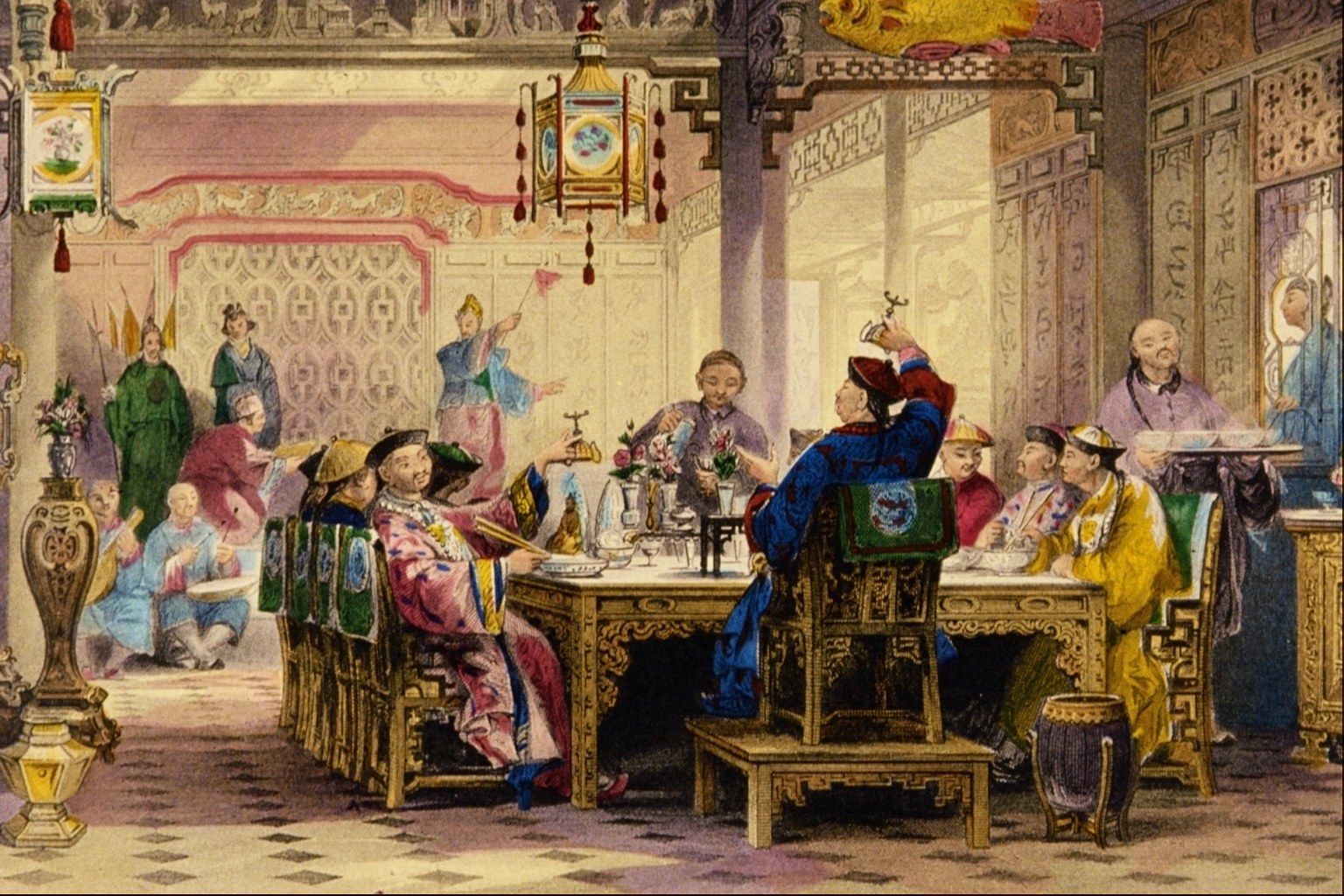
Dinner Party at a Mandarin's House - Thomas Allom
Thomas Allom
- Medium:
- Oil Painting
- Source:
- Wikimedia Commons
- Rights:
- Public domain — free to use, share and adapt.
- Recorded as:
- Public Domain
This work exemplifies how 19th-century European artists visualized non-Western social worlds for home audiences, and offers visual evidence of Chinese domestic dress, interior decoration, and social ritual. For dance historians, it serves as a comparative document: while no dance is staged, the naturalistic gestures and spatial choreography of social interaction reveal cultural differences in how bodies moved and organized themselves in formal settings.
What you are looking at
A formal dinner party in a wealthy Chinese household, rendered in the chinoiserie style popular in 18th-century European art. The scene unfolds across a richly decorated interior with pale yellow walls, ornamental friezes, and hanging lanterns. A large table dominates the center, where numerous figures in elaborate silk robes—some in brilliant blues, reds, and yellows—are seated and attended by servants. The composition is densely populated: some guests recline in conversation, while others stand in animated discussion or gesture expressively. To the left, figures in formal green and crimson court dress observe from the background. The spatial recession suggests depth through the careful placement of figures at varying distances, and throughout the scene, decorative Asian ceramics, vessels, and architectural details emphasize the exotic wealth of the setting. The warm palette and careful attention to textile pattern and ornament suggest the hand-colored print or watercolor technique characteristic of Allom's work.
The dancing
Most figures are seated or standing in conversation rather than in coordinated dance formation. Those standing display animated arm gestures—one central figure raises a hand expressively, others gesture in dialogue. The postures are social and convivial rather than balletic: relaxed, varied, naturalistic. No dancers are in closed or partner holds; this is a social gathering captured mid-conversation rather than a choreographed dance moment. The figures' placement and overlap create a sense of spontaneous, overlapping social interaction.
The dance depicted
No organized dance is depicted. This is a genre scene of leisure and dining in a Chinese mandarin's house, rendered for a European audience curious about exotic customs. While some gestural animation and social movement animate the scene, no dance form—whether historic-baroque, contemporary, or any style in the taxonomy—is evident. The work documents social life and etiquette rather than dance performance.
How it was made
The record identifies this as an oil painting, though the clarity of detail, the bright hand-applied color, and the compositional style suggest it may be a hand-colored engraving or aquatint, techniques Allom frequently employed for his chinoiserie subjects. The meticulous decoration of the interior, the even lighting, and the legibility of small details throughout the crowded scene are characteristic of print media rather than oil paint. The technique—whether print or painting—allowed for mass circulation of images of Chinese domestic life among European collectors.
About this work
This is a genre scene of Chinese domestic leisure in the style of 18th-century European chinoiserie, depicting the interior of a wealthy household during a formal meal. Thomas Allom was a British artist and illustrator who specialized in detailed, colorful representations of Chinese life, customs, and architecture for a European market fascinated by the exotic East. The work belongs in the Gallery of Dance in Art not because dance occurs, but as a counterexample: a richly detailed social scene that documents gesture, posture, and bodily comportment in a non-Western context, and invites comparison with contemporary European paintings of social gathering and etiquette.
How to look at it
Attend to the gestures and postures throughout the crowd: the raised hands, the leaning figures, the varied stances. These convey social animation and dialogue without forming any coordinated dance pattern. Notice how Allom distributes figures across the depth of the interior, creating a sense of overlapping social space. The contrast between the formal architectural setting and the animated, varied postures of the guests suggests a moment of relaxed sociability rather than ceremonial or choreographed movement. The ornamental detail of the room—the wall patterns, hanging vessels, decorative scheme—was as much the subject of the work as the human figures.
The artist
Thomas Allom (1804–1872) was a British painter, printmaker, and illustrator celebrated for his detailed chinoiserie scenes. He spent time in China and Japan and published extensively illustrated accounts of his travels, producing hand-colored engravings and watercolors that satisfied Victorian appetite for images of Asian life and architecture. His works were widely reproduced and distributed, making him one of the primary visual sources through which 19th-century Europeans understood Chinese domestic culture.
The period
This work dates to the height of the European chinoiserie tradition, when wealthy households collected images of Chinese interiors, customs, and exotica. In the 1830s–1860s, when Allom was most active, such images served both aesthetic and anthropological functions: they decorated walls and books while also claiming to document 'authentic' non-Western life. Simultaneously, European ballroom and theatrical dance was formalizing into the Romantic and classical ballet traditions; this painting sits outside that world entirely, offering a contemporary glimpse of leisure in a society with entirely different movement vocabularies and social rituals.
Where it lives
The work is catalogued as an oil painting held in an unrecorded collection and sourced from Wikimedia Commons. The lack of accession information and the uncertain provenance suggest this may be a reproduction or study rather than a unique work in a major collection.
Questions about this work
Is this a real scene or did Allom invent it?
Allom based his chinoiserie works on firsthand observation during travels in Asia, but he composed and stylized them for European taste. The architectural details and decorative elements are observed, while the scene itself is an artistic arrangement designed to convey wealth, exotic custom, and social refinement to a Western audience.
Why is this in a dance gallery if no one is dancing?
The work documents bodily movement, gesture, and spatial organization in a social setting—core concerns of dance research. It provides evidence of how bodies moved and held themselves in 19th-century Chinese formal life, and invites comparison with European dance and social etiquette of the same period.
What can we learn about Chinese culture from this image?
With caution: the work is mediated through European artistic convention and was designed for European sale. However, the clothing, interior decoration, table arrangement, and gestural conventions do reflect observed elements of Chinese domestic life. It should be read alongside Chinese sources and used as evidence of how Allom understood and chose to represent that life.
More dance artwork