49 works in this view — arrow keys or swipe to move between them.
Dance in Art
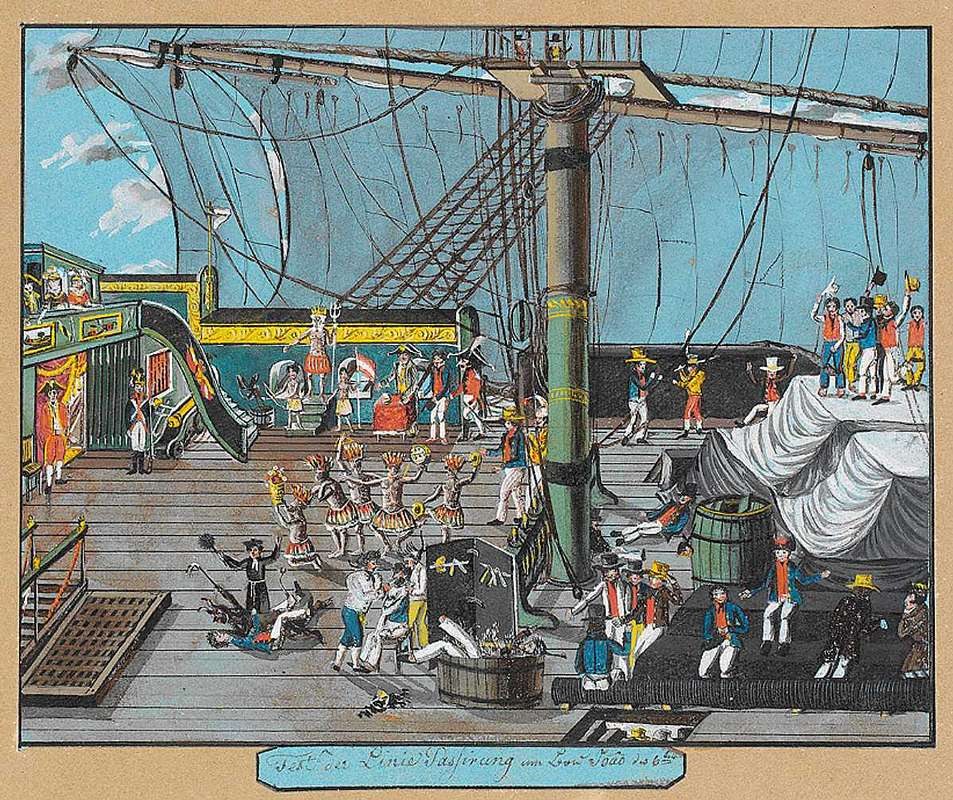
Franz Josef Frühbeck Equator Ioâo
Franz Josef Frühbeck
- Medium:
- Oil Painting
- Source:
- Wikimedia Commons
- Rights:
- Public domain — free to use, share and adapt.
- Recorded as:
- Public Domain
The image is historically significant as a detailed visual record of shipboard life and ceremony in the early modern or 18th-century merchant or naval world, showing how music and gathering functioned in a maritime context. For dancers and historians, it illustrates the social contexts in which music and movement occurred outside the formal theater or ballroom, and the kinds of public ritual that involved assembled bodies and musical accompaniment.
What you are looking at
A crowded harbor or ship's deck scene rendered in hand-colored engraving, showing two distinct zones of activity separated by a central mast. On the left, a covered or canopied area hosts what appears to be an indoor entertainment space with musicians and spectators in rich dress—reds, golds, and dark fabrics—suggesting a formal or commercial venue. The right side of the deck is open to daylight and shows figures in lighter clothing, many standing or processing in groups across the planked floor. The rigging and sails overhead are rendered in fine parallel lines; the sky is clear blue. The whole composition is busy and precisely detailed, with figures small enough to require close study but numerous enough to convey a scene of significant social gathering or public spectacle aboard a substantial vessel.
The dancing
The figures are upright and mostly stationary or moving in processional manner rather than in closed partnered holds. Many stand in clusters or loose groups; some appear to gesture or converse. The dress—period coats, breeches, hats, and skirts—and the formal postures suggest spectators and participants of some ceremony or display rather than social dancers in motion. No figures are captured mid-leap, in turnout, or in the characteristic frames of ballroom or theatrical dance. The composition emphasizes gathering and viewing over executed movement.
The dance depicted
The image most likely depicts a social gathering or ceremonial event aboard a ship, possibly a merchant vessel or pleasure yacht, rather than a formal dance performance. The title reference to 'Equator' and 'João' (a Portuguese name) suggests a nautical context, possibly a celebration or initiation ceremony such as those historically enacted when ships crossed the equator. While music-makers are visible and groups are assembled, the pictorial evidence for recognisable dance steps, partnering conventions, or choreography is minimal. This appears to be a document of a social occasion with musical accompaniment rather than a depiction of dance as a formal practice.
How it was made
This is a hand-colored engraving, identifiable from the fine parallel hatching used to model form and depth, the precision of the line work, and the careful application of watercolor or gouache over the printed base. The technique allowed for wide circulation—engravings were reproducible and relatively affordable—and suggests this scene was of sufficient public interest to warrant publication and collection. The careful architectural detail of the ship and the numerous figures indicate this was a commissioned or documentary work, possibly recording a specific historical event.
About this work
This is a hand-colored engraving of a nautical gathering, likely from the 18th century, showing a crowded deck scene with musicians, spectators, and assembled figures in what appears to be a formal or ceremonial occasion. The title suggests an equator-crossing celebration, a common ritual aboard ships of the period. While the scene includes music-makers and assembly, it documents a social occasion rather than a choreographed dance practice, making it valuable as a record of shipboard culture, costume, and social ritual rather than as evidence of dance technique or style.
How to look at it
Attend first to the architectural clarity of the ship itself—the engraver has rendered the rigging and structure with precision, establishing the scale and function of the vessel. Then scan the two social zones: the sheltered entertainment space on the left and the open deck on the right. The eye is drawn to the density of figures and the variety of dress and posture, which conveys the sense of occasion without requiring knowledge of specific dance forms. Notice how the engraver uses light (the clear sky, the contrast between covered and open areas) to organize the scene spatially and to suggest the time of day and season of the voyage.
The artist
Franz Josef Frühbeck is not well documented in standard references. The signature or attribution visible in this work suggests he was an engraver active in German-speaking territories, likely in the 18th century. The precision and documentary character of the work indicate professional training and commission-based practice, but further details of his biography or other works are not established here.
The period
The engraving technique and the style of ship construction and dress suggest a date in the 18th century or possibly the early 19th. This was the era of expanding European maritime commerce and exploration, when equator-crossing ceremonies were well-established ritual events. Shipboard entertainments and the integration of music with social ritual were common features of long voyages. Engravings documenting such events served as curiosities and records for the European reading public interested in exotic or novel social practices.
Where it lives
The work is held in Wikimedia Commons, a digital repository of public-domain cultural material. The bare title in the source suggests it is catalogued primarily by subject and artist name, with minimal documentation of its original publication context or current physical holding.
Questions about this work
What is an equator-crossing ceremony?
An equator-crossing ceremony was a festive ritual enacted when a ship crossed the equator for the first time, involving initiation rites, music, costumes, and celebrations for crew members who had not previously crossed. These ceremonies were documented in engravings and journals and served as both entertainment and a mark of transition in the voyage. They often involved theatrical or musical elements, making them of interest to artists and writers of the period.
Is this a dance scene?
The image shows a social gathering with musical accompaniment aboard a ship, but it is not primarily a depiction of formalized dance with recognizable steps or choreography. It is better understood as a record of a shipboard ceremony or celebration in which music, gathering, and social ritual played central roles.
What can we learn about 18th-century shipboard life from this image?
The engraving shows the scale and structure of merchant or naval vessels, the dress and social hierarchies of shipboard society, the presence of musicians and entertainment, and the ways in which formal or ritual occasions were organized and witnessed on deck. It suggests that music and assembly were integral to shipboard culture and to the marking of significant moments in long voyages.
More dance artwork