49 works in this view — arrow keys or swipe to move between them.
Dance in Art · 2016
Halina Chrostowska, W świetlicy, 1954r
ZPAP Warszawa
- Medium:
- Oil Painting
- Source:
- Wikimedia Commons
- Rights:
- Public domain — free to use, share and adapt.
- Recorded as:
- Public Domain
The work records an important moment in mid-twentieth-century Polish cultural history: the persistence of folk dance traditions in collective farm communities despite political pressure to modernize and conform to state-sanctioned culture. For dance historians, it offers visual evidence of how folk movement traditions were maintained and celebrated in ordinary social spaces. The artist's attention to the body in motion—the weight, the raised arm, the crowd's response—demonstrates that serious artistic attention was given to dance as a subject worthy of formal study and commemoration.
What you are looking at
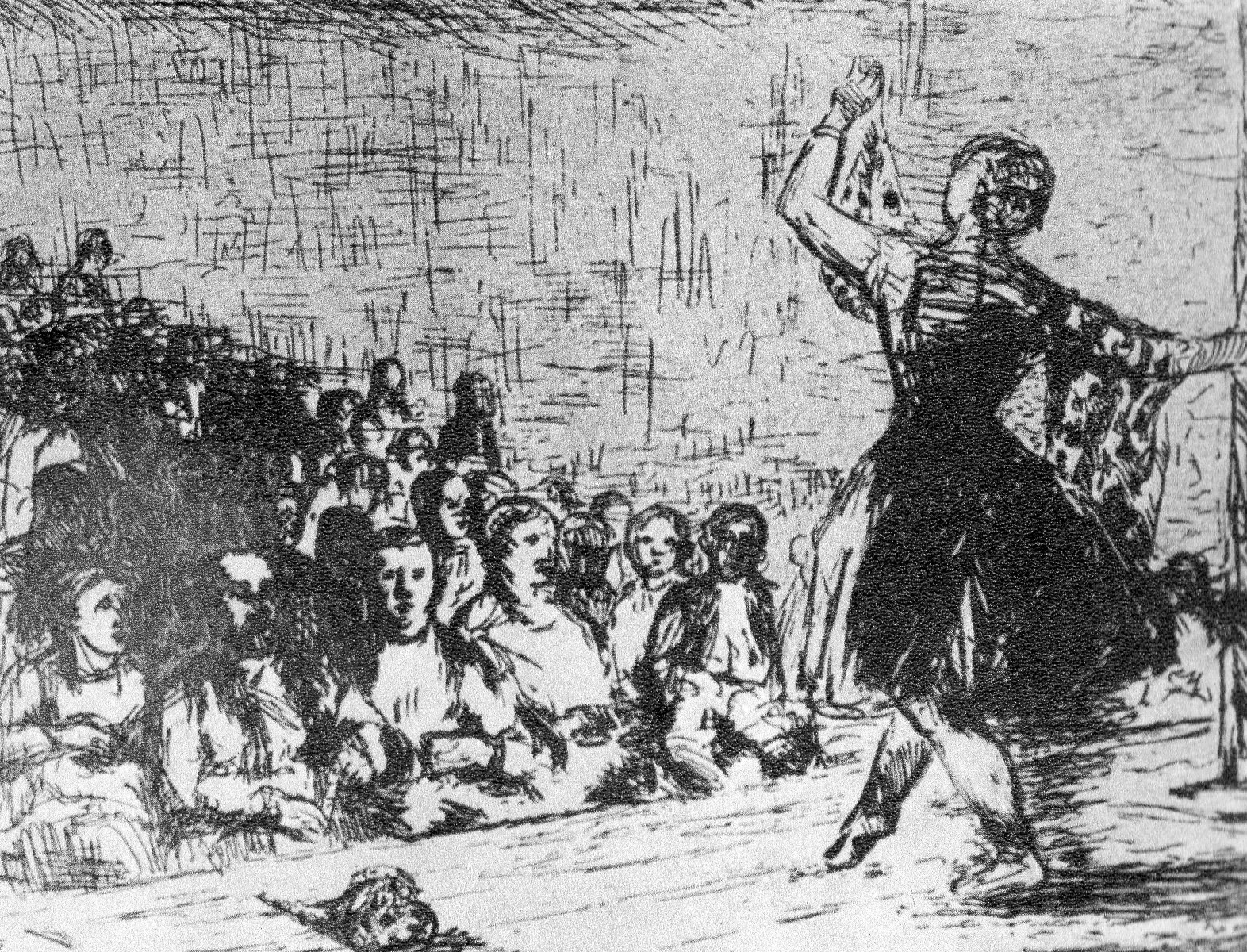
A densely composed scene rendered in ink or etching shows a community gathering indoors, possibly a cultural or social event. In the foreground, a woman in a light dress stands at center-right with one arm raised expressively, her body in clear motion. She is surrounded by a crowd of onlookers seated and standing, their faces turned toward her with evident engagement. The setting appears modest—perhaps a community center or village hall suggested by the simple interior—with cross-hatched walls creating shadow and depth. The artist has used varied line weights to suggest both the solidity of the crowd and the animation of the central figure, whose raised arm and torso convey an active, perhaps celebratory or performative moment. The composition pulls the viewer's eye through the crowd toward the dancing figure, making her the undeniable focal point of the scene.
The dancing
The central female figure is captured mid-movement with her left arm raised to approximately shoulder height or above, her body turned slightly away from the viewer, suggesting rotation or pivoting in her dance. Her posture suggests an upright carriage with weight likely distributed across both feet rather than a static pose. The surrounding crowd is rendered in various states of attention—some seated in profile, others standing at the edges, their bodies leaning or tilted toward the action. The artist has clearly understood choreographic movement, capturing the moment of dynamic extension rather than a static position. No visible ballroom hold is present; this appears to be a solo performer or a movement within a social or folk dance context.
The dance depicted
This scene most likely depicts folk or regional social dance rather than theatrical ballet or ballroom forms. The modest interior setting, the casual clothing, and the centrality of a single performer before a community crowd are consistent with documented Polish folk traditions or village social dancing from the mid-twentieth century. The raised-arm gesture and rotational movement align with Central or Eastern European folk dance conventions. The title references a community center (świetlica), and the cycle designation 'P.G.R.' suggests this may be part of a series documenting social scenes from collective farms (Państwowe Gospodarstwo Rolne), which were common in postwar Poland. The image captures what appears to be an authentic moment of cultural expression rather than a staged theatrical performance.
How it was made
This is a black-and-white print, likely an etching or engraving based on the controlled line work, cross-hatching for tone, and the precision of the composition. The technique allows for sharp detail in the figures' faces and expressions while maintaining atmospheric depth through variations in line density. The artist has used the medium's constraints skillfully, building form and shadow entirely through mark-making rather than tone. This printing technique suggests a work intended for circulation beyond a single canvas—reproduced in books, journals, or exhibitions—making it a democratic form reaching working-class or peasant audiences. The record lists this as an oil painting, but the visual evidence of the print medium contradicts that description.
About this work
This work documents a moment of folk celebration or social dance, likely from postwar Poland, showing a woman dancing in a community gathering while onlookers engage with the performance. The composition—dense with figures yet focused on a single active body—captures the role of dance in village social life and collective experience. By depicting dance not as a theatrical spectacle but as a participatory community event, the work affirms the cultural continuity and resilience of folk traditions. This sits at the intersection of social realism (a dominant mode in Polish art of the 1950s) and ethnographic documentation, using the specificity of a particular gesture and setting to speak to broader questions of cultural identity and community.
How to look at it
Observe first the contrast between the static crowd and the animated central figure—how the artist uses the density and stillness of the onlookers to throw the dancer's movement into relief. Notice the raised arm and the angle of the torso, which convey energy and rotation rather than a held pose. The cross-hatched background and the treatment of light and shadow create an interior space that feels intimate despite the crowd. Look closely at the faces in the crowd to see how the artist has differentiated individual attention and engagement—the work is as much about witnessing and community response as it is about the dance itself.
The artist
ZPAP Warszawa refers to the Związek Polskich Artystów Plastyków (Association of Polish Visual Artists) based in Warsaw. This attribution suggests the work was produced within an organized artistic collective rather than by an individual artist, or was catalogued under the organization's records. The ZPAP was active in documenting and promoting socially engaged art during the postwar period, including prints and works that celebrated workers' and peasants' cultural life. The collective or organizational context reflects the cultural politics of 1950s Poland, where visual artists often worked within state-supported or artist-collective frameworks.
The period
In postwar Poland of the 1950s, social realism and documentary art were dominant modes, encouraged by the state and embraced by many artists as a way to record the lives and cultures of ordinary people. The collective farm (P.G.R.) was a central institution of postwar agricultural policy, and cultural documentation of peasant and worker communities—including their dances and celebrations—became a subject of artistic interest. This period saw a tension between modernization and cultural preservation, and visual artists often recorded folk traditions as they perceived them to be under threat or transformation. Dance appeared frequently in Polish art of this era as a marker of cultural identity, collective joy, and social continuity.
Where it lives
The work is recorded as held by Wikimedia Commons, sourced as a publicly available image. It is part of a documented series or cycle titled 'P.G.R.' from 1954, suggesting it may have been published or exhibited as part of a larger project documenting collective farm life in postwar Poland. The organization responsible is listed as ZPAP Warszawa.
Dance in this work
Questions about this work
Is this definitely a Polish folk dance?
The title, the setting (świetlica = community center), the cycle reference to P.G.R. (collective farms), and the stylistic context all strongly suggest a Polish or Central European folk dance tradition documented from life or memory. The raised-arm gesture and rotational movement are consistent with regional European folk conventions. However, the exact specific dance form cannot be determined from the image alone without additional historical documentation.
Why does the record say 'oil painting' when this looks like a print?
This discrepancy is noted in the record flags. Based on the technical evidence—controlled line work, cross-hatching, the absence of oil paint texture, and the overall aesthetic—this is almost certainly a print (etching or engraving) rather than an oil painting. Catalogue records from the 1950s or later may have been inaccurate or may have conflated the original artwork with later reproductions.
What is a P.G.R. and why does it matter?
P.G.R. stands for Państwowe Gospodarstwo Rolne (State Agricultural Farm), the collective farm system established in postwar Poland. The reference to this cycle suggests the work was part of a systematic documentation of collective farm life and culture. This context is important because it places the dance within a specific historical and political moment—the artist was recording folk culture at a moment when traditional village life was being reorganized under state control.
Is the dancer alone or is she part of a larger group dance?
From the composition, she appears to be the focal point and likely the primary performer at this moment, though she may be part of a group activity. The crowd's attention is concentrated on her, and her isolated position suggests she is performing for or leading the group. Whether this is a solo turn within a communal dance or a single-performer event cannot be determined from the image alone.
More dance artwork