49 works in this view — arrow keys or swipe to move between them.
Dance in Art
Hey.diddle.diddle
Unknown artist
- Medium:
- Oil Painting
- Source:
- Wikimedia Commons
- Rights:
- Public domain — free to use, share and adapt.
- Recorded as:
- Public Domain
Illustrators of nursery rhymes made choices about how to depict movement and gesture that shaped how millions of children first encountered the idea of bodies in motion. This image shows both the artist's interpretation of exuberant, anarchic movement and the conventions of late-19th-century children's book illustration. It documents the cultural space where dance, narrative, and visual imagination overlap.
What you are looking at
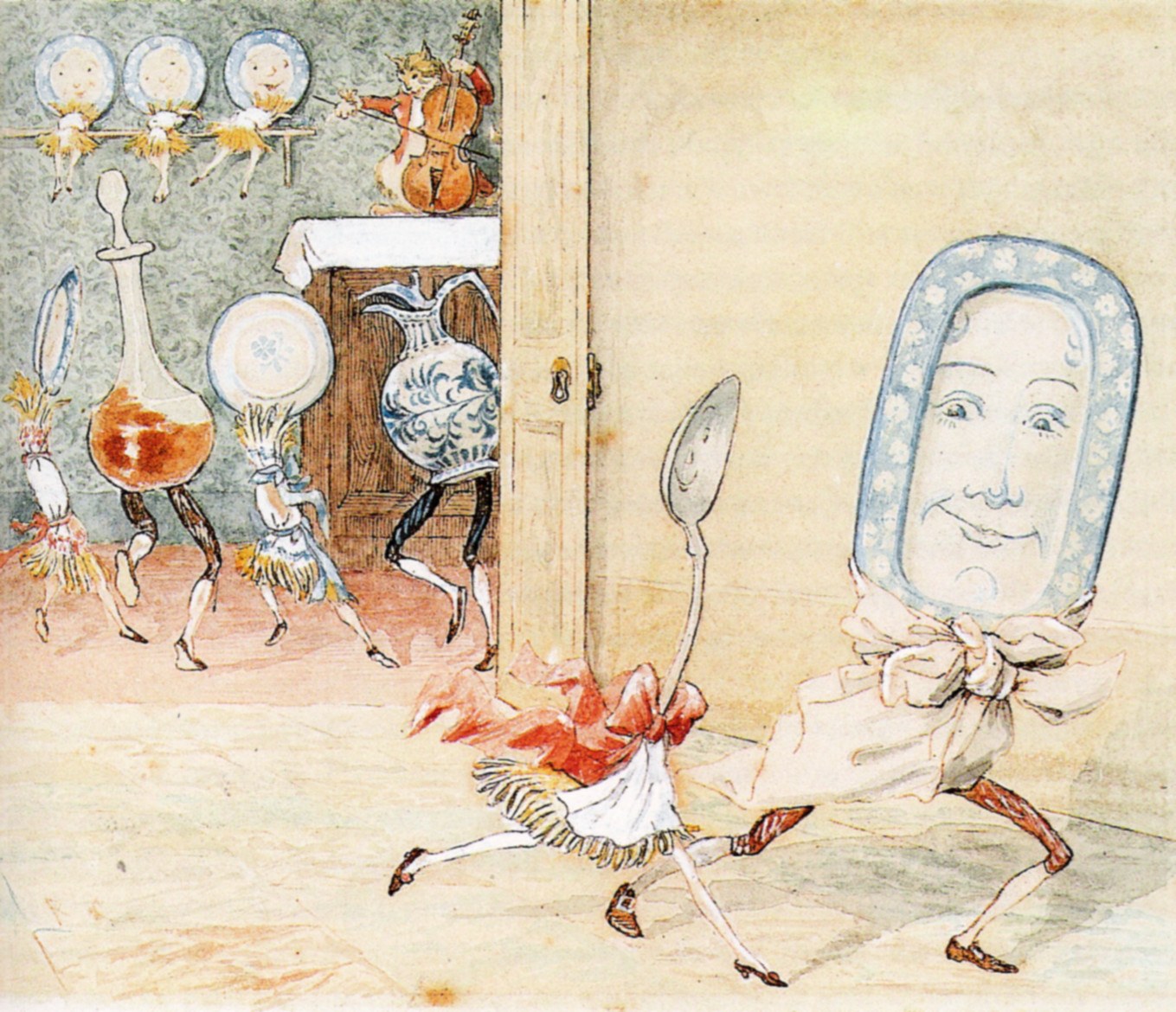
A whimsical illustration in watercolor and ink depicts a nursery-rhyme scene split into two spaces. On the left, inside a modest domestic interior with a wooden door and shelf holding ceramic vessels and a violin, three small winged figures with round heads sit perched on a tall candlestick, while below them a fourth figure dances with exuberant energy—legs splayed, body arched backward, holding what appears to be a large fork. The figure wears patterned clothing in red and white. On the right side of the door, a large woman's head in profile, wearing a blue bonnet and smiling, occupies most of the frame; below it a small red animal (a cow or calf) leaps in the opposite direction, completing the narrative of the nursery rhyme.
The dancing
The main dancer (bottom left) exhibits an energetic, almost acrobatic posture with an extreme backward arch and splayed legs suggesting dynamic, uncontrolled movement rather than trained technique. The figure grips a large fork or paddle, which extends the line of the arm and emphasizes the exuberant gesture. The three seated figures above are static, facing forward. The leaping animal on the right shows a stretched, airborne silhouette with legs extended. The proportions and stylization are deliberately cartoonish and illustrative rather than anatomically precise.
The dance depicted
This is an illustration of the English nursery rhyme 'Hey Diddle Diddle' ('Hey, diddle, diddle, / The cat and the fiddle, / The cow jumped over the moon...'). The dance depicted is not a trained or codified dance form but rather the spontaneous, joyful movement of the rhyme's narrative. The fork-wielding figure appears to represent the cat or one of the rhyme's characters in a state of gleeful abandon. The style suggests this is domestic, playful movement—dance as interpreted through children's literature rather than choreographic practice.
How it was made
The work is executed in watercolor and ink with pen line work. The artist has used transparent washes for color (blues, oranges, rust tones) layered over delicate line drawing, a technique that allows both the spontaneous expressiveness of gesture and the clarity of illustrative detail. The aging of the paper (visible foxing and discoloration) and the source from Wikimedia Commons suggest this is a reproduction of a period illustration, likely from the 19th or early 20th century. The technique is characteristic of children's book illustration of that era.
About this work
This is a watercolor illustration of the nursery rhyme 'Hey Diddle Diddle,' showing the moment of the cow's impossible leap and the cat's delighted response. It belongs in a dance gallery not because it documents a recognizable dance form, but because it captures how movement, narrative, and play intersect in popular culture and childhood—the spontaneous, rule-free physicality that precedes or exists outside formal dance. The image is a record of how a specific story about impossible motion was visualized and circulated through illustrated children's literature.
How to look at it
Notice the extreme backward arch of the main figure's body—this is the moment of maximum exuberance and loss of control, not a posed or balanced position. The artist has frozen the dance at a peak of energy rather than a moment of repose. Observe how the figures are scaled: the woman's head is enormous, the dancer small and frantic, the animals leaping. This distortion serves the narrative and emotional logic of the rhyme rather than realistic proportion, signaling that this is imaginative, not documentary, representation.
The artist
The artist is not recorded in the catalogue. The style and medium are consistent with late Victorian or Edwardian children's book illustration, possibly British. The careful composition, decorative patterning, and expressive line suggest a professional illustrator working in the tradition of Walter Crane or Kate Greenaway, though attribution would require further research.
The period
This appears to be from the era when children's literature became a significant genre and illustrated nursery rhymes were widely produced and circulated (roughly 1870s–1920s). During this period, childhood was increasingly idealized and commercialized, and illustrated rhymes became both pedagogical tools and collectible objects. Simultaneously, modernist dance was beginning to break free from ballet's constraints; this illustration's celebration of uninhibited, joyful movement aligns with period anxieties and celebrations about expressiveness in movement.
Where it lives
The work is sourced from Wikimedia Commons, indicating it is in some form of public digital collection, though the original holding institution and accession details are not recorded. It appears to be a period illustration, likely from a published children's book or anthology of nursery rhymes.
Questions about this work
Is this really a dance illustration if it shows the nursery rhyme, not actual choreography?
Yes. Dance appears wherever human bodies are depicted in motion, whether the movement is formal, trained, or improvised. Nursery rhyme illustrations document how societies visualize and teach movement to children. This image shows what the artist understood 'joyful leaping and dancing' to mean in visual terms—the grammar of uninhibited physicality.
Who illustrated this?
The artist is not recorded in the catalogue. The style is consistent with late Victorian or Edwardian children's book illustration, possibly British, but without further documentation or a visible signature, attribution cannot be confirmed. If you recognize this image or the source, please contact the gallery.
When was this made?
The catalogue record gives no date. Based on the medium, style, and printing conventions, the work appears to date from the late 19th or early 20th century, but this is an estimate from visual evidence alone. Further research into publication history would be needed for certainty.
More dance artwork