49 works in this view — arrow keys or swipe to move between them.
Dance in Art
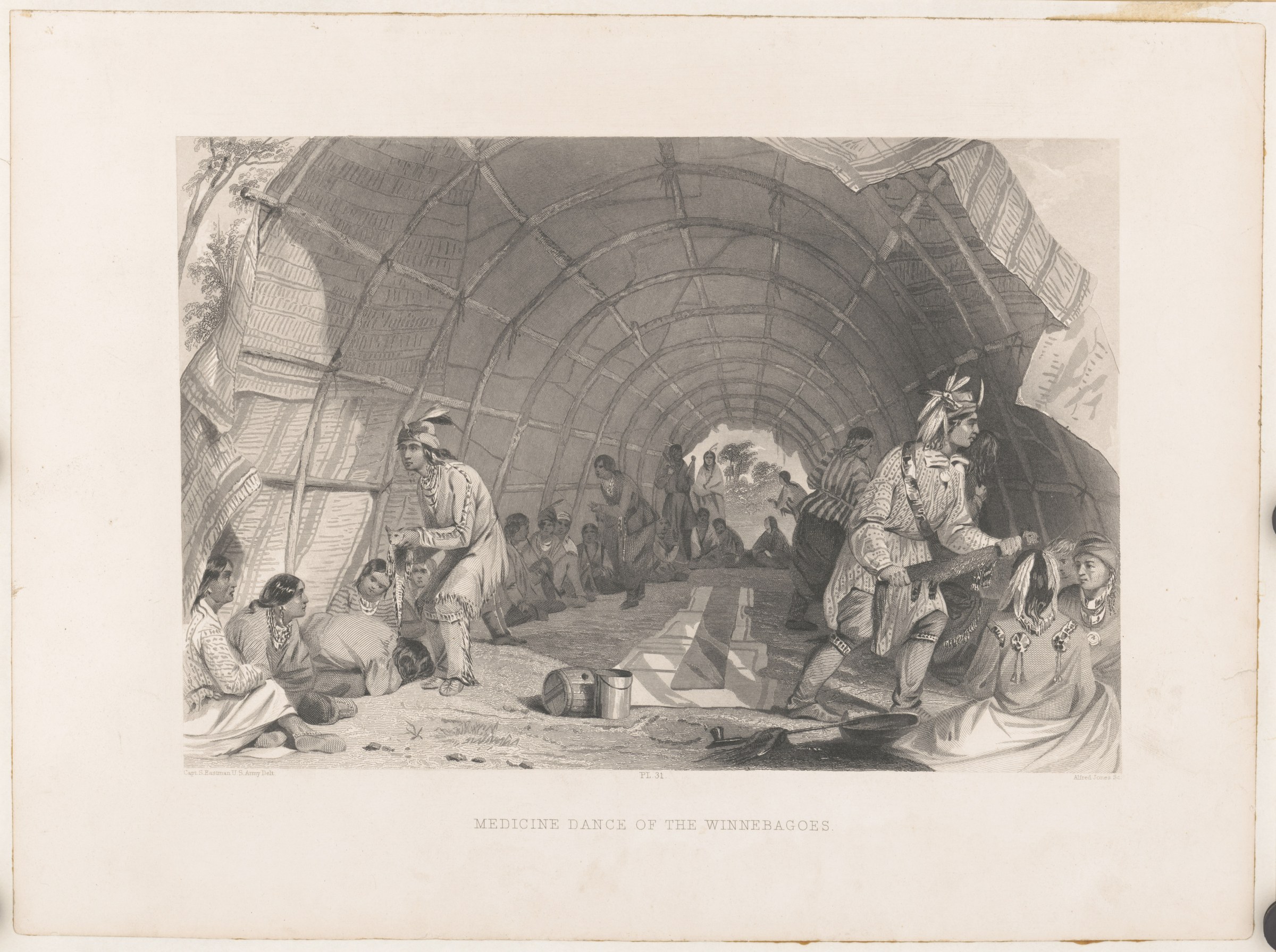
Medicine dance of the Winnebagoes LCCN2004670687
Jones, Alfred, 1819-1900, engraver
- Medium:
- Oil Painting
- Source:
- Wikimedia Commons
- Rights:
- Public domain — free to use, share and adapt.
- Recorded as:
- Public Domain
This work documents the centrality of ceremonial dance to indigenous North American life and spiritual practice, challenging narratives that positioned indigenous peoples as static or non-dancing. It also illustrates how 19th-century visual media recorded indigenous practices through an external gaze, raising questions about ethnographic representation, artistic authority, and whose knowledge of these ceremonies should be trusted—issues that remain urgent in museums and galleries today.
What you are looking at
This engraving depicts a medicine dance ceremony inside a large conical structure, likely a tipi or similar indigenous dwelling. The composition is viewed from within the structure looking toward its apex, where light streams through openings in the framework. The curved wooden ribs form the central perspective, drawing the eye upward and inward. Numerous figures are distributed throughout the interior space: some seated on the ground along the sides, others standing in central positions. The figures wear fringed and decorated clothing with patterns suggesting indigenous dress, with some wearing feathered headdresses. In the foreground, figures in elaborate costume dominate—particularly two tall figures in ornate regalia positioned prominently on either side, their clothing heavily decorated with what appear to be medallions or insignia. Between them and to the sides are grouped dancers and observers in various poses of activity and stillness. The lighting creates strong shadow and volume within the structure, emphasizing the three-dimensional depth of the ceremonial space.
The dancing
The central figures, particularly the two tall individuals in prominent regalia, stand in upright, dignified postures with arms positioned in gestures that suggest either authority or ceremonial significance—one appears to have a raised or extended arm. The surrounding figures are arranged in a loose gathering rather than a formal line or set formation, with some kneeling or crouching, others standing, suggesting a flexible, participatory structure. The bodies are oriented toward the center and toward each other, creating multiple focal points rather than unified directional movement. Footwork cannot be clearly discerned, but the overall composition suggests standing, stationary positions punctuated by individual gestural moments rather than coordinated traveling steps.
The dance depicted
This is documented as a medicine dance of the Winnebago (Ho-Chunk) people, a ceremonial practice integral to indigenous North American spiritual and community life. Medicine dances were healing ceremonies that combined prayer, movement, singing, and drumming to address illness and maintain community welfare. The image captures the ceremonial rather than kinetic aspect: the emphasis on costume, regalia, and hierarchical positioning of specific individuals (likely medicine people or leaders) over uniform group movement suggests this records the social and spiritual structure of the ceremony more than the mechanics of the dance itself. Without witnessing actual movement or having contemporary documentation, the specific steps and formations remain unclear, but the gathering structure and central positioning of authority figures are consistent with leadership-centered ceremonial practices.
How it was made
This is a steel engraving, a technique that allowed for fine linear detail and wide circulation through print reproduction. The engraving technique is evident in the careful parallel hatching that creates shadow and volume—particularly visible in the curved interior of the structure and the modeling of the figures' clothing. Steel engravings were a primary medium for illustrated travel narratives and ethnographic documentation in the 19th century, allowing publishers to reach broad educated audiences with detailed visual records of distant peoples and practices. This would have been printed from an engraved plate, likely created from an original drawing or painting, and distributed through books, periodicals, or as individual prints. The fineness of the line work and the legibility of ethnographic detail (costume, regalia, architectural elements) made engraving ideal for this documentation purpose.
About this work
This is a 19th-century engraving of a Winnebago medicine dance ceremony, a healing and community ritual central to Ho-Chunk spiritual practice. The image is valued not as a record of specific movement vocabulary but as documentation of the ceremonial structure and visual markers of indigenous North American religious practice at a moment when such documentation was often created by outsiders with mixed ethnographic accuracy. The work sits within a long tradition of European and Euro-American visual representation of indigenous peoples—a tradition that requires careful contextualization regarding whose perspective is being recorded and what aspects of the practice are visible to or understood by the artist. For dance historians, it serves as evidence of the importance of movement practices to indigenous governance, healing, and spirituality, even when the specific movement content is obscured by the ethnographic framing.
How to look at it
Attend first to the architecture and framing: the artist chose an interior perspective that emphasizes the ceremonial space itself as a container and character in the scene. Notice how the curved structural ribs and the centered light pull the viewer's eye inward and upward, replicating the experience of standing within the structure. Look at the placement and costume of the central figures, which suggests a hierarchy and authority structure within the ceremony—these are likely individuals with specific roles. The surrounding figures' varied postures and positions suggest a gathering that is at once formal (due to costume and regalia) and flexible in its movement and positioning. The engraving's linear technique creates sharp differentiation between light and shadow, emphasizing the solemnity and interiority of the ritual.
The artist
Alfred Jones (1819–1900) was an English engraver specializing in historical, literary, and ethnographic subjects. He was prolific in creating illustrations for travel narratives, natural history publications, and historical texts during the mid-to-late 19th century. Jones's work was part of the broader Victorian-era project of visual documentation and dissemination of knowledge about distant peoples and places, typically created from descriptions, other artists' drawings, or literary accounts rather than firsthand observation. His engravings were widely reproduced and circulated, making him a significant conduit for public understanding of indigenous peoples, though this mediation raises questions about accuracy and interpretation.
The period
This engraving was created in the 19th century, a period of intense ethnographic interest and documentation of indigenous American practices as tribal communities faced forced removal, cultural suppression, and rapid change. Visual representations of indigenous ceremonies served multiple purposes simultaneously: scientific documentation, exotic entertainment for European and American audiences, and an increasingly nostalgic record of practices being actively suppressed by U.S. policy. In the same era, indigenous ceremonial practices, including medicine dances, were prohibited by the U.S. government through the Indian Religious Crimes Code and other legislation. The engraving thus captures a ceremony at a moment of profound threat to its continuation, mediated through a European artistic tradition and distributed to audiences far removed from its spiritual context.
Where it lives
This engraving appears in the Library of Congress collection (LCCN 2004670687) and is available through Wikimedia Commons. The work likely originated as an illustration in a 19th-century travel narrative or ethnographic publication, though the specific publication has not been identified in the available record. As a widely circulated print, it may appear in multiple institutional collections.
Dance in this work
Questions about this work
Did the Winnebago actually dance like this?
We cannot know from this engraving alone. The image records the ceremonial context and the artist's interpretation of it, but shows little actual movement. Medicine dances were kinetically complex practices with specific songs, steps, and spiritual purposes. This engraving emphasizes costume, regalia, and social structure over movement itself. Contemporary accounts by Winnebago people or participants would provide far more reliable information about the actual dance practice.
Who created this image and why?
Alfred Jones, an English engraver, created this as an illustration—likely from a description or another artist's drawing rather than firsthand observation. It was part of the 19th-century publishing industry's intense interest in documenting indigenous peoples for European and American audiences. The work served simultaneously as ethnographic record, exotic spectacle, and often as a nostalgic preservation of practices that U.S. policy was actively suppressing.
What is a medicine dance?
A medicine dance is a healing ceremony central to many indigenous North American practices, combining movement, music, prayer, and communal participation to address illness and maintain community welfare. These were (and remain) sacred practices with specific spiritual purposes and protocols. The term 'medicine' refers to spiritual power and healing, not medicinal substances.
Why does this matter for dance history?
This image documents that indigenous North American peoples maintained complex, structured ceremonial dance practices that were integral to spiritual and community life. It counters historical narratives that minimized or ignored indigenous dance. It also illustrates how 19th-century visual media mediated and sometimes distorted indigenous practices for external audiences—a methodological caution for historians.
More dance artwork