49 works in this view — arrow keys or swipe to move between them.
Dance in Art · 2008
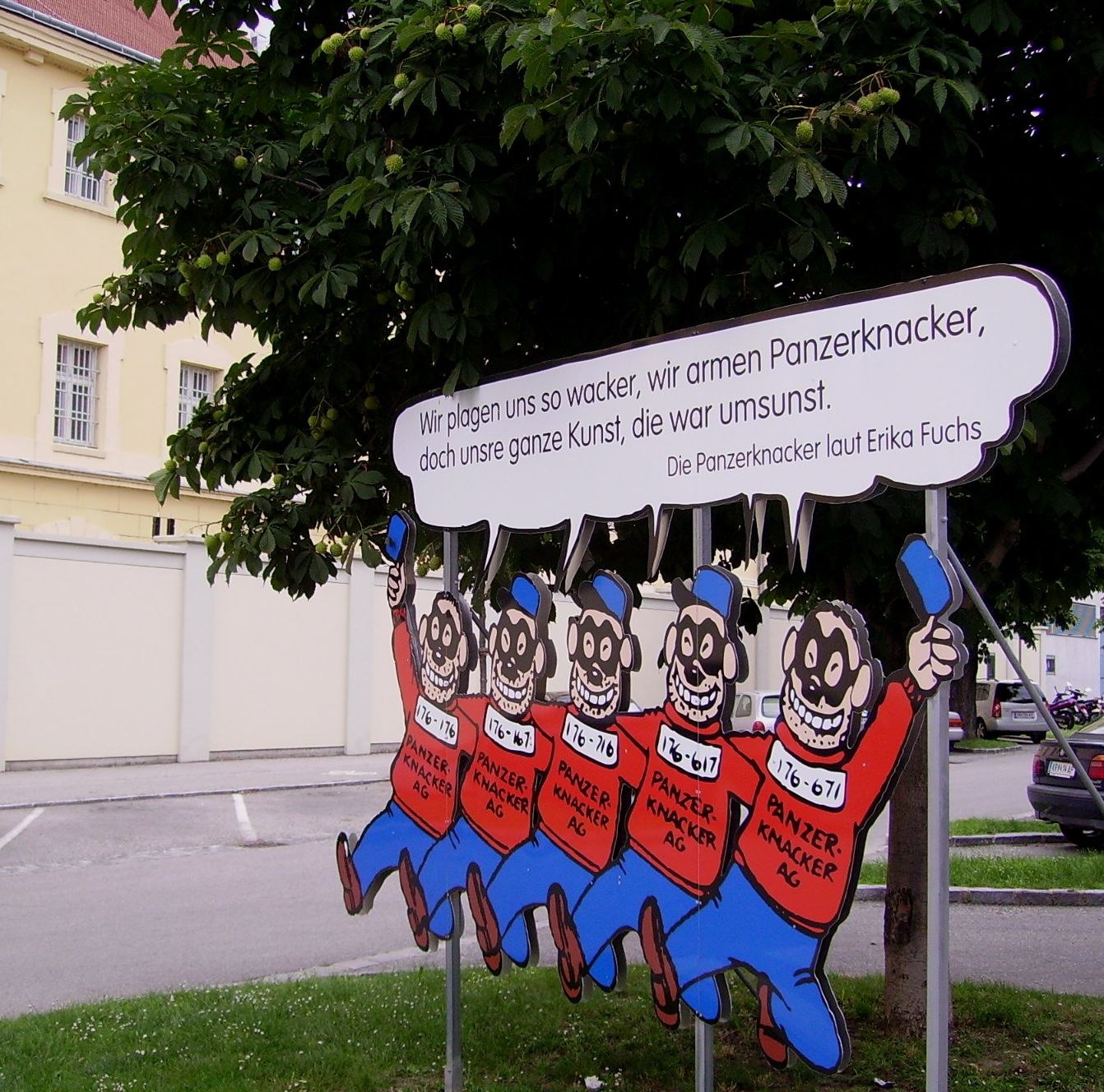
Panzerknacker in Stein
Immanuel Giel
- Medium:
- Oil Painting
- Source:
- Wikimedia Commons
- Rights:
- Public domain — free to use, share and adapt.
- Recorded as:
- Public Domain
This work demonstrates how choreography and synchronized movement can be weaponized as satire: the very formality and unison that give military or theatrical dance its power are here turned against authority. For dance historians, it is a reminder that not all organized group movement in art is celebratory or aspirational; it can be deeply critical. The work also anchors dance imagery firmly in post-war European visual culture and in the politics of mockery.
What you are looking at
This is a street art installation—a large shaped sign mounted on a pole in an urban plaza in Krems an der Donau, Austria. The sign depicts five cartoon soldiers in red uniforms and blue trousers, rendered in a bold, caricatural style with exaggerated grinning faces. They are shown in a dynamic jumping or dancing pose, legs splayed, arms raised holding blue objects (possibly weapons or flags). Above them is a speech bubble containing German text that reads: 'Wir plagen uns so wacker, wir armen Panzerknacker, doch unsre ganze Kunst, die war umsonst. Die Panzerknacker laut Erika Fuchs.' (We soldiers labor so bravely, we poor tank-crackers, but all our art was in vain. The Panzerknackers according to Erika Fuchs.) The setting is a contemporary street with a pale yellow residential building visible to the left, mature foliage overhead, parked cars in the background, and grass in the foreground. The tone is satirical or humorous, treating military figures as comic subjects.
The dancing
The five figures occupy the lower half of the sign in a loose horizontal row. Each has an identical grinning face with wide eyes and prominent teeth, rendered in a comic strip idiom. Their bodies are in a synchronized jumping or celebratory pose: knees bent, legs spread wide in a V-shape, torsos upright or slightly forward, arms raised. The figure on the right holds or gestures with an extended arm. There is no classical dance frame or balletic line—the movement is antic and comedic, closer to slapstick or music-hall buffoonery than to formal dance technique. The uniformity of pose suggests choreography, but of a deliberate, exaggerated kind designed to amuse rather than impress.
The dance depicted
This is not a serious depiction of a dance form, but rather a satirical use of synchronized group movement for comedic and political effect. The Panzerknacker (literally 'tank-crackers' or tank-busters) were soldiers in the German military, and the text attributes the image to Erika Fuchs, the German writer and translator of Donald Duck comics. The leaping, grinning pose appears to mock military discipline and heroism by reducing armed soldiers to identical, grinning buffoons performing an undignified jump. The 'dance' here is a rhetorical device: the synchronized movement undercuts military authority and suggests absurdity. This is street art commentary, not a record of an actual dance practice.
How it was made
This is a commercial street sign—a two-dimensional graphic artwork affixed to a public pole. The medium appears to be painted wood or metal with a white ground, printed or hand-painted text, and bold graphic illustration in a comic or poster style. The technique is flat and graphic, with solid colors (red uniforms, blue trousers and objects, white background) and bold outlines. The speech-bubble format echoes cartoon and comic-strip conventions, making the form inseparable from its satirical message. As a public sign, it was designed for legibility at a distance and for easy circulation of a visual-political message in an urban space.
About this work
This is a street art installation in Krems an der Donau that uses synchronized comic movement—a group of identically posed soldiers jumping and grinning—as a vehicle for visual satire. Rather than documenting an actual dance, the work employs the formal properties of choreographed group movement (repetition, unison, synchronized action) to deflate military authority and heroism. The text references Erika Fuchs, a translator and cultural figure, suggesting the piece is engaged with mid-to-late 20th-century German culture and perhaps the long shadow of military history. The work is included here because it consciously stages 'dance'—synchronized movement in unison—as a rhetorical and comedic tool, not because it documents a real dance practice or genre.
How to look at it
Observe the synchronized pose and its deliberate absurdity: the artist has frozen the soldiers mid-jump, mouths open in identical grins, bodies deployed in unison. This is not the grace or precision of ballet, nor the earth-rooted power of martial dance—it is slapstick. The speech bubble above contextualizes the image as satire: the soldiers themselves lament that their 'art' was 'in vain' (umsonst). The viewer should notice how the formal properties of choreography—unison, repetition, symmetry—are enlisted to mock rather than to celebrate. The work asks: what does it mean when synchronized movement becomes ridiculous?
The artist
Erika Fuchs (1906–2005) was a German author, translator, and cultural figure best known for her German translations of Disney comics, especially Donald Duck, which became culturally defining in Germany. She was also a writer and editor of children's and adult literature. The attribution in the text suggests this sign is either a work by Fuchs herself or a public artwork created in reference to her work or legacy. Fuchs was active during and after the Nazi era and in the Cold War, periods when satire of military authority held particular cultural weight.
The period
This work belongs to the tradition of post-war European graphic satire and public art commentary. The aesthetic—cartoon style, bold colors, speech bubbles, street installation—is consistent with late-20th-century pop art, graphic design, and public interventions. The specific mockery of military figures (Panzerknacker) reflects the long European engagement with the trauma and absurdity of 20th-century military history, particularly in German cultural memory. Street art as a vehicle for political and cultural commentary became increasingly prominent from the 1960s onward.
Where it lives
This is a public street installation in Krems an der Donau, Austria. The image comes from Wikimedia Commons and is documented as street art or public signage. The work is attributed in its own text to Erika Fuchs, though the specific date, artist, and commissioning history are not recorded in the catalogue.
Questions about this work
Is this actually a dance?
Not in the conventional sense. The five soldiers are posed in a synchronized jumping movement that mimics dance-like choreography, but the work is satirical street art, not a record of an actual dance form or practice. The 'dance' is the visual rhetoric, not an art form being performed.
What does the German text mean?
It translates roughly as: 'We labor so bravely, we poor tank-crackers, but all our art was in vain. The Panzerknackers according to Erika Fuchs.' The text suggests the soldiers are lamenting the futility of their own efforts or heroism, which the grinning, undignified pose reinforces.
Who was Erika Fuchs?
Erika Fuchs (1906–2005) was a prominent German author and translator, best known for her German translations of Donald Duck comics. She was a significant cultural figure in German literary and comic culture.
Where does this fit in dance history?
This work belongs to a broader conversation about choreography as rhetoric: how synchronized movement can be used to convey meaning beyond entertainment or athletic display. It is an example of anti-heroic or critical deployment of dance-like forms in contemporary visual culture.
More dance artwork