49 works in this view — arrow keys or swipe to move between them.
Dance in Art · 2014
Rothschild Prayerbook 20
Miniaturists of the final flowering of the Ghent-Bruges school of Flemish illumination (see Rothschild Prayerbook.
- Medium:
- Oil Painting
- Source:
- Wikimedia Commons
- Rights:
- Public domain — free to use, share and adapt.
- Recorded as:
- Public Domain
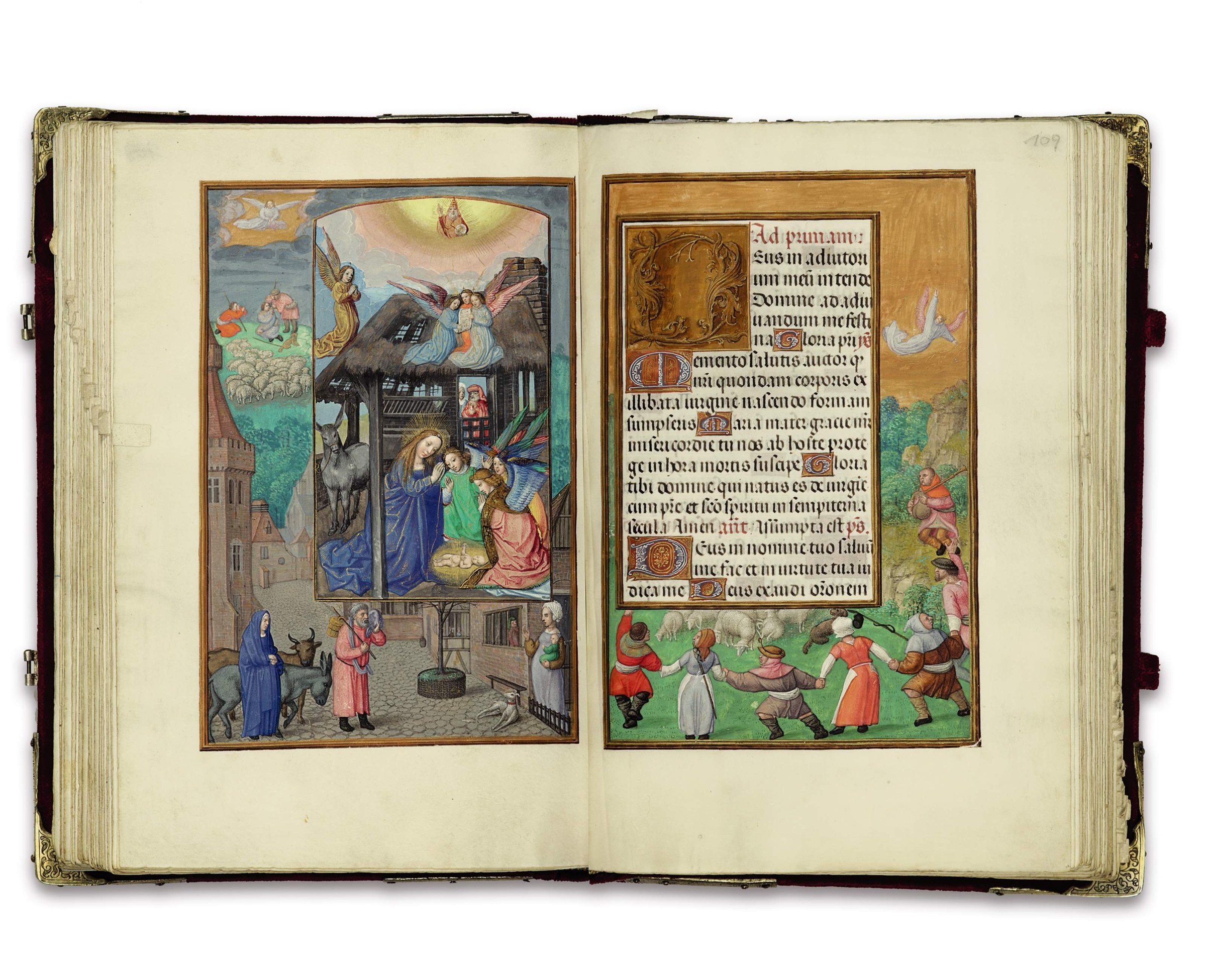
For historians of dance, this border offers an unusually detailed and naturalistic record of how bodies moved in spontaneous, festive play in the 15th-century Low Countries—a rare glimpse of everyday movement outside the courtly or theatrical contexts that dominate surviving dance documentation from this period. The artists of the Ghent-Bruges school were renowned for their close observation of life, and this scene exemplifies that practice.
What you are looking at
This illuminated manuscript page shows two scenes of Nativity narrative set in contemporary 15th-century Flemish settings. On the left, the main scene depicts the Nativity in a stone stable structure with a wooden roof; Mary kneels in deep blue robes beside the Christ Child in a manger, while Joseph and angels in luminous garments attend. The composition is crowded with figures—shepherds in the lower left with animals, heavenly hosts above with outstretched wings against a gold sky. On the right page, Latin text in dark ink fills the upper portion in two columns with decorative initials; below runs a wide border scene in landscape where children and young people dance, run, and play together on a grassy ground, their bright garments—reds, oranges, yellows, whites—scattered across the composition in small, active clusters. The children are distributed casually across the meadow rather than in formal arrangement, some leaping, others gesturing with arms raised.
The dancing
The dancers in the border are rendered as small, energetic figures without formal partnering or frame. Bodies are shown in profile and three-quarter view with limbs extended in play—arms raised overhead or spread wide, legs bent in running or jumping postures. There is no evidence of closed holds, lines, or structured formations. The composition emphasizes freedom of individual motion rather than synchronized or coupled movement; figures overlap and scatter across the ground plane with the naturalness of children at play rather than trained dancers executing steps.
The dance depicted
This appears to be secular children's play rather than codified dance. The border scene depicts the kind of spontaneous leaping, running, and gesturing associated with festive play or celebration in the 15th century—the sort of marginal revelry that appears often in Flemish manuscript borders. The figures wear contemporary dress and move with exuberant informality. The setting in a lush landscape and the clustering of young people suggest celebration or carnival atmosphere, but the movements are too unstructured and the figures too childlike to be identified with any specific dance form or courtly practice.
How it was made
This is an illuminated manuscript—ink and probably tempera and gold leaf on vellum—a luxury religious text made for a wealthy patron. The left page shows the sophisticated modeling of the Nativity scene with careful perspective, layered colors, and fine detail characteristic of the Ghent-Bruges school at its height. The border ornament on the right—architectural framing in gold leaf and the naturalistic landscape scene below—exemplifies the lavish margins typical of devotional manuscripts of this period. The technique allowed for minutely detailed figural work and rich color, and the circulation was limited to a single patron or small noble household.
About this work
This is a page from a Flemish devotional manuscript, probably a book of hours or similar prayerbook, dating to the mid-15th century and likely from the famous Ghent-Bruges atelier tradition. The primary image illustrates the Nativity; the border below offers a secular counterpoint—a scene of children and young people at play or festival, rendered in the lively, observant style that made Flemish manuscript borders repositories of contemporary life. The juxtaposition of sacred narrative and secular festivity is typical of the period's visual culture.
The dance-related content is marginal and informal, capturing celebratory play rather than learned or courtly movement. Yet the scene is historically valuable: it shows how the artist understood the physicality of youth and festival, the kinds of movement and costume that marked play and celebration in 15th-century Flanders, and the role of such scenes in offsetting and humanizing sacred text.
How to look at it
Examine the border scene closely: notice how the artist differentiates the poses and gestures of individual figures, the variety of arm and leg positions, and the scattered, overlapping arrangement. Compare this to any formal dance scene you may know from the same period (such as courtly dances in other manuscripts)—this scene lacks the aligned bodies, mirrored gestures, and spatial order of trained choreography. The artist was capturing movement as perceived in real life: children in bright clothes moving in clusters, leaping and reaching without constraint. The energy comes from the variety and apparent spontaneity of the gestures.
The artist
This page comes from the circle of illuminators associated with the Ghent-Bruges school of Flemish manuscript painting, one of the most accomplished and influential centers of artistic production in northern Europe during the 15th century. The school is known for the integration of naturalistic detail, rich color, and complex spatial composition with gold-leaf ornament. Individual manuscripts sometimes involved multiple master artists and apprentices. The sophistication of the Nativity scene and the quality of the border work suggest this was a prestigious commission, likely made for a noble or wealthy merchant family.
The period
In the 15th century, the Low Countries were centers of both manuscript production and a flourishing courtly dance culture. The same patrons who commissioned these luxury manuscripts also patronized court dances like the basse danse and estampie. However, manuscript borders often served as spaces for depicting popular, lower-status, or spontaneous activities—including folk play and festival movement that contrasted with the formality of the court. The Nativity itself was a subject laden with theological significance, but the addition of lively border scenes grounded the sacred in the sensory reality of the living world.
Where it lives
The manuscript is known as the Rothschild Prayerbook, identified in the catalogue record. It is a Flemish devotional manuscript of the 15th century, likely a book of hours or similar text made for a single noble patron. Such manuscripts were high-value objects, often passed through collections and sometimes dispersed. The current holding is not specified in the record provided.
Questions about this work
Is this a real 15th-century manuscript or a later copy?
The record identifies this as a product of the Ghent-Bruges school—the most celebrated illumination workshop of the 15th-century Low Countries. The quality of execution, the naturalism of the figures, and the sophistication of the gold-leaf ornament are consistent with original work from that atelier. Without further provenance detail, the specific history cannot be stated here, but the image shows the characteristic mastery of that school and period.
What is the border scene actually depicting?
A group of children and young people at play or festival in a landscape. They are running, leaping, and gesturing with raised or outstretched arms. The scene captures the exuberant, informal movement of youth at leisure, not choreographed or courtly dance. Such scenes were common in manuscript borders as places to depict everyday or marginal life.
Why is a children's play scene included in a religious manuscript?
Manuscript borders served multiple purposes: they provided space for ornament, they allowed artists to showcase observational skill and variety, and they offered visual contrast to the solemnity of the main sacred text. Including secular or playful scenes in the margins was a conventional practice in devotional manuscripts, humanizing and grounding the spiritual content.
What can we learn about 15th-century movement from this scene?
The image shows how an accomplished artist understood spontaneous, festive movement: the variety of arm positions, the enthusiasm of raised limbs, the clustering and overlapping of figures, and the bright colors that made such gatherings visually striking. It captures a kind of movement—children at play—that rarely appears in surviving dance documentation from the period.
More dance artwork