49 works in this view — arrow keys or swipe to move between them.
Dance in Art
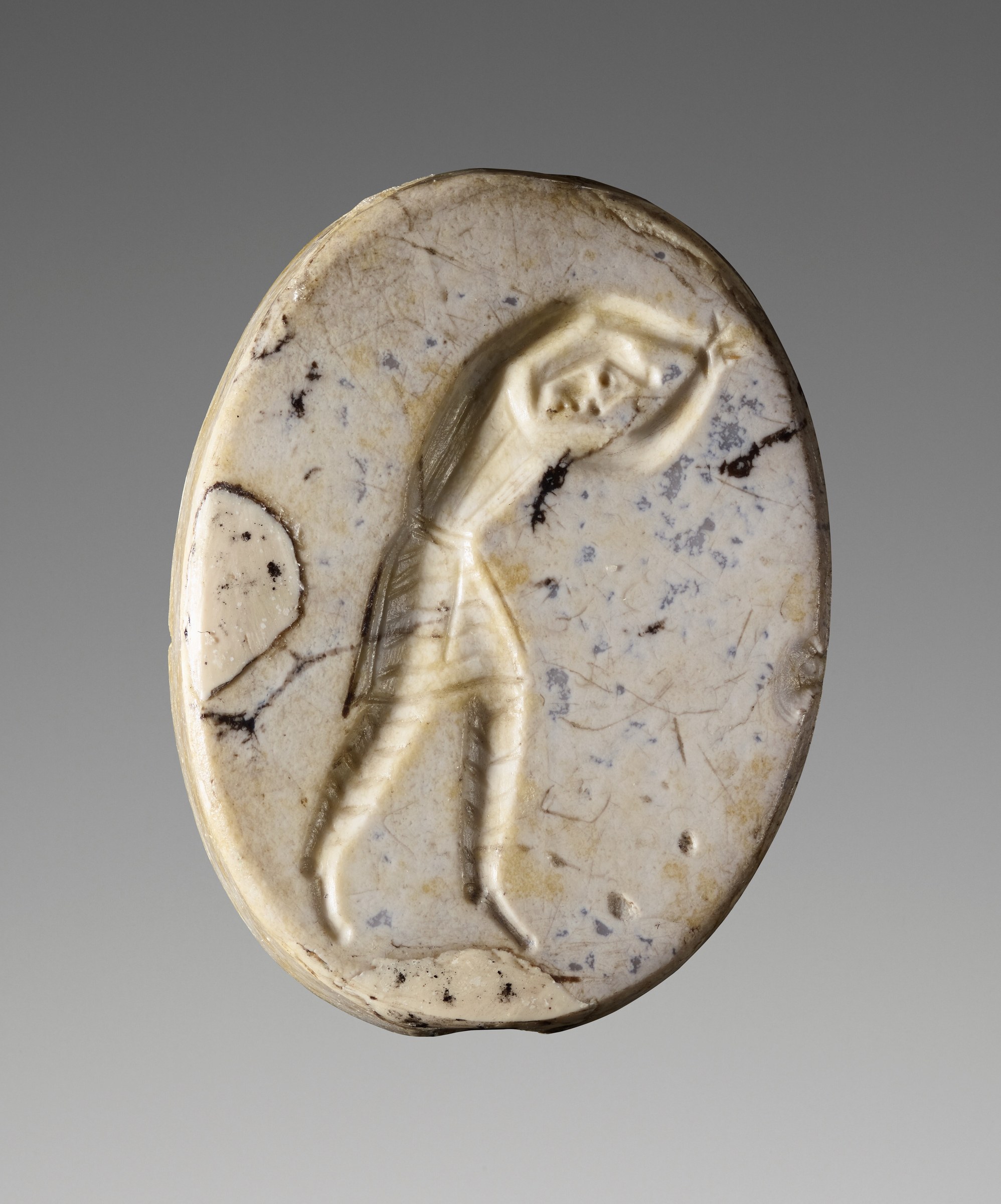
Seal with a Persian Man Dancing, about 400 B.C
Unknown artist
- Medium:
- Oil Painting
- Source:
- Wikimedia Commons
- Rights:
- Public domain — free to use, share and adapt.
- Recorded as:
- CC0
This seal is one of the earliest surviving depictions of organised, deliberate dance from the Persian world, and one of very few images of male Persian dance from antiquity. It demonstrates that sophisticated, formally trained movement existed in the Achaemenid court and was worth commemorating in a prestigious portable object. For dance historians, it raises questions about cross-cultural movement exchange: what was the relationship between Persian, Greek, and Near Eastern dance vocabularies in this era?
What you are looking at
A chalcedony scaraboid seal carved in relief shows a single male figure in profile, occupying the full height of the oval stone. The figure stands with legs in a wide stride, his body weight distributed dynamically. His arms are raised and bent, hands clasped above his head in a posture suggesting upward reach or celebratory gesture. He wears a fitted soft cap, a short-sleeved tunic, and what appears to be fitted trousers or leggings—a practical court or military dress typical of the Achaemenid Persian Empire. The stone itself is mottled grey-white chalcedony with visible inclusions and weathering marks consistent with ancient use. The carving technique creates a sharp silhouette; the engraver cut away the background to leave the figure in high relief, with careful attention to anatomical proportion and the articulation of cloth and form.
The dancing
The single dancer is shown in a frontal stance with weight distributed across both feet planted firmly in a wide base. The raised arms create an upward lift through the torso; the hands are clasped together at or above head height, a gesture that reads as exultant or celebratory rather than restrained. The sculptor understood the body's axis and the way weight and counterbalance work in an expansive posture. The legs are straight and braced, the torso upright, suggesting a moment of suspension or peak extension rather than a mobile travelling step.
The dance depicted
This seal depicts a Persian male dancer, likely a professional or courtly performer of the Achaemenid period (c. 500–330 BCE). The pose suggests a moment of celebration or climax within a formal dance tradition—the raised clasped hands and planted stance are consistent with ceremonial or court dances known to have existed in the Persian Empire, though specific named forms do not survive in the archaeological record. The practical dress and formal posture suggest this was a dance performed before court or elite audiences. The image is one of few surviving visual records of Persian movement practice from this period and suggests a vocabulary that emphasised verticality, symmetry, and controlled exuberance.
How it was made
This is an engraved cylinder or scaraboid seal cut in intaglio into hard chalcedony stone—a technique requiring exceptional skill and patience with hand tools. Such seals were both functional (pressed into clay or wax for authentication) and prestige objects; the care lavished on the carving of this figure suggests the owner's status or the seal-maker's ambition. The engraver worked in negative space, removing stone to leave the image in relief. The survival of such fine detail in a small stone object (under 3cm long) indicates an experienced hand and implies this was not a throwaway commodity but a valued object likely to circulate among the elite.
About this work
This Achaemenid seal preserves one of the few surviving images of Persian dance from antiquity. It captures a moment of formal, celebratory movement—a single male figure with raised arms and planted feet, carved with anatomical understanding and decorative refinement into hard stone. The seal's function as both seal and prestige object tells us that dance, or at least this image of dance, mattered enough to the Persian elite to warrant preservation and display at close hand. For historians of ancient movement, it is a rare window into the body language of the Persian court, showing a tradition of upright, controlled, symmetrical movement that contrasts sharply with the athletic exuberance seen in Greek imagery of the same period.
How to look at it
Notice the width of the stance and the upward thrust of the arms: the artist has chosen the moment of peak extension, the fullest expression of the movement's energy, rather than a travelling or transitional position. The engraver has also respected the constraints of the scaraboid form, fitting the figure to the oval stone so that it reads as a complete and self-contained image even in miniature. The clasped hands above the head and the planted feet create a visual 'closed' form—a shape that reads quickly and holds meaning even when worn as a seal and glimpsed briefly. Observe the care taken with the proportions of the body and the precision of the costume details: this is not a casual or hurried carving, but the work of a maker who understood both anatomy and the importance of the commission.
The period
The Achaemenid Persian Empire (c. 550–330 BCE) was a cosmopolitan power that encountered and absorbed movement traditions from across three continents. Greek sources describe Persian court dances and musicians, though Greek writers' accounts are coloured by their own aesthetic values and often dismissive tone. Archaeological evidence is sparse; seals and carved vessels offer almost the only surviving images of Persian bodies in motion. Dance at the Achaemenid court was likely tied to ceremony, military display, and elite entertainment. This seal was created at a moment when the Persian Empire was at the height of its power and cultural confidence—before the Macedonian conquest of 330 BCE—and reflects the formal, dynastic aesthetics of that court.
Where it lives
The seal is housed in the Getty Museum (accession 81.AN.76.88) and is recorded as part of their ancient Near Eastern collection. It is catalogued as Achaemenid Persian, dated to approximately 400 BCE. No copyright restrictions apply in the United States.
Dance in this work
Questions about this work
How do we know this is a dance and not just a figure with raised arms?
The pose—the wide planted stance, the symmetry, the upward reach, the apparent moment of peak extension—reads as a deliberate, choreographed gesture rather than a casual or functional one. In the visual language of Achaemenid royal iconography, such formal postures typically denote ceremonial or courtly activity. The seal's subject matter and the deliberation of its carving suggest the figure is meant to be understood as engaged in a formal, valued activity: dance fits that context.
What kind of dance is this?
We do not know the specific name or form. Greek and later Persian literary sources mention court dances and entertainment dances at the Achaemenid court, but no detailed descriptions of technique or named styles survive. This image is archaeological evidence of a movement tradition, not a fully documented dance form. It shows us that upright, symmetrical, exuberant movement was part of Persian court culture, but the finer details of vocabulary and transmission are lost.
Why is this a seal, and what does that tell us?
Seals were essential bureaucratic and prestige objects in the ancient Near East—pressed into clay or wax to authenticate documents and mark property. The fact that an Achaemenid elite figure chose to commission a seal carved with an image of dance suggests that the subject held sufficient cultural value to warrant daily visibility. Seals were also worn or carried, meaning this image of Persian dance would have been handled, shown, and discussed among the elite. It is a window into what mattered to the people in power.
More dance artwork