49 works in this view — arrow keys or swipe to move between them.
Dance in Art · 2025
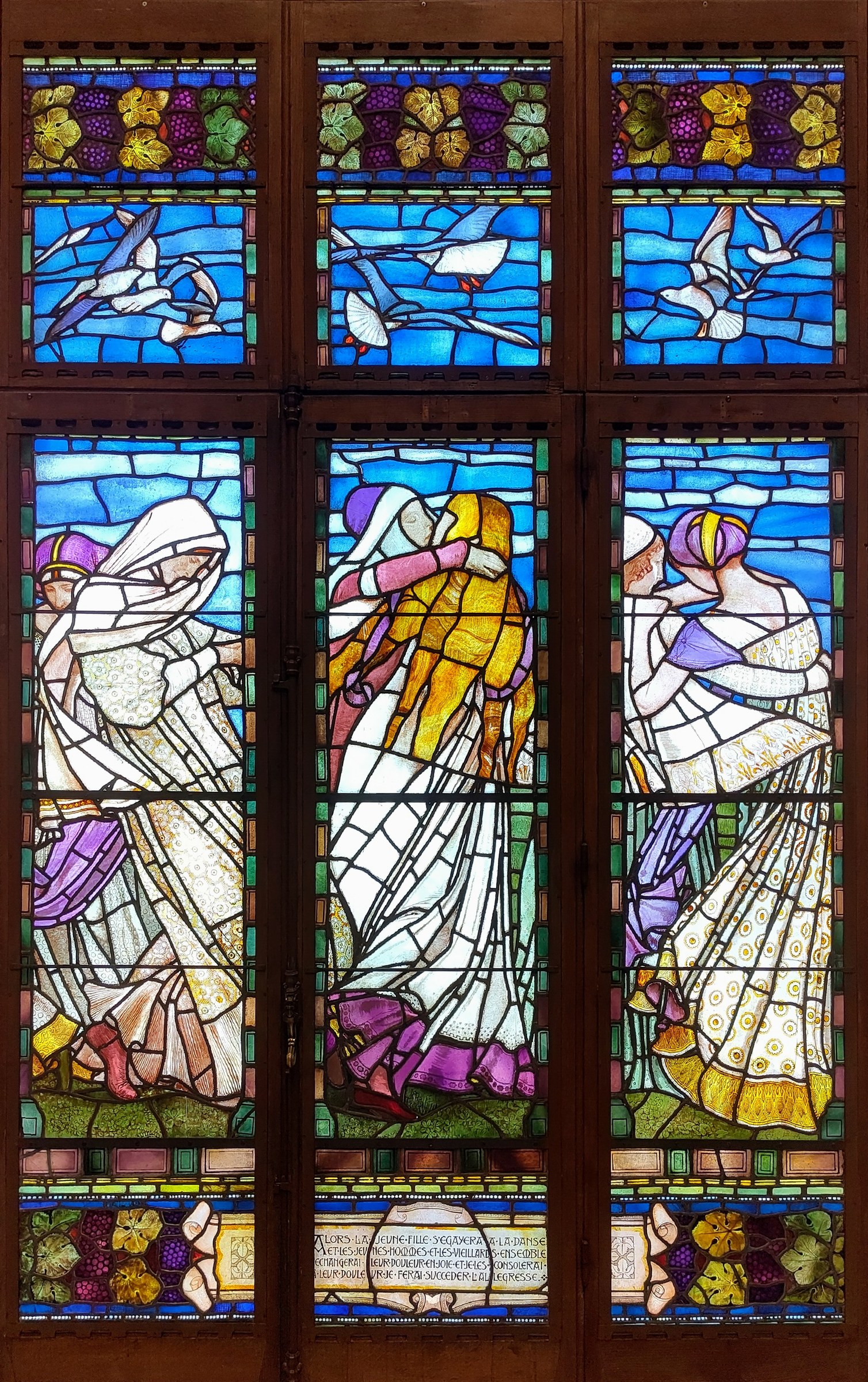
Vitrail de Heaton au MAH Neuchatel
Pohoua
- Medium:
- Oil Painting
- Source:
- Wikimedia Commons
- Rights:
- Public domain — free to use, share and adapt.
- Recorded as:
- CC0
This window documents a crucial moment when fine artists and craftsmen began to reimagine dance not as a technical practice but as an embodiment of beauty and movement divorced from social convention. It shows how the aesthetics of modern dance—particularly the flowing, weightless quality associated with Isadora Duncan and early 20th-century avant-garde performance—entered the visual arts and architectural decoration, creating a new visual language for representing the body in motion.
What you are looking at
Three tall stained-glass windows depict allegorical female figures in flowing classical drapery, each in a different pose of graceful motion against a background of horizontal blue glass representing sky or water. The figures wear draped white robes with colored accents—pink, purple, and gold—and appear to be dancing or moving in a weightless, ethereal manner. Above each window sits a decorative border of golden grapevines and purple grapes on a dark ground, a reference to fertility and Dionysian celebration. Below, a band of text in serif capitals runs across the base, suggesting classical or literary inscription. The windows are set in wooden frames with lead came typical of late 19th- or early 20th-century art glass, with subtle green, pink, and amber accent pieces throughout the leading. The overall effect is of three dancers in a unified narrative, their bodies suspended in an otherworldly grace that belongs to neither classical ballet nor contemporary social dance, but rather to an idealized vision of feminine movement as embodied in the Arts and Crafts or Symbolist aesthetic.
The dancing
Each figure occupies a full vertical panel and stands in a distinct attitude of movement: the left dancer leans diagonally with one arm extended, her drapery swirling in a helical pattern around her body; the center figure holds a pose of greater stillness, with arms held close and drapery falling more formally; the right figure echoes the diagonal thrust of the left, with drapery caught in mid-flow. None of the figures appear to be on pointe or in any recognizable balletic stance. Instead, their weight seems distributed in a more classical or idealized manner—they float rather than dance, their bodies elongated and their movement suggested through the arrangement of cloth rather than through limb position. The poses suggest neither partnered dance nor competitive athleticism, but rather an aesthetic of graceful contemplation in motion.
The dance depicted
These figures represent an allegorical or classical ideal of dance and movement rather than any specific dance form recognizable to practitioners. The treatment is consistent with early 20th-century Symbolist or Art Nouveau attitudes toward the female body in motion—drawing on classical Greek imagery, Isadora Duncan's vision of natural movement, and the theatrical ideals of the period. The drapery and pose reference ancient Greek dancing figures and bacchanalian processions, but filtered through a modern aesthetic sensibility that privileges line, fluidity, and ethereal weightlessness over any codified technical vocabulary. The work presents dance as a philosophical or spiritual ideal rather than as a social or theatrical practice.
How it was made
This is a stained-glass work executed in the traditional leaded glass technique: individual pieces of colored glass are cut to shape, details are painted on using enamel or grisaille, and the pieces are then joined with strips of lead solder. The lead lines do not merely hold the glass together; they function as an integral part of the composition, directing the eye and defining the contours of the drapery and the divisions between the three figures. The translucence of the medium and the play of light through it—with the white drapery glowing and the blue background appearing atmospheric—creates an effect impossible in opaque media. This is a work designed for architectural installation, meant to be backlit by natural light and viewed from a distance, making it a monumental public or institutional statement rather than a private collector's piece.
About this work
This is a monumental three-panel stained-glass window by Clement Heaton, a prominent English designer and craftsman of the Arts and Crafts movement, now housed in the Musée d'Art et d'Histoire in Neuchâtel. The work presents three allegorical female figures in classical drapery, each in a pose of graceful, weightless motion. Rather than depicting any recognizable dance form, the window embodies an early 20th-century ideal of movement as an aesthetic and philosophical condition—influenced by both classical antiquity and contemporary modern dance aesthetics. The work sits at the intersection of decorative arts, theatrical design, and a broader Symbolist reimagining of the dancing body as a vehicle for beauty, fluidity, and spiritual transcendence.
How to look at it
Attend first to the three distinct poses and how they relate across the triptych—not as a narrative sequence but as three variations on a theme of graceful, continuous motion. Notice how the lead lines mimic and enhance the fall of the drapery, so that the skeleton of the window becomes part of the visual rhythm of movement. Look at how the figures seem to float within their panels rather than stand or dance within a defined space—the blue background is not a stage but an immaterial expanse. Finally, observe the play of light through the translucent white drapery and how it glows against the darker glass, giving the figures an otherworldly luminosity that no painting could achieve.
The artist
Clement Heaton (1861–1940) was an English stained-glass designer, metalworker, and painter associated with the Arts and Crafts movement. He worked across multiple media, from stained glass to ceramics and decorative metalwork, and was known for integrating fine art sensibility with craft tradition. Heaton was part of a broader circle of designers who rejected industrial standardization in favor of handcrafted beauty and meaningful ornamentation. His stained-glass work is characterized by elegant, elongated figures, rich jewel tones, and a sophisticated use of leading as compositional line. He worked on commissions for churches, civic buildings, and museums across Britain and Europe.
The period
The early 20th century saw a profound shift in how artists visualized dance. Isadora Duncan's revolutionary barefoot dancing and rejection of classical ballet technique influenced not only theater but visual culture broadly. Simultaneously, the Arts and Crafts movement in Britain—and parallel Art Nouveau movements across Europe—championed the integration of beauty into everyday functional objects and architectural spaces. Stained glass, with its medieval heritage, was revived as a medium capable of expressing modern sensibilities. This window emerges from that confluence: it applies Modernist and Symbolist attitudes toward the dancing body to the ancient craft of leaded glass, creating an image of dance as a kind of cosmic or spiritual principle rather than as a codified practice.
Where it lives
The window is held in the Musée d'Art et d'Histoire in Neuchâtel, Switzerland, and likely was originally commissioned as an architectural installation for a significant public or institutional building, possibly in Switzerland or Britain. Its presence in a museum collection suggests it was either removed from a demolished or altered building or acquired directly by the institution as a significant example of early 20th-century decorative arts.
Questions about this work
What dance form is depicted in this window?
None in the strict sense. The figures embody an allegorical or idealized vision of movement and grace rather than any specific dance technique. The poses and drapery reference classical Greek imagery and early 20th-century modern dance aesthetics, particularly the flowing, weightless quality associated with Isadora Duncan, but they are not meant to represent a codified social or theatrical dance.
Why are there three panels instead of one?
The triptych format allows Heaton to present multiple variations on the theme of graceful motion, creating a unified composition that speaks to movement itself as a kind of eternal principle. The three figures may represent different aspects or phases of motion, or simply three complementary expressions of the same ideal.
How is this different from a painting of dancers?
Stained glass is translucent and backlit, so the white drapery glows with internal light rather than being rendered through paint and shadow. The lead lines become part of the composition, guiding the eye and reinforcing movement. The work is also monumental and architectural, designed to be experienced in space rather than hung on a wall.
More dance artwork