25 works in this view — arrow keys or swipe to move between them.
Dance in Art · 2009
Gardelazo
Gardelisimo
- Medium:
- Oil Painting
- Dance:
- Tango
- Source:
- Wikimedia Commons
- Rights:
- Public domain — free to use, share and adapt.
- Recorded as:
- CC0
Gardel transformed tango from a marginal urban practice into an internationally celebrated art form, and monuments to him mark the geography of tango memory. Understanding how societies commemorate dance figures—through portraiture, scale, placement, and tone—reveals what aspects of dance culture they choose to valorize and how they integrate that culture into civic identity. The style and context of this monument tell us as much about how mid-20th-century Uruguay saw Gardel as the image itself does.
What you are looking at
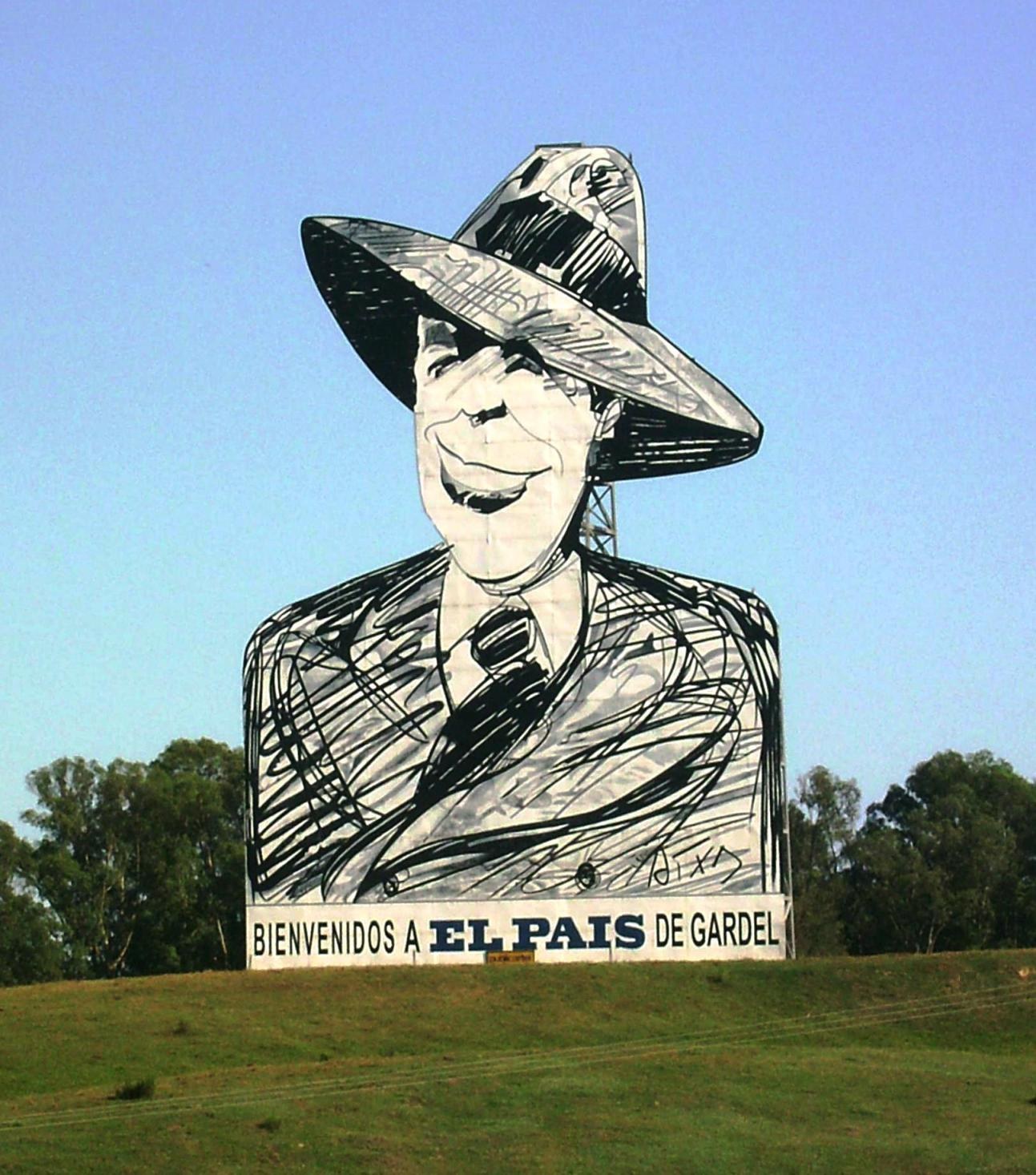
A massive outdoor billboard or monument dominates the landscape, featuring a caricatured head rendered in bold black line-work against a cream-colored ground. The figure wears an oversized gaucho hat with a wide brim, tilted at a jaunty angle, and displays an exaggerated grin with prominent teeth and a pronounced chin. The chest shows a patterned garment with cross-hatching suggesting embroidered or decorated cloth, and a neckerchief or scarf. The artist's signature appears in the lower right. Below the portrait runs a text banner reading "BIENVENIDOS A EL PAIS DE GARDEL" (Welcome to the Land of Gardel). The monument is set in a flat, rural landscape with trees visible at the horizon and a clear blue sky above, suggesting a roadside welcome sign marking entry to a region.
The dancing
This is not a figure in motion but a portrait head frozen in a permanent expression. The caricature exaggerates the facial features with an almost theatrical grin and elongated proportions typical of public monument portraiture. There is no dance gesture, hold, or body position to analyze—the figure is presented frontally and statically, shoulders visible but not in a stance that conveys movement or partnering.
The dance depicted
While the subject is Carlos Gardel, the legendary Argentine tango singer and cultural icon, the monument does not depict dance in progress. Gardel was central to tango's emergence and popularization as both performer and film star, and tango itself is fundamentally tied to dance. However, this work presents a portrait of the man, not a representation of tango dance or dancers in movement. The image commemorates Gardel as a cultural figure rather than documenting or interpreting a dance form.
How it was made
The work employs bold graphic simplification characteristic of large-scale public monument art. The heavy black outlines and cross-hatched patterning suggest either a painted mural or a drawn design translated to outdoor installation, likely created with paint or similar durable materials suitable for prolonged outdoor exposure. The technique prioritizes visibility and legibility from a distance—large forms, high contrast, and bold delineation ensure the portrait reads clearly to approaching motorists or travelers. This approach is typical of roadside welcome monuments designed to serve as both artistic expression and directional landmark.
About this work
This is a public monument erected as a welcome sign at the entrance to Tacuarembó, Uruguay, honoring Carlos Gardel, the towering figure in tango history. While tango itself is a dance, this work is a portrait of Gardel rather than a depiction of the dance form or dancers. It belongs in a dance archive not because it shows dancing, but because Gardel's life and career are inseparable from tango's global ascendancy and because monuments to performers are part of how societies memorialize dance culture. The exaggerated caricature style reflects popular and comic traditions of portraiture while simultaneously investing Gardel with monumental status—the scale and public placement transform a grinning face into a cultural landmark.
How to look at it
Approach this work as a public monument encountered in landscape, not as an artwork viewed in a gallery. The caricature style is deliberately exaggerated—note how the artist prioritizes Gardel's hat, grin, and decorative costume over anatomical accuracy or realism. The outsized scale relative to the landscape transforms a human face into a territorial marker. The inscription grounds the portrait in place and purpose: this is not art for contemplation but a sign meant to welcome travelers and assert regional identity. The style sits somewhere between folk art, graphic design, and popular caricature tradition.
The artist
The work is attributed to "Gardelisimo," a name that is almost certainly a playful pseudonym or descriptive coinage rather than an artist's birth name—the suffix -ísimo in Spanish denotes superlatives ("most Gardel-like"). This suggests either a local artist working anonymously, a communal or institutional monument, or a tongue-in-cheek attribution reflecting the spirit of popular monument-making. Without additional documentation, little else can be established about the artist or their practice.
The period
The work dates to 2009, more than five decades after Gardel's death in 1935. By the early 2000s, Gardel had long been mythologized as tango's founding genius, and his image had become universally recognized across the Americas. The monument reflects a broader 21st-century revival of interest in tango as cultural heritage—both as a living dance practice and as a historical symbol of national and regional identity. Tacuarembó, located in northern Uruguay, has cultivated its connection to Gardel to boost cultural tourism, making the welcome monument a contemporary tool of place-branding rather than a work created in Gardel's lifetime or era.
Where it lives
The work is documented in Wikimedia Commons, a digital commons repository of media files. The original object is a public monument sited at the entrance to Tacuarembó, Uruguay, and is therefore accessible to anyone passing through the region. It is not held in a traditional museum collection and is subject to outdoor weathering and alteration.
Questions about this work
Is this actually a dance image?
It is a portrait of Carlos Gardel, whose life and career are inseparable from tango dance history. Gardel did not dance himself—he was a singer and performer. The monument commemorates the man, not a dance or dancers. It belongs in a dance context because Gardel's influence on tango is foundational, but the image does not depict dancing or dance technique.
Who was Carlos Gardel?
Carlos Gardel (1890–1935) was a French-born performer who grew up in Buenos Aires and became the most celebrated figure in tango's early history. He sang, acted in films, and helped popularize tango internationally. His death in a plane crash elevated him to legendary status, and he became so closely identified with tango that many consider him synonymous with the form itself.
Why is there a giant monument to him in Uruguay?
Although Gardel is most closely associated with Buenos Aires, Argentina, his cultural influence extended throughout the Spanish-speaking Americas. Tacuarembó has promoted itself as a tango destination partly through association with Gardel. The monument serves dual purposes: artistic homage and tourism marketing, asserting the town's place in tango geography.
What does 'Gardelisimo' mean?
It is almost certainly a playful reference meaning "most Gardelian" or "pure Gardel," using the Spanish superlative suffix -ísimo. It may be a pseudonym, a collective credit, or a humorous attribution reflecting the spirit of popular public art. Without additional documentation, the true artist remains unidentified.
More Tango artwork
![[Les noces de trottoir, par les compagnies Tango Sumo et Vendaval. Chalon dans la rue. 2007 / photographies de Joël Verhoustraeten] by Verhoustraeten, Joël (1954-2019). Photographe](https://gallica.bnf.fr/iiif/ark:/12148/bc6p058zgkc/f1/full/800,/0/native.jpg)