25 works in this view — arrow keys or swipe to move between them.
Dance in Art
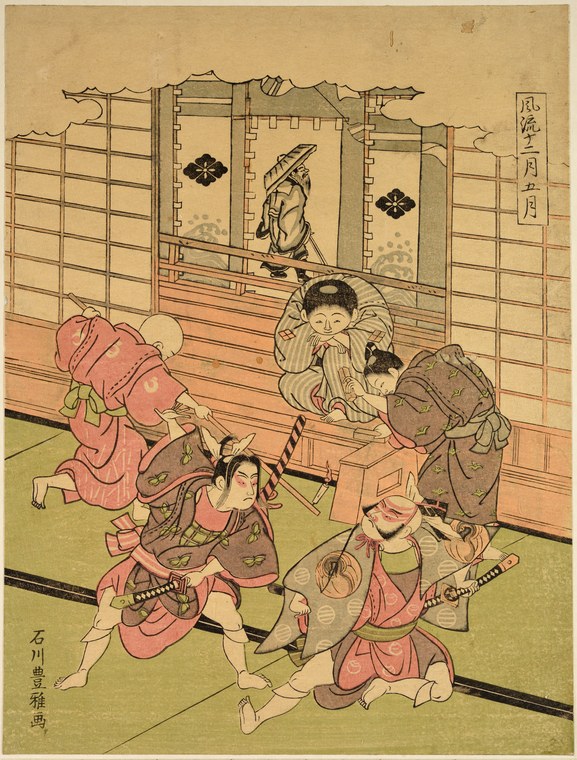
Four boys taking part in an amateur theatrical performance and a fifth seated in the veranda lookin
Unknown artist
- Dance:
- Tango
- Source:
- New York Public Library
- Rights:
- Public domain — free to use, share and adapt.
- Recorded as:
- public_domain
This print documents a form of theatrical practice—amateur kabuki-influenced street theater—that left few written records but shaped how young people in Edo Japan encountered performance, narrative, and embodied expression. It shows performance culture at a grassroots level, outside the professional kabuki theaters, making visible the everyday theatrical training and entertainment that reached most people. For dance historians, it reveals that the Western genealogy of 'dance' excludes rich performance traditions grounded in narrative, character, and ensemble play rather than abstract movement.
What you are looking at
A theatrical performance captured in a Japanese woodblock print depicts five young performers in an indoor stage setting. Four boys are actively engaged in dramatic action on a wooden platform stage, while a fifth sits cross-legged on a veranda at left, watching or waiting. The stage itself is a traditional Japanese wooden structure with latticed railings and a decorative roof line; behind it stands a backdrop painted with landscape elements. The performers wear brilliantly colored costumes in coral pink, rust, and muted greens—the colors characteristic of hand-applied pigments to woodblocks. The scene captures a moment of physical play and exaggerated gesture: one performer lunges or staggers, another crouches, a third stands with arms raised or extended, their bodies arranged in dynamic diagonal compositions across the stage platform. The veranda figure, wearing warm robes, observes from outside the action, anchoring the composition at left.
The dancing
The four performing boys display exaggerated, large-gestured movement appropriate to amateur kabuki or street theater: wide stances, extended arms, and emphatic body angles that carry expression across a distance. One figure appears to lunge forward with a weapon or staff; another crouches low; a third stands with torso twisted and arms gesturing. The postures suggest pantomime and character portrayal rather than balletic line. The fifth figure sits formally on the veranda in seiza position, knees folded, body upright and still—a compositional counterpoint to the animated stage action. The energy is dispersed and informal rather than unified in a single spatial relationship.
The dance depicted
This is not a depiction of formal dance in the Western sense, but rather amateur theatrical performance in the Japanese tradition, likely kabuki-influenced street theater or festival entertainment. The physical vocabulary—the exaggerated stances, the use of props, the narrative mime—places this in the category of performative theater rather than codified dance. The setting suggests a temporary or amateur stage, and the age of the performers (all young boys) points to village or festival entertainment rather than a professional company. No school of ballet or ballroom dance is evident; this is instead the embodied practice of storytelling and character portrayal through gesture and bodily attitude.
How it was made
This is a hand-colored woodblock print (or possibly an early color woodblock print with both pigment and hand-finishing), characteristic of Japanese ukiyo-e production. The flat, bold graphic quality of the medium is perfectly suited to this subject: clear outlines define the figures, and the bold color planes—particularly the warm coral of the costumes—create visual impact and depth. The technique allowed for multiple impressions, suggesting this image was made for circulation as a print rather than a unique artwork. The wooden stage is rendered with fine linear detail, while the figures remain bold and sculptural, emphasizing the theatrical moment over anatomical precision. The printing process's ability to handle strong color and linear clarity was ideal for theatrical subjects.
About this work
This is a Japanese woodblock print depicting an amateur theatrical performance, likely from the Edo period, showing five young performers on and around a temporary wooden stage. The work captures a moment of physical exuberance and dramatic gesture in what appears to be village or festival entertainment. The print represents the intersection of visual art and performative culture: the artist has composed a theatrical scene as if to preserve and circulate knowledge of how such entertainment looked, who participated in it, and what kind of bodily movement and expression it involved. For historians of Japanese theater, performance culture, and the social life of early modern entertainment, this image provides crucial evidence of how young people learned and performed narrative theater through imitation and physical play.
How to look at it
Notice the compositional strategy: the artist has frozen a moment of energetic, discordant action, with each performer in a different posture and gesture, yet arranged so that the eye travels across the stage from figure to figure. The exaggeration of gesture—the extended limbs, the twisted torsos, the lunges—is the language of character portrayal in kabuki. The contrast between the animated stage action and the still, formal figure on the veranda creates narrative depth: someone is watching, waiting, or about to enter. The flattened perspective and bold color planes are typical of woodblock composition, yet they enhance the sense of theatrical exuberance rather than detract from it.
The artist
The artist is not recorded. The style and subject matter are consistent with Japanese woodblock prints of the Edo period (17th–19th centuries), when theatrical subjects—particularly kabuki and folk performances—were popular in print culture. The seal visible at right is too small to read with certainty in this image, but suggests a known publisher or artist studio of the period.
The period
This print dates from an era when kabuki and other forms of theatrical performance were central to Japanese urban and village entertainment, and when woodblock prints served as a primary medium for documenting and circulating images of that culture. The Edo period saw both the professionalization of kabuki in urban centers and the flourishing of amateur and festival performances in villages. Young people—particularly boys—learned performance through imitation and participation in community performances. This image captures that amateur tradition at a moment when Japanese print culture was at its height of technical and artistic sophistication.
Where it lives
The print is held by the New York Public Library. It comes from a Western collection, where it was cataloged under a somewhat garbled English title. Prints of this kind were created in multiple impressions and circulated widely in Japan; later, they entered European and American collections as examples of Japanese artistic practice and were eventually absorbed into institutional holdings.
Questions about this work
Is this ballet?
No. This depicts Japanese theatrical performance in the amateur kabuki tradition, using narrative mime and character portrayal rather than ballet vocabulary. The bodies and gestures are deliberately exaggerated for theatrical effect rather than refined for aesthetic line. This is performance rooted in storytelling and popular entertainment, not classical dance training.
What does the figure on the veranda represent?
Likely either a performer waiting to enter, a musician preparing to accompany the action, or someone in charge supervising the performance. The seated position (seiza) suggests formality and stillness, and places that figure outside the immediate action—observing, anticipating, or in a different narrative role.
How do we know this is amateur theater and not professional kabuki?
The temporary-looking wooden platform, the informality of the stage construction, the composition of the performance group (all young boys, no clear star or lead), and the modest setting all point to village or festival entertainment rather than a professional kabuki theater. Professional kabuki productions were lavishly staged and performed in dedicated theaters; this depicts something more local and grassroots.
What can we learn about Japanese performance from a single image?
The print tells us about body language and spatial relationships in theater: how gesture was enlarged and clarified for distance viewing, how character was expressed through posture rather than scenery, how young people were trained through imitation and group participation, and how performance culture was embedded in village and festival life rather than separated into elite institutions.
More Tango artwork
![[Les noces de trottoir, par les compagnies Tango Sumo et Vendaval. Chalon dans la rue. 2007 / photographies de Joël Verhoustraeten] by Verhoustraeten, Joël (1954-2019). Photographe](https://gallica.bnf.fr/iiif/ark:/12148/bc6p058zgkc/f1/full/800,/0/native.jpg)