25 works in this view — arrow keys or swipe to move between them.
Dance in Art
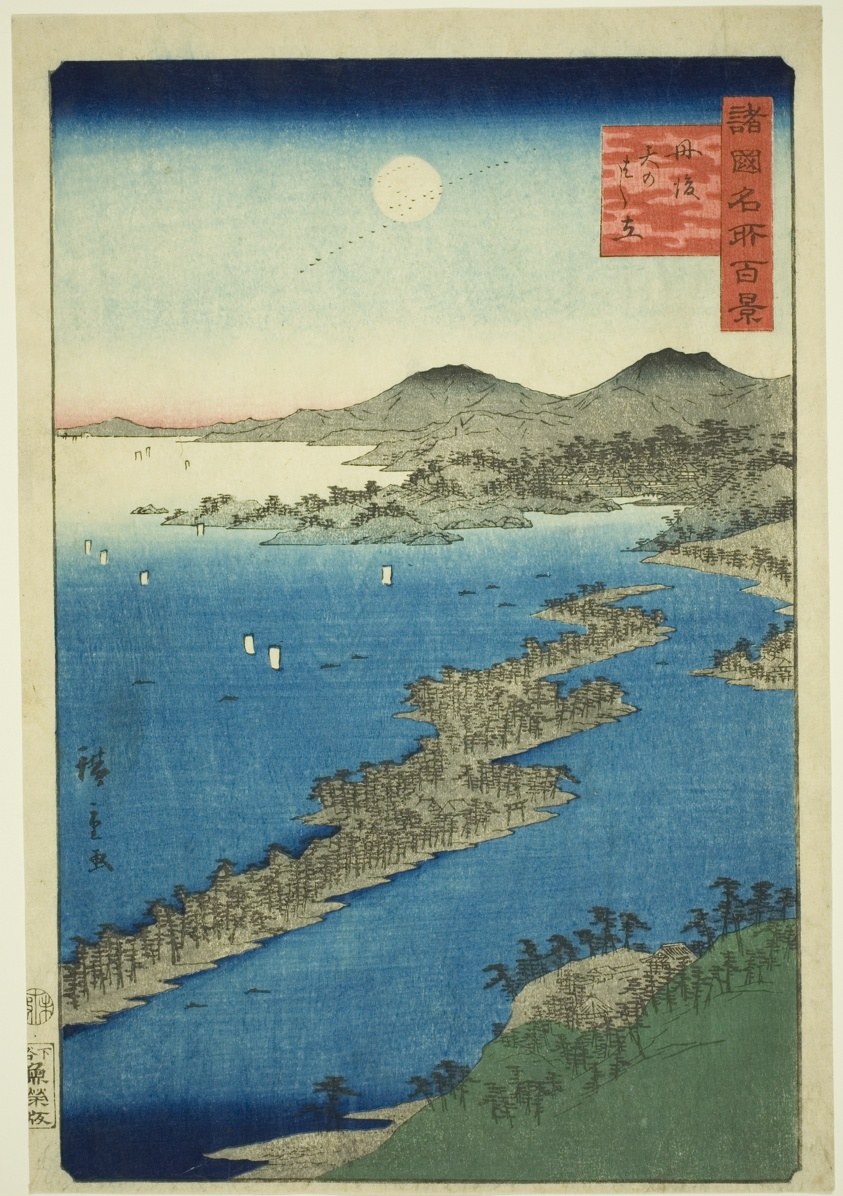
Amanohashidate in Tango Province Tango Amanohashidate fro
Utagawa Hiroshige II (Shigenobu)
- Dance:
- Tango
- Source:
- Art Institute of Chicago
- Rights:
- Public domain — free to use, share and adapt.
- Recorded as:
- CC0 (Public Domain)
This piece illustrates a common archival challenge: the collision between geographic nomenclature and dance terminology in keyword systems. It serves as a reminder that not every object in a cultural collection labeled with a dance-related term actually depicts dance.
What you are looking at
A Japanese woodblock print depicting a sweeping coastal landscape in Tango Province, with Amanohashidate—the celebrated sandbar peninsula—shown as a long, heavily forested strip dividing water from sky. The composition is vertical and aerial; the viewer looks down from a high vantage point across a bay dotted with anchored boats (rendered as small rectangular forms in the water). The foreground shows dark green vegetation on the lower right; the middle ground is dominated by the brilliant Prussian blue of the sea, textured with fine parallel lines suggesting depth and movement. The sandbar itself is rendered in pale tan with dense black hatching indicating forest cover. Beyond it, mountains rise in graduated tones—pale grey near the water, darker and more defined in the middle distance—under a sky that transitions from pale cream near the horizon to deep indigo at the top. A full moon with a dotted trail across the sky occupies the upper portion. The print is executed in the ukiyo-e style with careful registration of color blocks and shows evidence of hand-finishing (possibly added highlights or detail). Japanese cartouches and a maker's seal appear in the upper right and lower left.
The dancing
This is a landscape print with no human figures visible. There are no dancers or bodies depicted.
The dance depicted
This work does not depict dance. It is a topographical landscape print documenting a famous Japanese geographical site. The catalogue record's assignment of 'Tango' (the dance style) appears to derive from 'Tango Province' (the geographic location), a misreading of the Japanese text.
How it was made
This is a woodblock print (ukiyo-e), most likely from the mid-nineteenth century based on stylistic conventions and the use of Prussian blue pigment (introduced to Japan in the 1820s–30s). The technique involved carving separate blocks for each color, which allowed for mass production and wide circulation among educated merchants and townspeople. The print shows evidence of careful color registration typical of high-quality commercial production.
About this work
This is a landscape print in the ukiyo-e tradition, documenting the celebrated scenic site of Amanohashidate in Tango Province. It belongs in a digital archive but does not belong in a dance-centered gallery. The confusion between the geographical designation 'Tango' and the Argentine tango dance style has resulted in its misclassification. The work is significant as a document of Japanese cartographic and landscape representation, not as a source for dance history.
How to look at it
Observe how the artist uses color and tone to create recession into depth—the pale cream-to-indigo sky gradient, the darkening mountains, the brilliant blue of the water. Note the dense hatching that suggests the forest floor and the careful rendering of the boats as architectural forms rather than naturalistic detail. The placement of the moon with its dotted trajectory suggests time and contemplation rather than a specific moment. This is a print made to be read carefully for both aesthetic and informational value.
The artist
The artist is not recorded. Stylistically, this appears to be the work of a mid-nineteenth-century Japanese woodblock print master, possibly from the school of landscape specialists influenced by Dutch cartographic prints and Chinese painting traditions that were entering Japan during the Edo and early Meiji periods.
The period
Amanohashidate was a celebrated subject in Japanese art and literature, particularly during the Edo and Meiji periods. Its inclusion in series of famous landscapes reflected growing interest in geographic documentation and tourism. The print style and pigments date to the mid-nineteenth century, a period when Japanese woodblock printing was at its height and European pigments (like Prussian blue) were being integrated into traditional techniques. The artistic interest in aerial perspective and tonal gradation reflects engagement with Western landscape conventions.
Where it lives
The work is held by the Art Institute of Chicago. It was sourced from their collection via the AIC database.
Questions about this work
Why is this print labeled as depicting 'Tango' dance if there are no dancers?
The label derives from 'Tango Province,' the geographic location depicted. In database systems, 'Tango' was incorrectly matched to the Argentine tango dance style rather than recognized as a place name. This is a common cataloguing error where geographic and cultural terminology overlap.
What is Amanohashidate?
Amanohashidate is a famous sandbar and scenic site in Kyoto Prefecture, Japan. It is one of Japan's 'Three Views' (Nihon Sankei) and has been celebrated in literature and art for centuries. The name means 'bridge to heaven.'
What period does this print come from?
Based on stylistic features and pigment use, this appears to date to the mid-nineteenth century (approximately 1830s–1860s). The presence of Prussian blue, the compositional style, and the woodblock technique are consistent with this period.
More Tango artwork
![[Les noces de trottoir, par les compagnies Tango Sumo et Vendaval. Chalon dans la rue. 2007 / photographies de Joël Verhoustraeten] by Verhoustraeten, Joël (1954-2019). Photographe](https://gallica.bnf.fr/iiif/ark:/12148/bc6p058zgkc/f1/full/800,/0/native.jpg)