25 works in this view — arrow keys or swipe to move between them.
Dance in Art
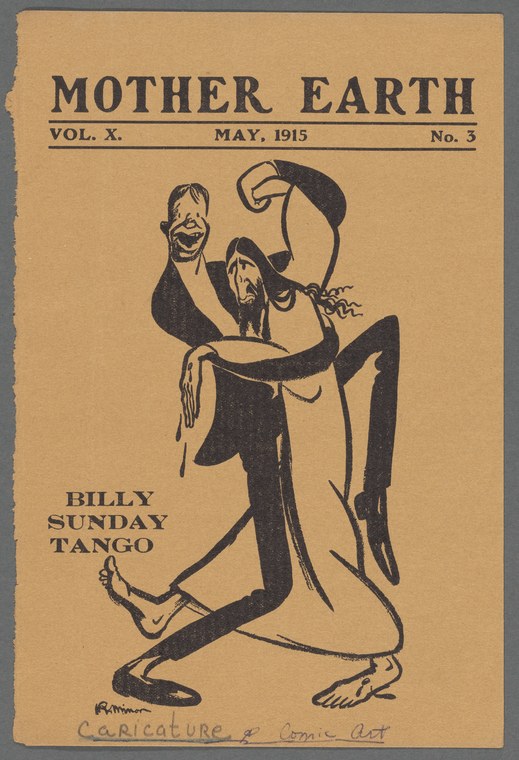
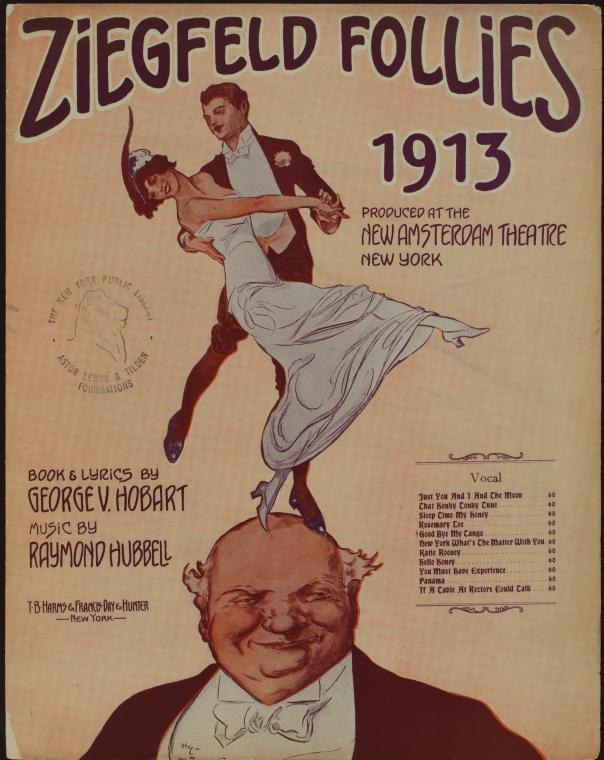
Good-bye my tango : (New York what's the matter with you)
Unknown artist
- Medium:
- Illustration
- Dance:
- Tango
- Era:
- 1900-1920 (Ragtime/Early Jazz)
- Source:
- New York Public Library
- Rights:
- Public domain — free to use, share and adapt.
- Recorded as:
- public_domain
This work is essential for understanding how avant-garde and exotic dances were absorbed into American popular culture in the early 20th century. It reveals that the "tango craze" experienced by New York audiences was often a theatrical fiction, a repackaged spectacle rather than authentic cultural transmission. For dance historians, it illustrates the gap between how dances are performed in their originating contexts and how they are marketed and experienced in commercial entertainment.
What you are looking at
This is a cover illustration for the Ziegfeld Follies of 1913, a theatrical revue produced at the New Amsterdam Theatre in New York. The composition is divided into two registers: the upper half shows a dancing couple in mid-performance, while the lower half displays a caricatured face of a man in formal dress looking directly outward. The dancer in the upper scene is a man in a dark suit and white shirt who supports a woman in a flowing white gown; her body is dramatically arched and tilted, her weight supported entirely by her partner. The woman's pose is one of theatrical abandon—her torso reclines at a steep angle, one leg extended, her fabric billowing around the pair in a way that emphasizes the dynamism of the moment. The upper couple occupies the space with theatrical vigor, the man's posture taut and controlled while the woman appears weightless. The cover is printed in rich burgundy and cream tones on aged paper, with bold lettering at the top announcing the production and credits for the music and lyrics by George V. Hobart and Raymond Hubbell respectively.
The dancing
The dancing pair shows a close partnered embrace with the man providing strong support from behind and to the side, his arm cradling the woman's torso as she leans dramatically backward in an inverted arch. This is not a standard ballroom closed position; instead, the woman is nearly horizontal, demonstrating extreme flexibility and trust in her partner's strength. The man's frame is vertical and solid, his legs firmly planted, while the woman's body forms a curved line from shoulder to knee. The theatrical nature of the pose—almost acrobatic in its daring—suggests a performance designed to astonish rather than execute technical precision in any conventional dance form.
The dance depicted
The image is titled "Good-bye my tango" yet the depicted movement contradicts standard tango technique and aesthetic. While the catalogue record identifies this as tango, the pose is more aligned with theatrical dip and lift vocabularies common in vaudeville and early Broadway performance than with Argentine or ballroom tango's characteristic closed position and Cuban motion. The woman's extreme arch and near-horizontal recline suggest the spectacle of early 20th-century American musical theater, where exotic dances like the tango were often reimagined for entertainment effect. The subtitle "New York what's the matter with you" hints at this being a satirical or comedic number about fashionable dance crazes. The work represents how tango—which arrived in New York during this exact period—was rapidly absorbed, sensationalized, and repackaged by Broadway producers for audiences unfamiliar with the actual dance.
How it was made
This is a color lithograph or chromolithographic print, a process that allowed for bold color separation and mass production of theatrical promotional materials. The technique's capability for rich, saturated tones in burgundy and cream, combined with crisp black typography, made it ideal for cover art that would attract attention from a distance. The aging of the paper to a warm tan suggests this is an original or early printing from the 1913 production run. Lithographic printing was the dominant method for theatrical poster and cover art of this era, enabling affordable distribution to theaters, newspapers, and theaters across the country, making this type of image a primary vehicle for shaping public taste in popular entertainment.
About this work
This is a promotional cover for the Ziegfeld Follies of 1913, one of the most celebrated theatrical revue series of the early 20th century. The image captures how the tango—a South American dance that had only recently arrived in New York—was being sensationalized and reinvented for Broadway audiences through exaggerated partnering and theatrical spectacle rather than authentic technique. The composition juxtaposes performance energy above with theatrical character work below, reflecting the Follies' signature blend of dance, comedy, and visual design. As an artifact of popular entertainment at a moment when tango mania was sweeping through American culture, it documents not the dance itself but how Broadway consumed and transformed it.
How to look at it
Attend to the physical impossibility of the woman's position and what it tells you about theatrical values of the period. The extreme arch and near-horizontal recline were not part of tango vocabulary; they were borrowed from acrobatic and vaudeville traditions, designed to generate gasps from the audience. Notice also the rigid verticality of the man's posture—he is a scaffold, not a dance partner. The caricatured face below, grinning at the spectacle above, suggests the number itself may have been comedic, mocking New York's tango obsession rather than celebrating the dance itself. The title's plaintive "Good-bye my tango" combined with the subtitle's sarcastic question creates a double meaning that rewards close attention to the image's satirical intent.
The artist
The artist is not recorded. The image credits George V. Hobart for the book and lyrics and Raymond Hubbell for the music, but the illustrator remains unidentified. This was common for theatrical cover art of the period, where illustrators worked anonymously within the machinery of theatrical production. The work was likely created by a house artist for the Ziegfeld organization or a commercial lithographic firm working from art direction provided by the producers.
The period
The years 1910–1915 saw the tango sweep through American urban culture with astonishing speed and controversy. The dance arrived from Argentina via Paris and was quickly embraced by New York's fashionable classes while simultaneously condemned by moralists who found its close position and hip motion scandalous. Broadway capitalized on this dual fascination with both the exotic allure and the social transgression of the dance, incorporating tango numbers into revues and musical comedies. The Ziegfeld Follies, which debuted in 1907, was the premier venue for showcasing these fashionable dances, and by 1913 the tango had become standard repertory. However, the theatrical versions bore little resemblance to the authentic dance form; they were designed for spectacle, visual novelty, and comedic effect rather than genuine cultural preservation.
Where it lives
This cover comes from the New York Public Library collection and is identified as an illustration from the Ziegfeld Follies of 1913. It functioned as a promotional and souvenir object, distributed to publicize the production and sold to audiences as a memento of the show. Such covers were printed in runs of hundreds or thousands, making them relatively common survivors from this theatrical era.
Dance in this work
Questions about this work
Is this actually a tango?
Not by any standard definition of the dance. The pose—with the woman nearly horizontal and the man providing vertical support—belongs to vaudeville and theatrical dipping traditions, not to tango technique. The title may be ironic or the image may be misidentified in the catalogue record. What we see is how Broadway reimagined the tango for maximum visual spectacle rather than authentic performance of the form itself.
Why was tango so controversial in 1913 America?
The tango arrived from Argentina with a reputation for sensuality and sexual suggestiveness rooted in its origins in working-class dance halls. The close partner hold and hip movement scandalized American moralists and clergy, leading to bans in some cities and condemnation from the pulpit. Yet the same provocative reputation made it irresistible to Broadway producers and urban audiences seeking novelty and transgression.
What are the credits telling us?
The names listed—George V. Hobart for the book and lyrics, Raymond Hubbell for the music—are the creative team for this particular number, not the entire Follies production. This suggests that 'Good-bye my tango' was likely one song or sketch within the larger revue, given its own composer and lyricist rather than drawing from the general score.
Who made this cover?
The illustrator is unrecorded. Theatrical cover art of this era was typically produced by commercial lithographic firms or house artists working under art direction from producers. Attribution was rarely given to illustrators, who worked as part of the production machinery rather than as recognized individual artists.
More Tango artwork
![[Les noces de trottoir, par les compagnies Tango Sumo et Vendaval. Chalon dans la rue. 2007 / photographies de Joël Verhoustraeten] by Verhoustraeten, Joël (1954-2019). Photographe](https://gallica.bnf.fr/iiif/ark:/12148/bc6p058zgkc/f1/full/800,/0/native.jpg)