25 works in this view — arrow keys or swipe to move between them.
Dance in Art · 2023
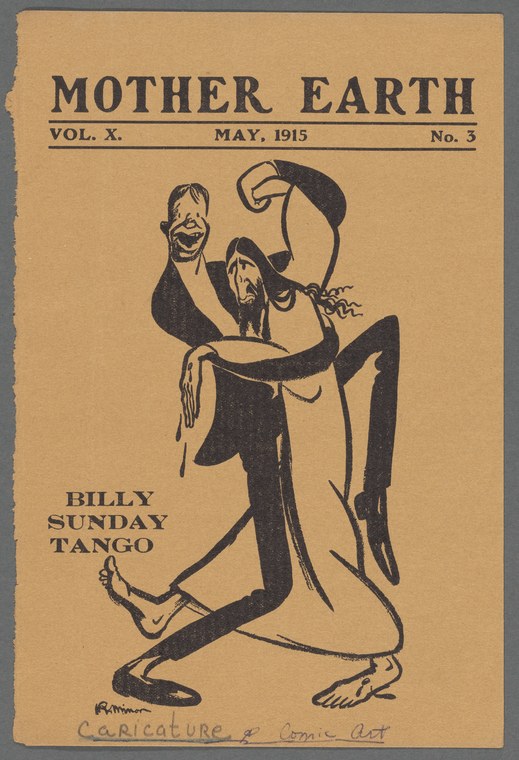
Billy Sunday tango
Unknown artist
- Medium:
- Illustration
- Dance:
- Tango
- Era:
- 1900-1920 (Ragtime/Early Jazz)
- Source:
- New York Public Library
- Rights:
- Public domain — free to use, share and adapt.
- Recorded as:
- public_domain
This image captures a crucial moment when the tango was at the center of American culture wars—condemned by churches, parents, and civic authorities as immoral and foreign, yet adopted eagerly by young Americans seeking modernity and transgression. The fact that a radical arts magazine would mock the dance alongside its target (Sunday) reveals the complex ideological landscape of 1910s America, where the left did not automatically celebrate all cultural rebellion. The image is evidence of how dance history intersects with religious history, immigrant experience, and debates about body, propriety, and American identity.
What you are looking at
A caricature illustration shows two grotesquely exaggerated male heads and shoulders emerging from or attached to a single elongated, contorted body in motion. The figure leans dramatically backward in an impossible arch, with one leg extended upward and the other bent, while one arm reaches upward with fingers splayed. The body is rendered as a continuous sinuous line suggesting rapid movement or elastic distortion. The two heads have prominent, bulbous noses and gap-toothed grins, drawn in a crude, satirical style typical of early 20th-century American comic illustration. The figure is rendered entirely in bold black lines against the tan paper, with minimal modeling or shading—a direct, emphatic drawing style suited to newsprint reproduction.
The dancing
A single grotesquely caricatured figure with two heads occupies the entire composition. The body is impossibly contorted in a deep backward arch (hyperextension), the pelvis thrust forward and the upper spine bent acutely. One leg kicks upward nearly to the level of the heads; the other is bent beneath. The raised arm reaches overhead with splayed fingers in an exaggerated, uncontrolled gesture. The posture conveys instability, abandon, and physical exaggeration—the opposite of the controlled, elegant frame of ballroom dance.
The dance depicted
This is a satirical caricature, not a depiction of actual dance technique. The title 'Billy Sunday Tango' is a pun: Billy Sunday was a famous American evangelical preacher and former baseball player of the 1910s, known for his histrionic, high-energy revivals. The image conflates the tango—a sensual, close-partnered Latin dance that scandalized American society in this period—with Sunday's own physical theatricality and moral opposition to 'worldly' dances. The grotesque, two-headed figure suggests the duet nature of the tango while the impossible postures mock both the dance's flamboyance and Sunday's own exaggerated evangelical style. This is political/cultural satire, not dance documentation.
How it was made
A pen-and-ink illustration, likely drawn on paper and reproduced in *Mother Earth*, a monthly anarchist and radical arts magazine published in New York. The bold, unmodulated line work and high contrast are characteristic of woodcut-derived printing and were designed for cheap newspaper and magazine reproduction. The style derives from vaudeville caricature and anarchist-era satirical cartooning. The technique allowed rapid, legible social commentary for a mass audience—this image was meant to be seen and understood quickly by magazine readers familiar with both Billy Sunday and contemporary dance crazes.
About this work
This is a cartoon satire published in *Mother Earth* magazine in May 1915, conflating the tango—a dance that shocked American mainstream society—with the theatrical evangelical revivals of preacher Billy Sunday. The grotesque two-headed figure in an impossible contorted pose mocks both the sensuality and bodily exaggeration of the dance and Sunday's own bombastic style. It is neither a naturalistic dance image nor an instruction in technique, but rather a weapon of social critique, using caricature and bodily distortion to ridicule both a dance and a public figure. The work sits at the intersection of dance history, American religious culture, and radical satire of the 1910s.
How to look at it
Attend to the posture: the backward arch and raised leg are drawn to be physically impossible and grotesque, not graceful. The two-headed figure is the visual pun—in ballroom dance, partners are two bodies in one frame; here they are literally fused. The gap-toothed, wide-grinned expressions are drawn in the tradition of blackface minstrelsy caricature (a vocabulary of racist satire that pervaded American comics of this era), indicating contempt for the subject. The exaggerated, flailing arm and the total loss of control suggested by the posture mock the tango as loss of reason and propriety—exactly the charge leveled at the dance by its opponents.
The artist
Unknown. The signature appears to read 'Rainer' but this cannot be confirmed from available records. The work is representative of early 20th-century American satirical cartooning—a vigorous tradition in anarchist, socialist, and radical publications that employed exaggeration, grotesquerie, and wordplay to target public figures and cultural phenomena.
The period
The tango arrived in New York and Paris from Argentina around 1912 and became a sensation among young urban dancers, particularly in cabarets and dance halls. American establishment institutions—churches, civic leagues, newspapers—condemned it as obscene, primitive, and a corrupting foreign influence. Billy Sunday himself was at the height of his influence as a revivalist preacher in the 1910s, famous for acrobatic, theatrical sermons that drew enormous crowds. The dance's emergence alongside Sunday's celebrity created opportunities for satirists to expose the hypocrisy of those who condemned the tango's bodily passion while celebrating Sunday's own theatrical exaggeration.
Where it lives
*Mother Earth* magazine was founded in 1906 by Emma Goldman and Alexander Berkman and published radical literature, art criticism, and cultural commentary until 1917. This illustration appeared in Vol. X, No. 3 (May 1915). The magazine is held by the New York Public Library and other major archives and is partially digitized.
Questions about this work
Was Billy Sunday a dancer?
No. Sunday (1862–1935) was an American evangelist and revivalist preacher famous for wildly theatrical sermons in which he would leap, contort his body, and act out biblical scenes to enthrall audiences of thousands. He was also a former professional baseball player. He strenuously opposed modern social dances including the tango as sinful.
Why was the tango controversial in America?
The tango arrived from Argentina around 1912 and shocked American society. It was danced in close embrace, with provocative hip motion and sensual body contact. Churches, civic organizations, and newspapers condemned it as primitive, sexually improper, and a corrupting immigrant influence. Some cities and institutions banned it or attempted to restrict access to dance halls where it was performed.
What does 'Mother Earth' magazine have to do with dance?
Mother Earth (1906–1917) was an anarchist and radical arts publication edited by Emma Goldman. While primarily focused on political and cultural critique, it published illustrations, reviews, and commentary on contemporary culture, including the sexual and social dimensions of modern dance crazes. This image is one of several dance-related works that appeared in the magazine.
Is this a real tango step?
No. The posture is deliberately impossible and grotesque—a caricature designed to mock the dance as uncontrolled, unseemly, and ridiculous. A real tango is danced in a controlled closed embrace with precise footwork and hip action. This image distorts the dance beyond recognition to serve its satirical purpose.
More Tango artwork
![[Les noces de trottoir, par les compagnies Tango Sumo et Vendaval. Chalon dans la rue. 2007 / photographies de Joël Verhoustraeten] by Verhoustraeten, Joël (1954-2019). Photographe](https://gallica.bnf.fr/iiif/ark:/12148/bc6p058zgkc/f1/full/800,/0/native.jpg)