25 works in this view — arrow keys or swipe to move between them.
Dance in Art · 1917
Tango, RP-T-1983-58-A-1
Unknown (Rijksmuseum collection)
- Medium:
- Ink
- Dance:
- Tango
- Era:
- 1900-1920 (Ragtime/Early Jazz)
- Source:
- Wikimedia Commons
- Rights:
- Public domain — free to use, share and adapt.
- Recorded as:
- CC0
This sketch provides rare visual evidence of how tango was actually danced and held in the ballrooms of Europe in the 1910s, before it became codified into standardized competitive forms. The artist's attention to the closed frame, the woman's emotional surrender, and the man's confident lead reveals the dance's identity as intimate, improvisational, and emotionally charged—qualities that made it controversial and thrilling to contemporary audiences. For dance historians, it documents a moment when tango was still a living social practice rather than a staged spectacle.
What you are looking at
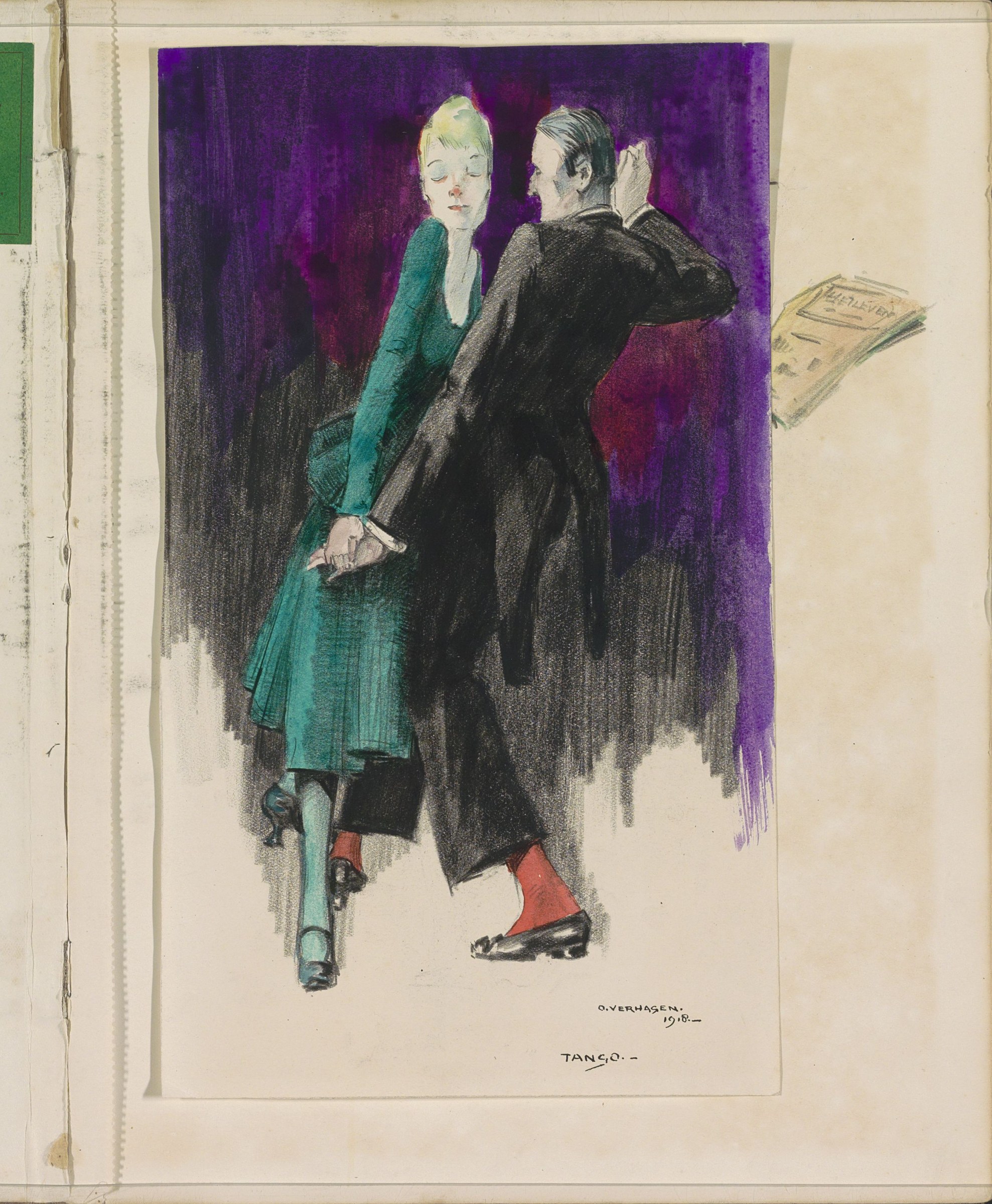
A man and woman are depicted mid-dance against a dramatic purple background. The woman, positioned on the left with pale blonde hair and closed eyes, wears a teal-green dress with long sleeves and a pleated skirt that falls below the knee. The man, seen from behind on the right, wears a dark suit jacket with visible red socks and dark shoes. His right hand is raised to his head in a characteristic pose. The two figures are closely positioned, suggesting an intimate dance hold. The background is rendered in deep purple and violet tones with loose, gestural brushwork that creates an almost expressionistic mood. A small sketchbook or magazine is visible in the upper right corner of the composition.
The dancing
The couple occupies a close frame typical of partnered ballroom dance. The woman's body is relaxed, her eyes closed in an expression of concentration or abandon, while the man's upright posture and raised hand suggest a leading role. Their proximity and the man's hand position indicate a chest-to-hip contact hold. The woman's weight appears to be supported by the partnership; her posture is slightly back-leaning. The artist has captured a moment of movement rather than a static pose, with the sense of forward motion and turn evident in their relative positioning.
The dance depicted
This is Argentine Tango, identified by the title annotation and the stylistic elements visible in the image. The close embrace, the man's characteristic raised hand (either preparing for a turn or a styling gesture), and the intimate, sensual positioning between the dancers are hallmarks of tango. The couple's formal dress and the mood of concentration suggest a social ballroom context rather than a performance. The woman's closed eyes and the overall emotional tenor convey the introspective, passionate quality associated with tango dancing in the early twentieth century.
How it was made
The work is executed in mixed media on paper—pencil, colored pencil, black chalk, and brush in colors, according to the catalogue record. The technique combines linear drawing with bold color application, particularly the saturated purples that dominate the background. This hybrid approach allows the artist to build form and volume through line while using color expressionistically to evoke mood rather than describe a literal environment. The sketchy, unfinished quality of the background suggests this is a preliminary study or sketch, likely from an artist's sketchbook, which would have circulated among a limited audience of collectors, other artists, and dance enthusiasts.
About this work
This is a sketch of a tango couple, rendered by Dutch artist Otto Verhagen circa 1917–1919 and extracted from a larger sketchbook. The work captures the essence of early twentieth-century ballroom tango—a relatively new dance in Europe at the time—through an intimate portrait of two dancers in close embrace. The expressive background and the artist's focus on the psychological and physical intensity of the moment reflect early modernist approaches to depicting movement and emotion. Verhagen's sketch documents not just a dance pose but the cultural fascination with tango as a symbol of modernity, passion, and social transgression in the years following its arrival in Europe from Argentina.
How to look at it
Attend first to the closed frame and the intimacy it conveys—this is the defining feature of tango, which distinguishes it from other ballroom dances of the period with their more open, presentational positioning. Notice the woman's surrendered posture and closed eyes: this expresses the emotional vulnerability and trust that characterize the tango partnership. The artist's choice to show the man from behind is deliberate; it positions the viewer in the woman's perspective and emphasizes the man's role as leader. Finally, observe how the expressionistic purple background isolates the couple and intensifies the emotional charge of the moment—the setting is interior and intimate rather than public and theatrical.
The artist
Otto Verhagen (I) was a Dutch artist working in the early twentieth century. The sketchbook from which this drawing was extracted (RP-T-1983-58-A-1) comprises 28 leaves and appears to have been used for studies of figures, dancers, and social scenes. Verhagen's practice involved rapid, expressive drawing in mixed media, capturing movement and social interaction with an eye for both anatomical accuracy and emotional atmosphere. His work reflects the modernist interest in contemporary life and leisure—particularly the new dance forms and social practices emerging in European urban culture.
The period
Tango arrived in Europe from Argentina around 1910 and rapidly became the dominant dance craze of the 1910s and 1920s, particularly in Paris, Berlin, and Vienna. Initially viewed as scandalous due to its close hold and sexual energy, tango was gradually adopted by respectable society and became a symbol of modernity and cosmopolitan sophistication. In art, this period saw growing interest in depicting contemporary life and social interaction, with dancers and ballroom scenes becoming popular subjects. Verhagen's sketch aligns with the broader modernist project of capturing movement, emotion, and the energy of modern urban leisure.
Where it lives
This sketch was held as part of the Rijksmuseum collection in Amsterdam (accession RP-T-1983-58-A-1) and is catalogued as a loose leaf extracted from a bound sketchbook of 28 leaves. It is a preliminary study, not a finished work intended for exhibition, which explains its modest scale and sketch-like qualities.
Dance in this work
Questions about this work
How do you know this is tango and not another ballroom dance?
The title annotation reads 'TANGO.-' and the visual elements confirm it: the close chest-to-hip embrace, the man's raised hand (used for styling and lead signals in tango), and the emotional intensity of the pose are all characteristic of tango rather than other ballroom dances of the period, which typically maintained more open frames.
Why did the artist draw the man from behind?
Showing the man's back serves multiple purposes: it allows us to see the woman's face and emotional response more clearly, it positions the viewer in her perspective as the led dancer, and it emphasizes the traditional gender roles of the tango partnership. This compositional choice tells us something about how tango was understood—as an intimate, hierarchical partnership rather than an equal exchange.
What does the purple background mean?
The saturated purple is likely representational—ballroom interiors of the period were often dimly lit and decorated in rich, jewel-toned colors. However, the expressionistic handling of the background also conveys mood: the loose, gestural brushwork suggests movement, passion, and the sensual atmosphere of a ballroom rather than a literal description of a specific place.
Is this a finished artwork or a study?
This is a sketch extracted from an artist's sketchbook, intended as a preliminary study rather than a finished, exhibition-ready work. The mixed media technique and sketch-like quality of the background indicate its function as a working drawing to explore a pose, gesture, or idea quickly.
More Tango artwork
![[Les noces de trottoir, par les compagnies Tango Sumo et Vendaval. Chalon dans la rue. 2007 / photographies de Joël Verhoustraeten] by Verhoustraeten, Joël (1954-2019). Photographe](https://gallica.bnf.fr/iiif/ark:/12148/bc6p058zgkc/f1/full/800,/0/native.jpg)