25 works in this view — arrow keys or swipe to move between them.
Dance in Art · 1921
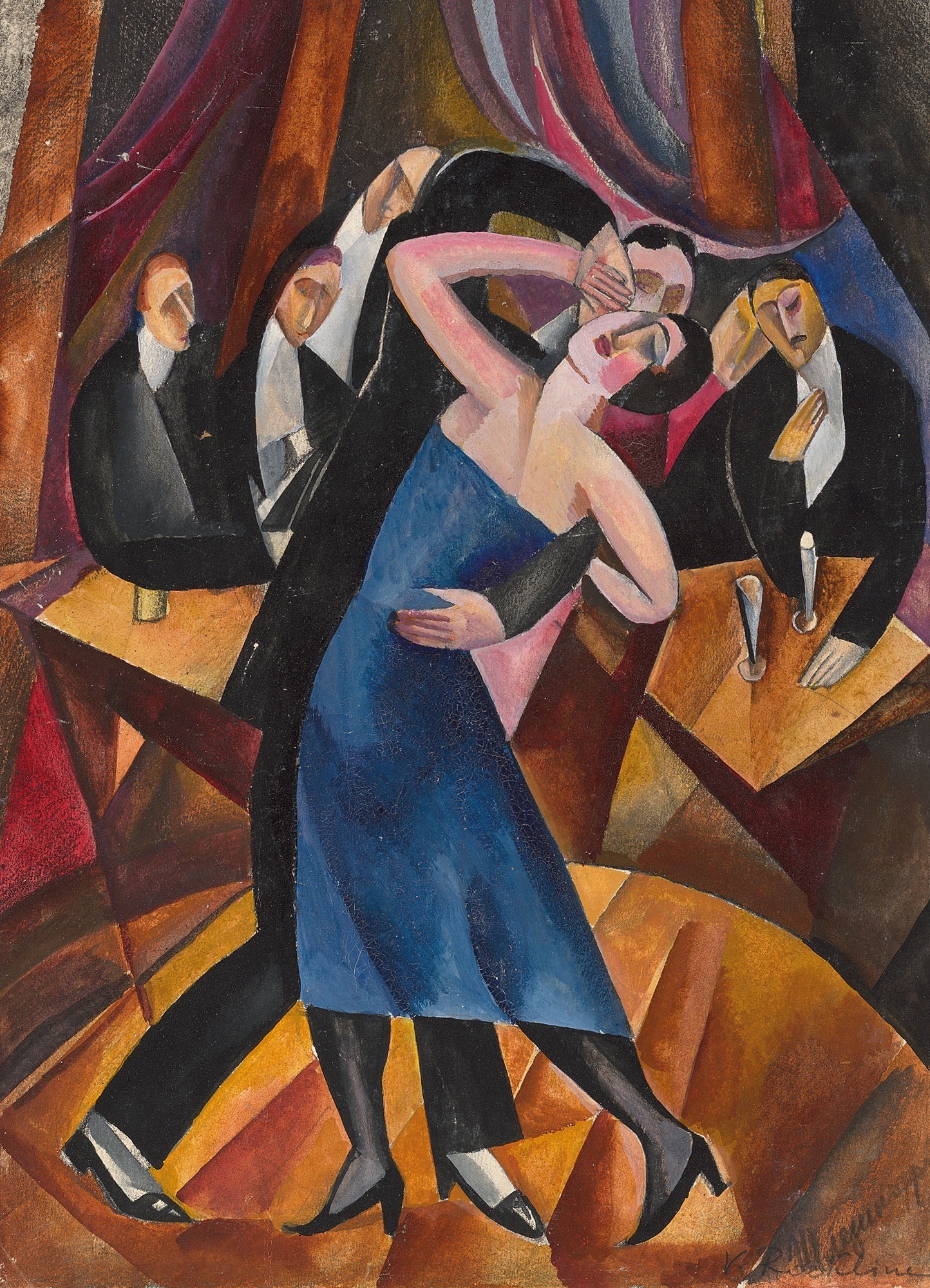
Vera Rockline Danseurs de Tango ca 1919-21
Vera Rockline (1896 - 1934)
- Medium:
- Watercolor
- Dance:
- Tango
- Era:
- 1920-1950 (Swing Era)
- Source:
- Wikimedia Commons
- Rights:
- Public domain — free to use, share and adapt.
- Recorded as:
- Public Domain
This image captures tango at a precise historical moment—after its arrival in Europe but before it became fully domesticated into ballroom competition. The artist has understood the essential lines and energy of the embrace, rendering it with enough specificity that the work functions as both artwork and dance documentation. It shows how modernist artists of the 1920s saw tango not as a folk form but as a sophisticated, urban, and inherently theatrical practice.
What you are looking at
A tango couple dominates the center of the composition, locked in an intimate embrace characteristic of the dance. The woman, in a fitted blue dress, arches backward with her head tilted up and arm extended, while the man in dark formal dress bends into her, their bodies forming a close diagonal line. Around them, five onlookers in evening dress—three men and two women in formal black and white—watch from the periphery, their faces and postures expressing fascination and approval. The setting is theatrical: rich, heavy drapery in burgundy, orange, and brown hangs behind the dancers, and the floor is composed of geometric blocks in warm ochres and reds. The whole scene is rendered in watercolor and gouache with a modernist sensibility, flattening forms and emphasizing the bold geometry of the architectural space and the drapery. The lighting is cool and even, with no single source, creating the effect of a studio or stage moment captured outside of narrative time.
The dancing
The lead dancer's body weight is fully committed to the forward motion of the embrace, with his frame vertical and controlled. The follower's upper body is arched in a pronounced back-lean, a signature tango posture, while her free arm extends gracefully. The couple stands in a true closed position—chest to chest, hips aligned—with no visible separation. The onlookers are rendered as simplified heads and torsos, deliberately less detailed than the couple, which emphasizes the hierarchy of attention. Their stillness and direct gaze underscore the performative nature of the moment.
The dance depicted
This is Argentine tango, one of the most iconic social dances of the early 20th century. The back-lean arch of the follower, the tight embrace (known as the abrazo), and the formal evening dress of both dancers are definitive markers of this style. The work captures not a street dance or social club scene, but a moment of performance or exhibition—the theatrical version of tango that was gaining currency in European art circles in the 1920s. Tango had crossed from Buenos Aires to Paris and beyond by 1919, and by this date it was both a respectable ballroom dance and a subject of high modernist artistic interest.
How it was made
The work is executed in watercolor, gouache, and pencil on paper, a medium well suited to the flattened, graphic approach the artist has adopted. Watercolor's transparency allows the artist to build color relationships—the cool blues and blacks of the dancers' dress sing against the warm, energetic background—while gouache provides opacity for strong color statements. The combination of translucent and opaque media, along with the visible pencil drawing underneath, gives the work a sketch-like immediacy despite its careful composition. This technique was typical of modern art illustration and stage design studies of the 1920s, suggesting an audience familiar with contemporary theatrical practice.
About this work
This watercolor depicts a moment of tango performance witnessed by an intimate audience, capturing the dance at the moment of its European celebrity. The artist has rendered the embrace and posture with anatomical understanding while subordinating naturalism to a bold modernist design of geometric space and dramatic color. The work sits at the intersection of dance documentation and modernist art practice—it is both a record of how tango was danced and performed in the early 1920s and a formal exploration of the human figure in space. For historians of dance in art, it is valuable evidence of how European artists of the period perceived and represented this newly fashionable form.
How to look at it
Attend first to the geometry of the embrace: the artist has captured the essential line of the tango posture—the forward lean of the leader's torso meeting the backward arch of the follower. Note how the couple's bodies form a closed, self-contained unit, while the onlookers frame them without intruding. Look at how the drapery and floor tiles create a stage-like space that is abstractly patterned rather than illusionistically rendered; the artist is interested in composition and color relationship as much as in dance representation. The woman's head and the extension of her free arm are the emotional and formal climax of the image.
The artist
Vera Rockline (1896–1934) was a painter and illustrator active in early 20th-century European modernism. She worked in watercolor and gouache, often depicting theatrical and social subjects with a bold, flattened modernist aesthetic. Her career was cut short by her early death at age 38. The present work is characteristic of her practice: a sharp eye for contemporary life, a graphic sensibility indebted to cubism and expressionism, and a particular interest in performance and spectacle.
The period
Tango arrived in Europe from Argentina in the years around 1910–1912 and underwent a rapid transformation from disreputable cabaret dance to respectable (if still slightly dangerous) social and ballroom form. By the 1920s, it had become a standard fixture of high society balls and the subject of intense artistic interest. Modernist artists were drawn to its formal properties—the tight embrace, the dramatic body line, the contrast of stillness and explosive movement—and to its associations with modernity, sexuality, and urban life. In the same decade, dance had become a major subject for painters influenced by cubism, futurism, and expressionism: works by artists like Jean Cocteau, Pablo Picasso, and others show dancers flattened, fragmented, and recomposed according to modernist principles. Rockline's approach situates her within this international conversation.
Where it lives
The work is known through Wikimedia Commons, which does not specify a holding institution. The catalogue record lists it as watercolor on paper, with dimensions 34.8 × 25.2 cm.
Dance in this work
Questions about this work
How do we know this is tango and not another ballroom dance?
The characteristic postures are unmistakable: the close embrace (abrazo) with the leader's frame vertical and the follower's upper body in a pronounced back-lean. This back-lean is central to tango technique and is not a feature of other ballroom dances of the period. The formal evening dress and the intimate proximity of the couple also accord with how tango was performed and represented in the 1920s.
Why are the onlookers rendered so much less clearly than the dancers?
The simplification of the background figures emphasizes the couple as the focal point and conveys a modernist aesthetic in which form and composition matter more than narrative detail. This compression of space and hierarchy of figuration was a standard strategy in early 20th-century painting. It also underscores the performative nature of the scene: the dancers are on display, while the onlookers are merely witnesses.
What does the theatrical setting tell us about how tango was understood at this date?
The rich drapery, controlled lighting, and geometric floor suggest a stage or studio rather than a ballroom or street. This reflects the reality that by 1921, tango was not only a social dance but also a subject of artistic performance and exhibition. The artist captures it as spectacle, not as everyday social practice.
Is this a record of a specific performance or a generalized scene?
Nothing in the image or catalogue record identifies a specific event or performers. The work is best understood as a modernist artistic interpretation of tango as a cultural phenomenon, combining observation of real dance practice with formal invention.
More Tango artwork
![[Les noces de trottoir, par les compagnies Tango Sumo et Vendaval. Chalon dans la rue. 2007 / photographies de Joël Verhoustraeten] by Verhoustraeten, Joël (1954-2019). Photographe](https://gallica.bnf.fr/iiif/ark:/12148/bc6p058zgkc/f1/full/800,/0/native.jpg)