49 works in this view — arrow keys or swipe to move between them.
Dance in Art · 2008
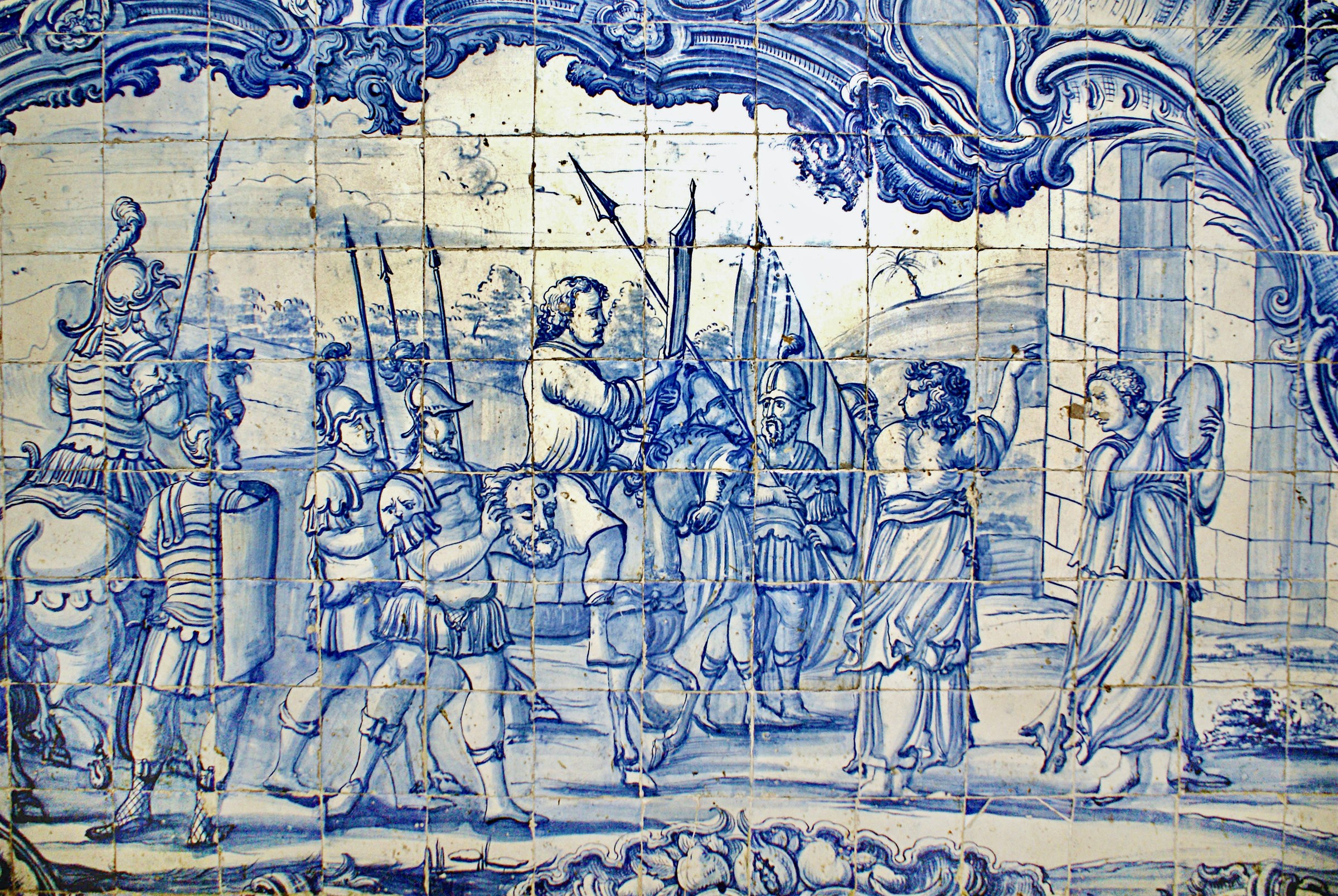
Triunfo de David
IconografiaMusical
- Medium:
- Oil Painting
- Source:
- Wikimedia Commons
- Rights:
- Public domain — free to use, share and adapt.
- Recorded as:
- Public Domain
This work matters because it documents the visual vocabulary of Baroque ceremony and hierarchy that informed how artists depicted courtly and theatrical spectacle—including dance—during the 17th and 18th centuries. The rigid formal positioning, the heraldic standards, and the architectural framing all show how authority and ritual were visualized in the period when Baroque court dance was at its height.
What you are looking at
This is a hand-painted tile panel (azulejo) depicting a biblical scene, rendered in the characteristic cobalt blue and cream palette of Portuguese Baroque tilework. The composition is divided by a grid of individual tiles that create a monumental narrative scene set within a palatial or fortified courtyard. At center stage stands a figure in classical military dress—plumed helmet, cuirass, and draped garments—surrounded by armed attendants bearing lances and flags. The figure appears to be David, recognizable by the heraldic iconography and his position of authority. Soldiers flank him in formation, some holding pennants or standards. The architectural setting features a fortified gateway or tower to the right, while the sky opens to a distant landscape. The entire scene is framed by an ornate Baroque border of scrollwork and acanthus leaves in the same cobalt blue.
The dancing
The figures are rendered in profile or three-quarter view, standing upright in formal military posture rather than in active movement. The soldiers assume rigid, parade-ground positions with erect torsos and minimal weight shift; there is no swaying, flexion, or dance-like quality to their stance. The central figure gestures with authority—one arm raised or extended—while attendants cluster in asymmetrical but dignified formation around him. The bodies are volumetric and modeled with hatching and shadow; the drapery falls in Baroque folds that suggest fabric weight and formality rather than the buoyancy of a moving body.
The dance depicted
This scene does not depict dance. Although the work is catalogued under 'General Dance' in the source record, the image shows a formal military or courtly ceremony: the triumph or acclamation of David as king. The standing figures in rigid military formation, the heraldic standards, and the architectural setting all point to pageantry, ceremony, and martial ritual rather than any form of choreographed movement. The composition is processional and hierarchical—appropriate to a biblical narrative about conquest or coronation—but not balletic or danced.
How it was made
This is hand-painted tin-glazed earthenware (azulejo), a signature Portuguese Baroque technique in which individual tiles were painted with cobalt oxide under a transparent glaze, then fired. The tiles were assembled into large narrative panels, with the grid lines of the tile work becoming part of the compositional structure. This technique allowed for large-scale wall decoration in domestic and institutional interiors and suggests a work commissioned for a major building—in this case, the catalogue identifies it as originally from the Colégio dos Meninos Órfãos (Orphans' College) in Lisbon. The method was labor-intensive but durable, suited to institutional and religious contexts.
About this work
This is a Portuguese Baroque azulejo panel depicting the triumph of David, likely from the 18th century based on style. It comes from a series of biblical narrative tiles that decorated an educational institution in Lisbon. The work belongs in this archive not as a depiction of dance proper, but as evidence of how biblical narrative—and specifically scenes of military victory and courtly ceremony—were visualized in Baroque visual culture. The formal, procession-like arrangement of figures and the heraldic symbolism reflect conventions of court representation that influenced dance imagery of the same period, even though no dancing occurs here.
How to look at it
Attend to the rigid, frontal posturing of the figures and the way the tile grid imposes a formal, architectural order on the scene. The artist has chosen a moment of stillness and presentation rather than movement—this is a ceremony frozen in time, not a fleeting gesture. Notice how the heraldic standards and architectural backdrop create a frame of authority and power, typical of how Baroque artists visualized triumph and kingship. The individual tiles create a subtle pattern that emphasizes the monumental, institutional character of the work.
The artist
The catalogue lists the artist as 'IconografiaMusical,' which is not a known historical artist name but may be a modern cataloguing designation or a collector's mark. Portuguese azulejo production in the 17th–18th centuries was typically workshop-based and collaborative, with master painters supervising teams of artisans. Individual tiles were often painted by specialists, and the style of this work—competent, formal, and institutional—suggests a major workshop rather than a named master.
The period
This tile panel was made during the high period of Portuguese azulejo production, likely in the 18th century, when narrative biblical and courtly scenes were standard decoration for religious and educational institutions. In the same period, Baroque court dance—minuets, gavottes, courantes—was formalized at European courts, and artists across media were developing visual conventions for depicting courtly ceremony and authority. The rigid, processional arrangement of figures in this panel reflects the hierarchical world of Baroque court culture, even though the scene itself is narrative rather than choreographed.
Where it lives
The panel came from the Colégio dos Meninos Órfãos (Orphans' College) in Lisbon, a major educational institution. It is documented in the Wikimedia Commons as a Baroque azulejo panel; the current holding institution is not recorded.
Questions about this work
Is this actually a dance scene?
No. Although the source catalogue labels it 'General Dance,' the image shows a formal military or courtly ceremony—the triumph of David as king. The figures stand in rigid military formation with heraldic standards and architectural framing, not in any choreographed movement. It has been included in this archive because it documents the visual language of Baroque ceremony that influenced how artists depicted dance and courtly spectacle during the same period.
What are azulejos?
Azulejos are hand-painted tin-glazed ceramic tiles, a signature technique of Portuguese decorative arts. Individual tiles were painted with designs (often in cobalt blue), glazed, and fired, then assembled into large narrative panels for walls. The grid lines of the tiles became part of the compositional design. This technique allowed for large, durable narrative scenes in churches, palaces, and institutions.
Why is this in a dance gallery?
The work is included because it documents Baroque visual conventions for representing ceremony, authority, and courtly spectacle. The formal positioning, heraldic symbolism, and architectural framing all reflect the visual world in which Baroque court dance—minuets, gavottes, and formal processions—was performed and understood. Although this particular scene is not choreographed, it shows how bodies and hierarchy were visualized in the same period and context.
More dance artwork