49 works in this view — arrow keys or swipe to move between them.
Dance in Art
AFTER THE DANCE
Jean-Louis Forain
- Medium:
- Oil Painting
- Source:
- Wikimedia Commons
- Rights:
- Public domain — free to use, share and adapt.
- Recorded as:
- Public Domain
For historians of dance and gender, this image is invaluable evidence of how women were positioned in Gilded Age social dance—not as autonomous performers but as objects of male attention and conversation, their bodies on display in formal dress even when stationary. For art historians, it exemplifies the Impressionist interest in modern leisure and social performance, capturing a moment that other genres (such as academic history painting) would have overlooked or idealized.
What you are looking at
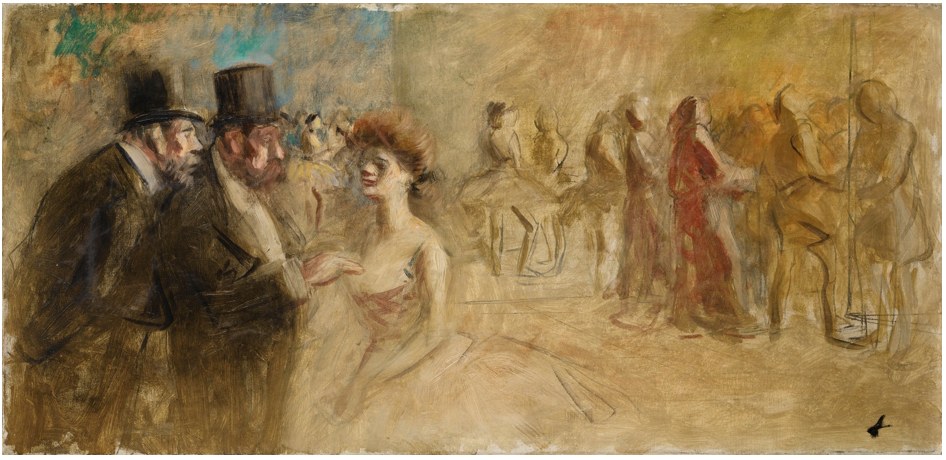
A social gathering in what appears to be a ballroom or theater foyer, captured mid-evening. In the foreground, two formally dressed men in top hats and dark coats converse with a seated woman in an elegant, low-cut pale gown—her bare shoulders and the drape of her dress suggest high fashion of the late 19th century. She appears animated, leaning forward in engagement. Behind them, the scene dissolves into a crowd of figures in evening dress: women in colored gowns (reds, golds, and earth tones), some standing in clusters, others in movement. The composition uses warm, muted tones—ochres, burnt siennas, and soft browns—with touches of blue-green in the upper register. The brushwork is loose and impressionistic, particularly in the background figures, which become increasingly sketchy toward the right edge, suggesting either the noise and movement of a crowded space or the artist's selective focus on the foreground conversation. The lighting is warm and ambient, typical of gaslit interiors of the period.
The dancing
The woman in the foreground sits in a relaxed posture, her torso turned slightly toward the standing men, her right arm raised in an open, conversational gesture. Her posture is receptive rather than balletic—there is no tension in the frame or formal alignment of the body. The two men flank her; the nearer one leans inward. In the background, figures stand and move in informal groupings; some appear to be in the act of walking or turning, but none display the rigid posture or unified alignment characteristic of a choreographed social dance. The overall impression is of social mingling rather than dancing proper.
The dance depicted
This work depicts a ball or soirée—a fashionable social event—rather than an active dance performance. The title *After the Dance* suggests a moment of rest or interlude between dances, when guests mingle and converse. The late 19th-century context and formal evening dress indicate this is salon society or the world of the theater and music halls. No specific dance style is visible because the figures are not dancing; they are socializing in the space where dancing occurred or will occur. The work captures the social rituals and courtship dynamics that surrounded dance in this period, not the dance itself.
How it was made
This is an oil painting executed in a loose, impressionistic style. The foreground is rendered with greater detail and finish, while the background dissolves into rapid brushstrokes and suggestive forms—a technique that economically conveys spatial recession and the busy atmosphere of a crowded room. The medium and technique allowed Forain to capture the transient, social nature of the scene with immediacy and spontaneity. Oil on canvas also permitted the warm, integrated palette and the flickering light effects typical of interior evening scenes of the period. The work circulated as a salon picture, part of the market for contemporary social observation aimed at educated, urban viewers.
About this work
This painting documents the social world surrounding dance in the Gilded Age—not the dance itself, but the flirtation, conversation, and hierarchy that structured fashionable evening life. Forain, a society illustrator and painter, made such scenes his specialty, treating the theater, the salon, and the ballroom as theaters of social performance. The work belongs in a gallery of dance in art because it shows how dance functioned as an event in society: a framework for encounter, display, and courtship rather than primarily an aesthetic experience. The painting is evidence that dance history includes not only the art of movement but the social choreography surrounding it.
How to look at it
Attend first to the title and the composition: the title tells us to read this as a moment *after* dancing, a pause or intermission. The brushwork invites you to contrast the sharply rendered foreground conversation with the sketched crowd behind it—a visual hierarchy that makes the social negotiation between the woman and the two men the interpretive center. Notice the woman's posture and facial expression: is she genuinely engaged, or is she performing engagement? The artist's loose handling of the background suggests the energy and noise of the ballroom persists just out of focus, reinforcing the sense of a fleeting social moment.
The artist
Jean-Louis Forain (1852–1931) was a French painter, illustrator, and printmaker who made a reputation as a sharp observer of Parisian social life. He worked frequently in theater, music hall, and ballroom settings, and his work appeared regularly in journals such as *Le Figaro*. Forain studied under Jean-Léon Gérôme and was influenced by the Impressionists, particularly Degas, though his style remained more linear and satirical. He was drawn to scenes of social encounter and moral ambiguity—the intersections of wealth, desire, and performance in modern Paris. His work often carried a note of critique beneath its surface elegance.
The period
This work dates to the late 19th century, a period when social dance was undergoing transformation. The waltz and quadrille remained central to ballroom culture, but the rise of the music hall and new dance forms (such as the can-can and later the tango) was reshaping attitudes toward dance and the body. The painting reflects a moment when the boundary between respectable salon dance and theatrical spectacle was becoming permeable. In art, Impressionism and its aftermath had made scenes of modern leisure and social performance a major subject; artists like Degas and Toulouse-Lautrec were similarly documenting the theater, the dance hall, and the salon. Forain's work sits at the intersection of Impressionist technique and social satire.
Where it lives
The work is sourced from Wikimedia Commons; no holding institution is recorded in the catalogue. It is a standard salon oil painting, the type that would have been exhibited at the Paris Salon or in commercial galleries during Forain's lifetime and would have appealed to wealthy collectors of contemporary social scenes.
Questions about this work
Is there actual dancing in this painting?
No. The title and composition indicate this is a moment between dances—a social interlude when guests mingle and converse. The work captures the rituals and courtship dynamics surrounding dance in Gilded Age society rather than the dance itself. This is nonetheless valuable for understanding how dance functioned in that world.
What does the woman's pose tell us?
Her relaxed, open posture and upturned face suggest attentiveness to the two men around her, but the painting's satirical tone (characteristic of Forain) may invite a skeptical reading: is she genuinely engaged or performing interest? Either way, she is positioned as an object of male attention rather than as an autonomous agent—evidence of gender dynamics in the ballroom.
Why is the background so loose and sketchy?
The contrast between the sharp foreground and the suggestive background is deliberate. It draws the viewer's eye to the social negotiation in the foreground while suggesting the busy, noisy atmosphere of the ball continuing around this intimate moment. The technique also conveys the fleeting, transient nature of social encounter.
More dance artwork