49 works in this view — arrow keys or swipe to move between them.
Dance in Art
Arolsen Klebeband 18 007 2
Unknown
- Medium:
- Ink
- Source:
- Wikimedia Commons
- Rights:
- Public domain — free to use, share and adapt.
- Recorded as:
- Public Domain
This work records the visual language of Northern European carnival and popular festive culture—the gestural chaos, costume inversion, and animal masquerade that characterized public celebration and satire before the modern era. For dance historians, it offers rare visual evidence of how movement and bodies were understood in folk and carnival contexts, where the rejection of formal order was itself the point. The print demonstrates how engraving as a medium enabled the circulation of satirical social commentary through images of the body in motion.
What you are looking at
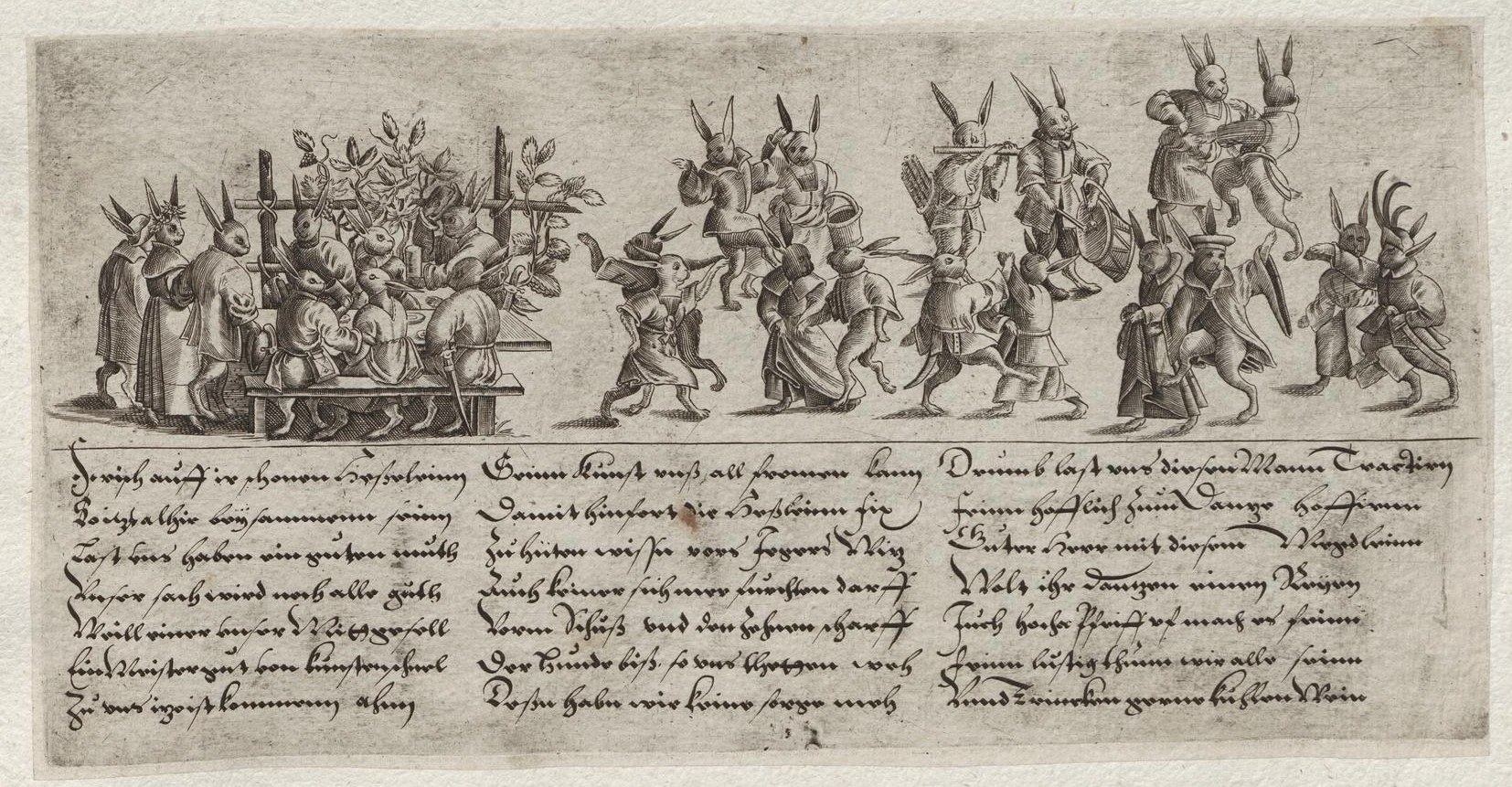
This engraving depicts an elaborate anthropomorphic satire in which hares dressed as humans perform a processional or celebratory dance and music-making. On the left, a group of hares in period costume gather around what appears to be a table or platform bearing plants or foliage; they wear doublets, cloaks, and feathered hats characteristic of early modern German dress. In the center and right, additional hares process or dance across the composition in various animated postures—some with arms raised, others bending or turning, all in exaggerated, comedic movement. The figures wear military dress, doublets, breeches, and plumed headpieces. The entire scene is populated by dozens of these anthropomorphic animals arranged in a frieze-like narrative sequence that unfolds across the print from left to right, suggesting a journey or procession. The engraving is accompanied by a substantial block of German cursive text below the image, indicating this is a narrative or satirical commentary on the scene.
The dancing
The hares are rendered in a caricatured human form: bipedal, wearing elaborate contemporary dress, and posed in dynamic, often contorted attitudes. Their limbs are thin and exaggerated, their bodies twisting in ways that emphasize the mockery of human pretension. Several figures have their arms raised above their heads or extended outward; others are bent forward or turned in mid-stride. The postures suggest both joyful celebration and absurdist parody. The density of figures—overlapping and varied in scale—creates a chaotic, carnival-like energy rather than the ordered geometry of formal courtly dance.
The dance depicted
This appears to be a German satirical print, likely from the 16th or early 17th century, depicting an anthropomorphic beast fable or Fastnachtsspiel (carnival play) scenario in which hares have taken on human roles and behaviors. The text references 'Haßelein' (little hares) and speaks of their newfound ability to outwit hunters through cunning—suggesting the dance and procession are a mock triumph or celebration of animal wisdom. This genre was popular in Northern European prints and played on the inversion of social hierarchy through animal masquerade. The movements shown are not formalized dance steps but rather the gestural chaos of carnival celebration, aligned with folk entertainment and popular mockery of authority rather than courtly or theatrical dance.
How it was made
This is an engraving or etching—a line-based intaglio print made by incising metal (likely copper) and inking the recessed lines to create an impression on paper. The technique is evident in the fine parallel hatching used to model forms and create tonal variation; the crisp, consistent line weight; and the dense composition packed onto a single plate. The medium allowed for mass reproduction and wide circulation at relatively low cost, making such prints ideal vehicles for satire and popular commentary. The combination of image and substantial explanatory text below indicates this was a broadsheet or single-leaf print intended for public sale and viewing.
About this work
This is a satirical engraving depicting anthropomorphic hares in human dress engaged in a riotous, processional celebration or dance. The work belongs to the German Renaissance or early modern tradition of carnival and animal satire prints—a popular genre for political and social mockery. The hares, rendered in exaggerated human postures and contemporary costume, are shown in movement that mixes carnival revelry, mock triumph, and absurdist humor. The accompanying German text frames the scene as a narrative about hares' newfound cunning against hunters, suggesting an inversion of natural hierarchy and social order typical of carnival performance. This print is a document of popular festive culture and visual satire rather than a record of actual dance practice.
How to look at it
Attend to the variety of postures and the overlapping, chaotic arrangement: this is not the ordered symmetry of courtly dance but the visual equivalent of noise and exuberance. Notice how the hares' limbs are distorted and exaggerated—spindly legs, twisted torsos, raised arms—to emphasize the mockery of human dignity and pretension. The progression from left to right through the composition suggests a narrative unfolding, a journey or procession rather than a fixed dance figure. Read the German text to understand the specific satire and its target; the image alone is intelligible as carnival chaos, but the caption anchors it to a particular social or political commentary about the hares' cunning.
The artist
Unknown. The print belongs to the tradition of German and Northern European satirical engravings of the 16th–17th centuries, a practice that flourished in cities like Nuremberg, Augsburg, and Frankfurt. Such prints were often anonymous or attributed only to the publisher-printer; they were produced for a broad popular market and frequently copied or imitated. The style and subject matter align with the workshop traditions of beast fable and carnival satire that produced thousands of prints over this period.
The period
This work dates to the era of the German Renaissance and Reformation, when printed satire—especially beast fables, carnival plays, and mockeries of clergy and nobility—flourished as a means of popular political and social expression. Carnival itself was a peak season for performance, inversion of hierarchy, and animal masquerade; these themes were captured and disseminated through prints. The engraving coincides with the height of the broadsheet and satirical print market in the Holy Roman Empire, when such images served as vehicles for humor, moral commentary, and subversive critique. Dance in this period remained largely a marker of social rank and courtly refinement; popular and carnival movement was caricatured and celebrated in satirical prints precisely because it inverted those norms.
Where it lives
The work is catalogued as part of the Arolsen Klebeband (scrapbook) 18 of the Fürstlich Waldecksche Hofbibliothek (Princely Waldeck Court Library) in Arolsen, Germany. Klebebände were bound collections of prints and drawings assembled over time; this particular volume has been digitized and the image made available through Wikimedia Commons. Such scrapbooks are valuable repositories of early printed ephemera and popular culture.
Questions about this work
Is this documenting an actual dance or festival?
The print is a satirical artwork, not a documentary record. However, it reflects real practices of carnival, festive performance, and animal masquerade that were central to Northern European popular culture in this period. The hares' antics allude to both carnival behavior and the hunting of hares—a common subject of satire—but the choreography and costumes are fantastical inventions designed to amuse and mock rather than to preserve an exact record of performance.
What is the German text about?
The text is a narrative poem or verse that explains and amplifies the satirical scene. It references the hares ('Haßelein') and appears to celebrate their cleverness in outsmarting hunters and other threats. The verse provides the frame and moral or humorous point of the image; together, text and image constitute a complete satirical commentary on animal wisdom, human folly, or social hierarchy.
Why anthropomorphic animals?
Animal masquerade and beast fables were stock conventions of European popular satire, carnival, and morality plays. By dressing animals as humans and showing them behaving like people, artists could mock social pretension, political authority, or moral hypocrisy without direct censure. The inversion of hierarchy—animals above humans, or animals aping human dignity—made these prints both funny and subversive.
What does this tell us about early modern dance?
The print reveals the contrast between courtly, formal dance (which is not shown here) and popular, festive, carnival movement. The exaggerated, chaotic postures emphasize the gulf between refined, rule-bound courtly movement and the anarchic energy of folk celebration. It also documents how bodies in motion were understood and represented in popular visual culture—as vehicles for humor, social commentary, and the inversion of order.
More dance artwork