49 works in this view — arrow keys or swipe to move between them.
Dance in Art · 2010
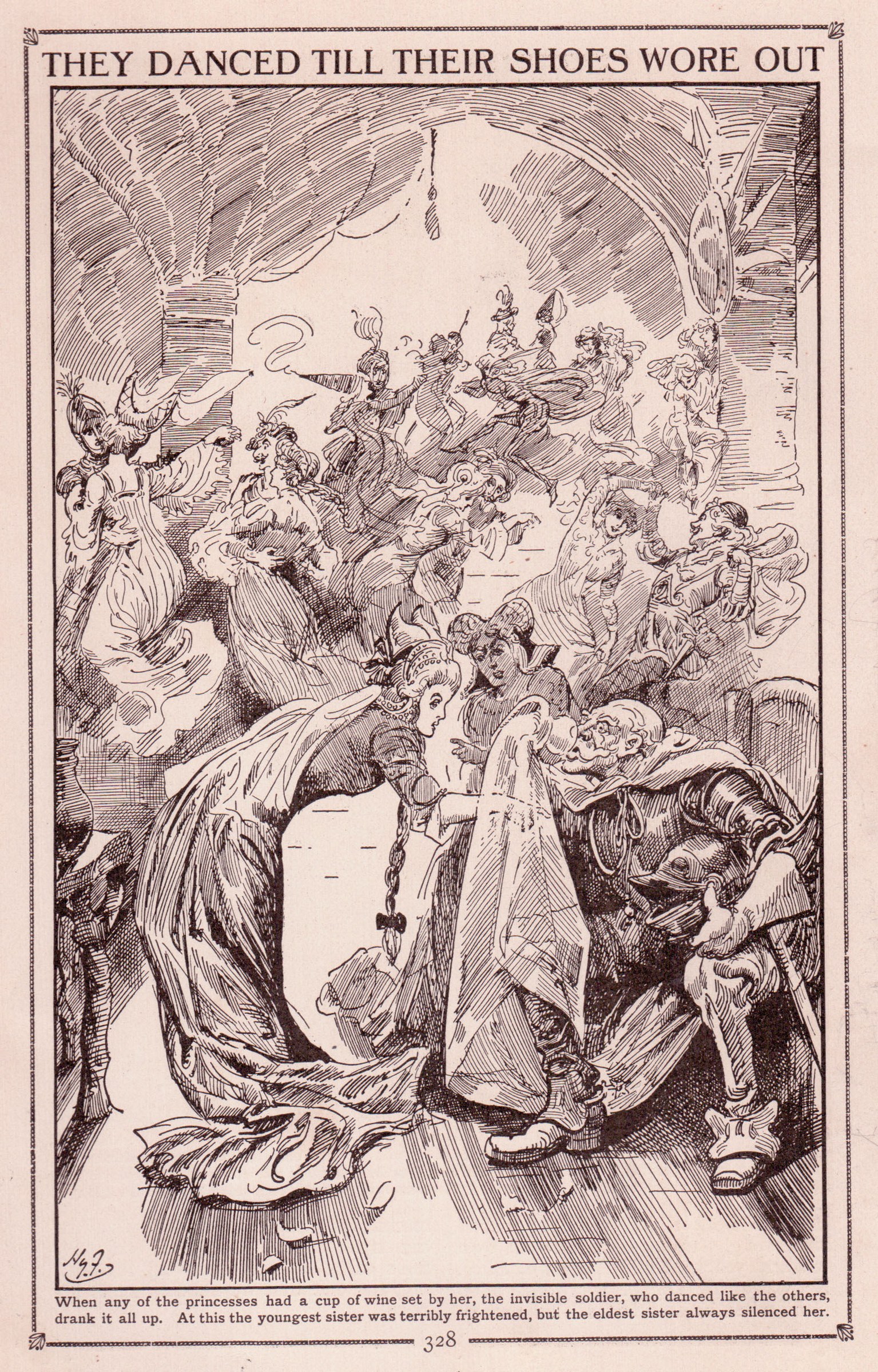
Dancing Princesses Page 328
Sue Clark
- Medium:
- Oil Painting
- Source:
- Wikimedia Commons
- Rights:
- Public domain — free to use, share and adapt.
- Recorded as:
- Public Domain
This image documents how dance functioned in early-twentieth-century children's literature and moral imagination: not as entertainment or skill but as danger, compulsion, and magical punishment. The composition reveals the artist's understanding of how to depict continuous movement in a static medium—the layering of figures, the asymmetrical arrangement, the active gesture language—making it valuable for historians of both book illustration and dance representation.
What you are looking at
A fairy-tale ballroom crowded with dancing figures in an enchanted castle or palace interior. The architectural setting suggests high vaulted ceilings and draped fabrics overhead. In the foreground, two figures in elaborate dress—one in flowing robes with a cloak, the other in ornate costume—stand or sit at ground level, apparently observing or frozen in the moment of discovery. The central and background space fills with numerous dancers in motion: women in long gowns with full skirts, men in period costume with decorative details, and supernatural figures including what appears to be a winged demon or jinn at left. The dancers are arranged at various depths, some elevated, some moving in swirling patterns. The illustration employs fine cross-hatching and line work typical of wood engraving or steel engraving, creating dramatic contrasts between light and shadow that emphasize the frenzy of the dance. Scattered at the bottom of the composition are worn-out shoes, the literal subject of the title.
The dancing
The dancers display energetic, unselfconscious movement: arms raised, bodies turned in space, feet in active positions suggesting continuous motion rather than formal steps. Several women's skirts billow outward, indicating dynamic weight shifts and rotation. The figures in the foreground are posed in shock or stillness—a sharp contrast to the animated dancers behind them—suggesting the moment of magical revelation rather than active participation. No formal hold or closed partnering is visible; instead, individuals move in a press of bodies, some paired loosely, others solo, with a sense of compulsion or enchantment rather than courtly discipline.
The dance depicted
This illustrates the Grimm Brothers' fairy tale 'The Twelve Dancing Princesses,' a story about enchanted maidens cursed or compelled to dance every night until their shoes wear through. The image captures the supernatural ballroom where the dancing occurs—a liminal space between the mortal world and fairy realm. The dance itself is not formally identified, but the visual language suggests a continuous, feverish waltz or round dance driven by magic rather than choice. The worn shoes at the bottom literalise the tale's central image: the princesses dance until their footwear is destroyed. This is social dance transformed into compulsive performance, a theme of Gothic and Romantic literature.
How it was made
This is a wood engraving or steel engraving, recognisable from the fine parallel lines (hatching and cross-hatching) that build tone and shadow, the precise linear clarity, and the high contrast between black line and white paper. The medium allows for intricate detail and subtle gradation of light; it was ideal for book illustration in the nineteenth and early twentieth centuries because the printing block could withstand thousands of impressions. The technique's requirement for white-line carving means the artist worked backwards, removing material to create the image, which produces the characteristic crisp edges and graphic power visible here. This is a professional commercial illustration, produced for mass circulation in a children's encyclopedia.
About this work
This is a wood engraving or steel engraving illustrating 'The Twelve Dancing Princesses,' published in *The Book of Knowledge*, a major early-twentieth-century children's encyclopedia. The image freezes the moment of magical revelation: the enchanted ballroom where the doomed princesses dance compulsively through the night, their shoes wearing out beneath them. The composition captures both the frenzy of the dancers—arranged in dynamic, swirling groups throughout a grand interior—and the frozen shock of the observers in the foreground who have discovered the secret. The worn shoes scattered at the bottom ground the fairy tale's central image in material fact, transforming an abstract curse into visible devastation.
How to look at it
Attend to the compositional contrast between the frozen foreground figures and the writhing dancers behind them: the engraving captures two temporal states at once—the moment before discovery and the ceaseless dance itself. The accumulation of hatching in the background creates a visual sense of frenzy and confinement; the vaulted space appears airless and compulsive. Look at the shoes: scattered, broken, and worn, they are the only evidence of the dance's duration and cost. The demonic figure at left marks the space as uncanny and dangerous—this is not a courtly waltz but a supernatural ordeal.
The artist
The catalogue record attributes this to Sue Clark and dates it 2010, but this contradicts the documented source: the illustration appears in *The Book of Knowledge*, Vol. II (1912), edited by Arthur Mee and Holland Thompson, published by the Grolier Society. The actual artist of this engraving is not identified in the available record. The work is a professional commercial illustration for a major educational encyclopaedia aimed at middle-class families.
The period
The early twentieth century saw a major expansion of illustrated children's literature and encyclopedic knowledge works aimed at family education. *The Book of Knowledge* (1912) was one of the most ambitious and widely distributed of these projects, bringing fine illustration and narrative literature into American and British middle-class homes. Simultaneously, the Romantic and Gothic tale—including the Grimm collection—experienced renewed popularity as a source of moral education and imaginative literature for children. The ballroom dance, in this literary context, often carried associations with danger, transgression, or supernatural transgression, reflecting anxieties about modernity and embodied pleasure.
Where it lives
This is a page illustration (page 328) from *The Book of Knowledge: The Children's Encyclopedia*, Vol. II (1912), edited by Arthur Mee and Holland Thompson, published by the Grolier Society of New York. It is a mass-produced educational work, circulated widely in print form and later digitised and released to public domain (Wikimedia Commons, under CC BY 2.0).
Questions about this work
Is this painting or a print?
This is a wood engraving or steel engraving, a relief-printing process. It was not drawn and painted but carved into a wooden or steel block, with the white areas removed and the black lines left to hold ink. The technique's fine parallel lines (hatching) and crisp edges are visible throughout the image. This allowed the image to be printed thousands of times for the encyclopaedia.
What is the 'Twelve Dancing Princesses' story about?
It is a Grimm Brothers fairy tale about twelve maidens who are mysteriously compelled to dance every night in a secret enchanted ballroom, wearing out their shoes. A soldier or young man discovers the secret and breaks the spell. The tale explores themes of transgression, hidden knowledge, and magical compulsion—and uses the worn shoes as a physical sign of invisible suffering.
Why are the shoes so important?
The shoes are the only tangible evidence of the ceaseless, invisible dance. They transform the abstract horror of magical compulsion into something visible and measurable. Their destruction literalises the fairy tale's core image: the cost of enchantment is paid in the body and its tools, worn away night after night.
Who is the artist?
The artist is not named in the available record. This is a professional illustration for a commercial encyclopaedia; many such works were published anonymously or credited only to the publisher. The catalogue record attribution to 'Sue Clark' (2010) appears to be an error based on the Wikimedia Commons uploader's name, not the original artist.
More dance artwork