43 works in this view — arrow keys or swipe to move between them.
Dance in Art
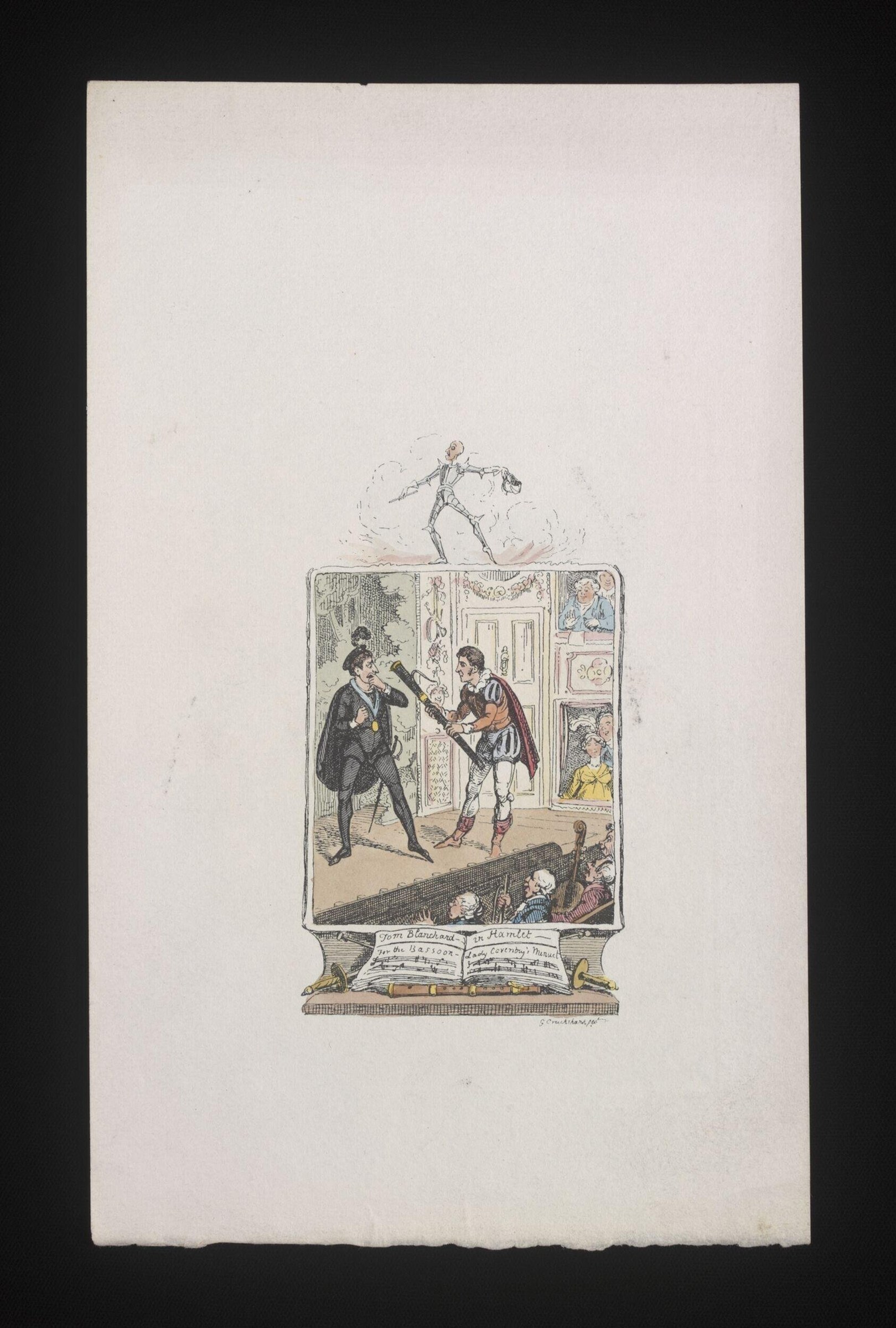
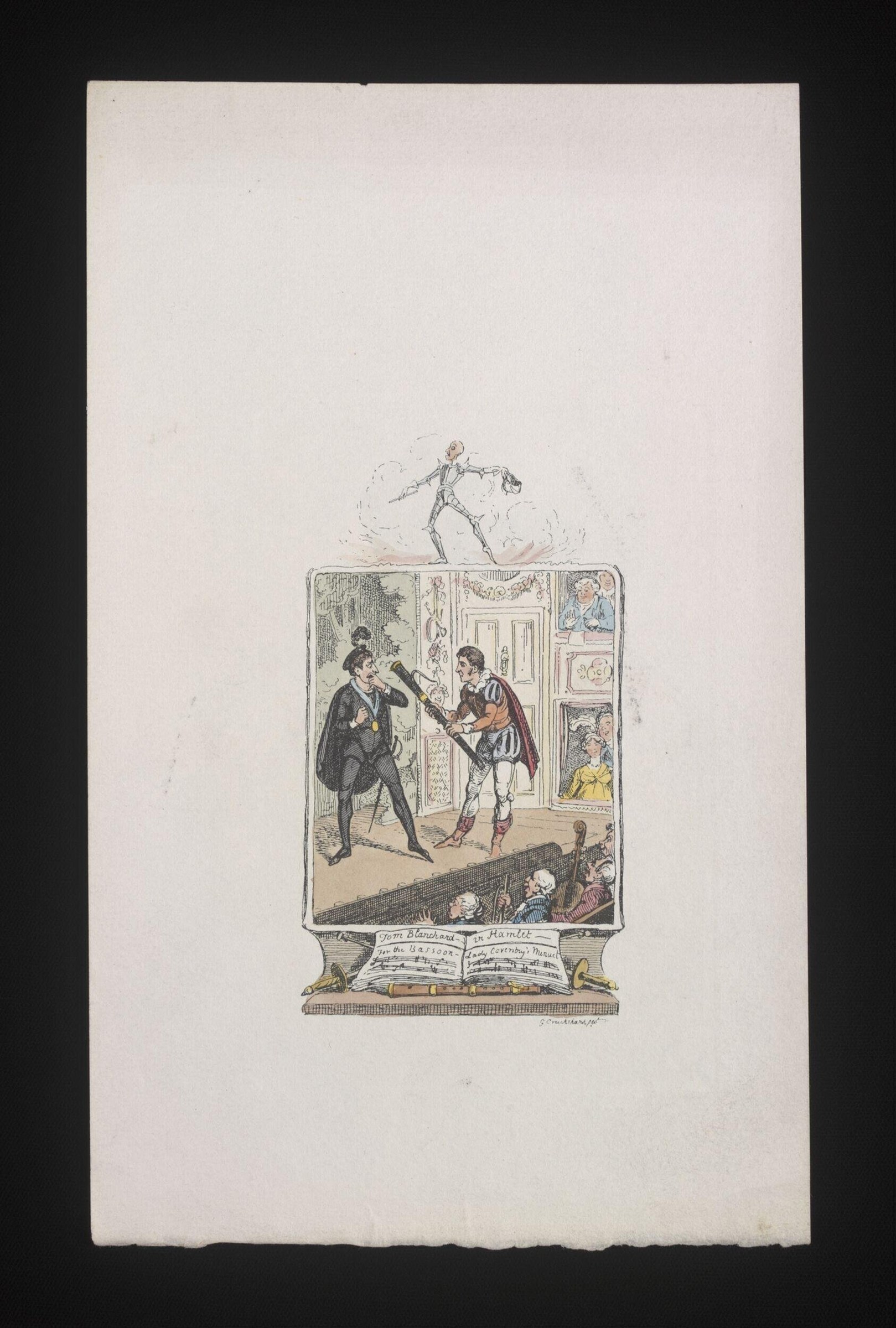
Tom Blanchard in Hamlet. For the Bassoon. Lady Coventry's Minuet
Cruikshank, George
- Dance:
- Minuet
- Era:
- 1700s (Enlightenment/Minuet Era)
- Source:
- Victoria and Albert Museum
- Rights:
- Rights vary by item — check the source record before reusing this image. Source record ↗
- Recorded as:
- Check V&A creditLine
For historians of dance, this print is a reminder that references to minuets and ballroom culture in visual satire often encode anxieties about class, affectation, and bodily propriety rather than records of how people actually danced. Cruikshank's work shows how the minuet—even when not actually depicted—remained a cultural touchstone by which Georgian society measured gentility and ridicule.
What you are looking at
This is a hand-colored satirical engraving set within a framed theatrical vignette, likely from a printed broadside or periodical. The main action shows two men in late 18th-century dress—one in dark coat and breeches on the left, one in lighter colored coat and breeches on the right—facing each other indoors. The man on the right holds what appears to be a bassoon or similar wind instrument horizontally between them in a posture suggesting either confrontation or musical performance. Behind them, an interior decorated with hanging garlands, a door, and framed pictures on the wall establishes a fashionable drawing room or reception space. At the bottom right, visible through a window or opening, sits an audience of several figures watching the scene. Above the main frame, a separate small figure is shown in mid-leap or acrobatic motion, posed on top of the theatrical frame itself. Below the scene, an open book or scroll contains text (now illegible in reproduction) that would have carried captions or verse explaining the satire. The entire composition is printed in outline and hand-colored in ochres, grays, blues, and flesh tones typical of late 18th-century popular prints.
The dancing
The two central male figures are upright and face-to-face in a confrontational stance, their bodies angled toward each other rather than in any dance position. Their weight appears planted and static; neither figure shows the ease of ballroom posture. The bassoon held between them is horizontal and prominent, suggesting its role as the satirical subject. The small acrobatic figure above—shown in an energetic, inverted or leaping attitude—has an entirely different physical vocabulary: this is athletic and impossible in ballroom terms. No couple is shown in closed position or any recognizable dance hold; the composition emphasizes the incongruity between the musicians' and the acrobat's bodies.
The dance depicted
The title and composition suggest a satirical commentary rather than a record of actual dance practice. 'Tom Blanchard in Hamlet' likely references a specific performer or theatrical moment; 'For the Bassoon' indicates the musical instrument is the joke. The reference to 'Lady Coventry's Minuet' suggests a known musical piece (minuets were standard social dance music of the period), but the image does not depict a minuet being danced. Instead, the confrontational pose of the two men and the absurdist acrobat above propose a visual pun or critique—perhaps mocking a performer's attempt to dance to bassoon music, or satirizing the affectations of fashionable theatrical or musical society. The scene is theatrical and performative but documentary only of satire, not of the minuet itself.
How it was made
This is a hand-colored etching or engraving, recognizable from the fine linear work, the ruled border, and the selective hand-coloring in watercolor or colored wash typical of popular prints from the 1790s. The technique allowed for rapid reproduction and wide circulation among the reading public; such prints were sold individually or as part of periodicals, magazines, and satirical series. The combination of text, image, and frame-within-frame structure is characteristic of caricature and satirical print culture in Georgian England. The small size and portable format suggest this was meant to be collected, pasted into scrapbooks, or shared in coffee houses.
About this work
This is a satirical engraving from 1792 by George Cruikshank, the pre-eminent caricaturist of Georgian and Regency England. It does not depict a minuet being danced; instead, it uses the minuet (referenced in the title) as the target of satire. The image shows two fashionably dressed men in confrontation over a bassoon, framed by an audience and topped by an impossible acrobat, all designed to mock theatrical pretension or musical absurdity in late 18th-century London society. Cruikshank's work was part of a wider tradition of satirical prints that used dance, music, and bodily ridicule to comment on contemporary fashion and social behavior.
The print belongs to the visual archive of Georgian satire rather than to dance documentation, but it is historically significant because it shows how dance references—specifically the minuet, still a marker of gentility and fashion—were weaponized for social critique. The composition and style are unmistakably Cruikshank's: the exaggerated features, the theatrical framing, the mixing of scales and impossibilities for comic effect, and the integration of verbal and visual wit.
How to look at it
Notice that the titled 'minuet' is entirely absent from the visual action: the title promises one thing, the image delivers satire instead. Look at the contrast between the static, confrontational poses of the two men and the impossible, inverted energy of the acrobat above—this dissonance is the joke. The frame-within-frame and the audience visible through the window are devices that emphasize the theatricality of the scene and invite the viewer to see through the pretense being mocked. Read the text beneath if legible; it will contain the verbal key to the visual satire.
The artist
George Cruikshank (1792–1878) was the most celebrated English caricaturist of his era, known for savage social and political satire executed in etching and engraving. He worked prolifically from the 1810s onward, producing single prints, series, and illustrations for books and periodicals. His early work, such as this 1792 piece, shows the influence of earlier caricaturists like Gillray and Rowlandson, with whom he shared a vocabulary of exaggeration, theatrical framing, and scatological or absurdist humor. Cruikshank's prints were widely collected, copied, and reproduced; they shaped public opinion and entertainment among the middle and upper classes of Regency and Victorian England.
The period
The minuet was the dominant social dance of the 18th century and remained culturally significant well into the 1790s, though its dominance was being challenged by newer dances like the cotillion and country dances. By 1792, the minuet was becoming old-fashioned among the younger set, and references to it in satire often carried implications of stuffiness, formality, or sexual restraint. In the same decade, theatrical dance was becoming a more spectacular and athletic form; the pantomime, the ballet d'action, and acrobatic performance were rising in popularity. Cruikshank's print captures this moment of transition: the rigid minuet (referenced but not shown) is the butt of the joke, while the acrobat above suggests the newer, more physically audacious entertainments that were capturing public attention.
Where it lives
According to the catalogue record, this work is held in the Victoria and Albert Museum (London). It is listed as a source 'va' (Victoria and Albert). The catalogue dates it 1792, but the record also labels it Pre-1700 (Renaissance/Baroque), which contradicts both the date and the visual evidence.
Questions about this work
Is this a depiction of a minuet?
No. The title references 'Lady Coventry's Minuet,' but the image does not show a minuet being danced. Instead, it is a satirical composition that uses the minuet (a marker of old-fashioned gentility) as part of its joke about fashionable society and musical pretension. The two men are in confrontation, not in dance position.
What is the bassoon doing in this image?
The bassoon is the central object of satire. It is held between the two men in a confrontational manner, suggesting either a musical dispute or the absurdity of dancing to bassoon music. The title 'For the Bassoon' implies that the humor lies in the incongruity between this bulky, low instrument and the refined social dance form (the minuet) referenced in the caption.
Who was Tom Blanchard?
The catalogue record does not identify Tom Blanchard beyond the title reference. He may have been a performer, musician, or public figure known to the 1792 audience for whom this satire was made. Without additional research, we cannot confirm his identity from the print alone.
Why is there an acrobat on top of the frame?
The acrobat is another layer of satire and spectacle. By placing an impossible, inverted figure above the theatrical frame, Cruikshank contrasts the rigid formality of the minuet-era gentility (referenced in the title) with the newer, more athletic and audacious entertainments (acrobatics, athletic performance) that were becoming fashionable in the 1790s. The composition suggests a critique of changing tastes in entertainment.
More Minuet artwork