43 works in this view — arrow keys or swipe to move between them.
Dance in Art
Minuet
Eugene, Frank
- Dance:
- Minuet
- Era:
- 1900-1920 (Ragtime/Early Jazz)
- Source:
- Victoria and Albert Museum
- Rights:
- Rights vary by item — check the source record before reusing this image. Source record ↗
- Recorded as:
- Check V&A creditLine
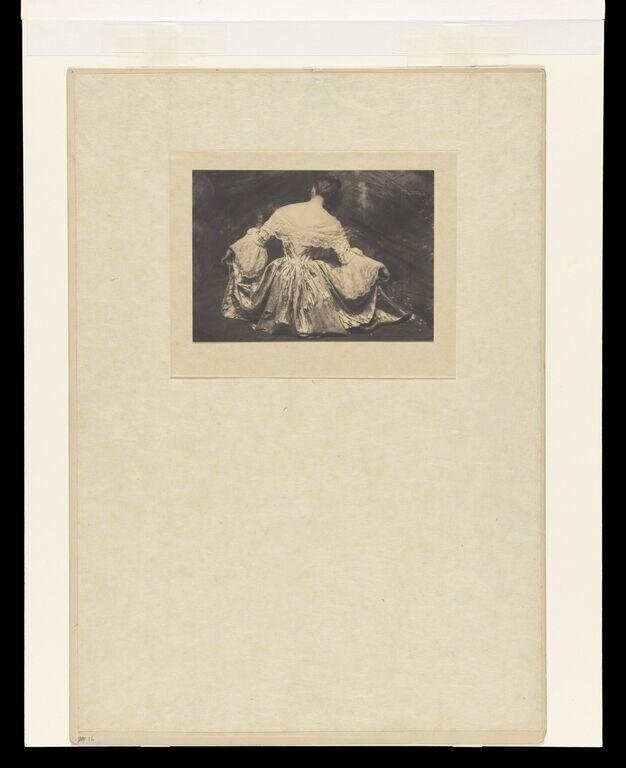
Minuet images are central to understanding 18th-century dance history, but most exist as teaching prints or fashion plates that prioritize costume. This work prioritizes the moving body and the moment of motion, showing how a trained dancer in the minuet achieved the visible grace that made the dance prestigious across Europe. For historians and dancers, it is a rare image that treats the minuet not as a costume display but as a kinetic art.
What you are looking at
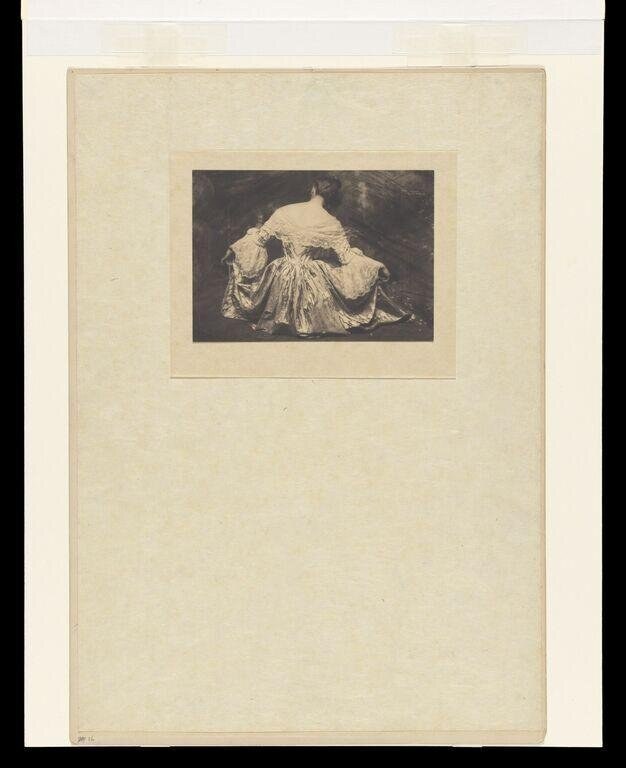
A solitary female dancer in an elaborate white gown dominates this intimate composition. She is caught mid-motion, her body angled away from the viewer and bent forward in a graceful curve, her arms raised and draped with the voluminous fabric of her skirts. The dress is the visual center—a confection of white silk or taffeta with massive puffed sleeves and gathered skirts that billow around her in the moment of movement, creating a sense of arrested motion. The background is rendered in dark tones that throw the luminous white fabric into sharp relief. The lighting is theatrical, concentrating all attention on the dancer's body and the sculptural qualities of her costume. There is no setting, no floor, no other dancers—only this single figure suspended in what appears to be a moment of courtly refinement.
The dancing
The dancer stands in a distinctly elegant posture with her torso inclined forward and her arms raised symmetrically, the sleeves creating wings of fabric. Her head is turned away from the viewer, obscuring her face. The weight appears to be forward and mobile, the body composed and controlled. This is not a leap or a dramatic gesture, but a moment of gliding motion—the kind of measured, continuous traveling step characteristic of European courtly dance. The arms are held with the soft curve and moderate elevation typical of baroque and rococo period dancing, and the overall frame suggests a dancer trained in the refinements of court movement.
The dance depicted
This is almost certainly the minuet, or a related courtly dance of the same period. The minuet dominated European aristocratic dance culture from the mid-17th through the 18th century, and this image—with its single elegantly dressed figure, its emphasis on graceful continuous motion, and the careful articulation of the arms and torso—captures the essence of how contemporaries understood the dance. The minuet was danced in couples or small groups in formal court settings, but artists often isolated single figures to show the refined carriage and controlled movement the dance demanded. The costume places this firmly in the 18th century at the latest, and the aesthetic—the focus on the beauty of the moving body in expensive fabric—aligns with how the minuet was celebrated in its own time.
How it was made
This is a work on paper, almost certainly an engraving or etching based on the tonal qualities, the handling of light and shadow through line and cross-hatching, and the monochromatic palette. The technique allowed the artist to achieve dramatic contrasts—the white figure emerging from near-darkness—and to render both the delicate detail of the costume and the flow of the movement through variations in mark-making. The image shows signs of having been printed from a plate, suggesting this was a multiple and could circulate, making it a work of considerable reach within educated circles interested in dance and fashion.
About this work
This is a studio image of courtly dancing at its moment of greatest influence and refinement. The minuet was the supreme ballroom dance of the 18th century, and images like this—isolating a single dancer to display the grace of trained movement and the visual drama of fashionable dress—were part of how the dance was taught, celebrated, and remembered. The work belongs in a dance archive both as evidence of how the minuet looked to contemporaries and as a document of the aesthetic principles that governed courtly movement: elegance, control, the integration of the body with costly fabric, and the visible pleasure of trained motion. The artist has chosen to show not a moment of maximum extension or height, but rather a traveling step—a minuet step—which is far more typical of how the dance was actually danced.
How to look at it
Attend to the moment the artist has chosen to freeze: not a climactic pose or a leap, but the middle of a traveling step, with the body in motion and the costume creating a secondary visual rhythm around the dancer. The composition—a single figure against darkness, with all light concentrated on the white dress—is itself a statement about how the minuet was valued: as a vehicle for displaying elegance and the beauty of refined motion. Look at the position of the arms and the curve of the back: these show a dancer trained in the specifics of courtly movement, with the kind of rounded arm position and subtle control that characterizes baroque and rococo dance technique.
The artist
Frank Eugene (1865–1936) was an American photographer and artist known for his experimental photographic techniques and his work in Pictorialism, a movement that emphasized photography as fine art. While he is primarily remembered for photography, he also worked in drawing and print media. His interest in movement, form, and the aesthetics of the human body—particularly in dance and performance—aligns with the broader Pictorialist concern with beauty and artistic effect. The title attribution and dating require verification against museum records.
The period
The minuet reached its cultural apex in the 18th century, becoming the marker of aristocratic refinement and the foundation of ballroom dancing throughout Europe. By the 19th century, when this image was made (or made to represent an 18th-century dance), the minuet had become a historical form—no longer the dance of the ballroom but a reference point for elegance and the classical past. Images of the minuet in the 19th and early 20th centuries often carried nostalgic weight, celebrating an earlier moment of courtly culture. Eugene's creation of this image at the turn of the 20th century places it within a broader revival of interest in baroque and rococo aesthetics and in the documented history of dance.
Where it lives
The work is recorded as part of the Victoria and Albert Museum collection, one of the world's major repositories of design, decorative arts, and works on paper relating to performance and fashion. The catalogue record provides minimal detail, but the holding suggests this is understood as a work relevant to the history of dress, design, and theatrical or social performance.
Dance in this work
Questions about this work
Was the minuet really danced like this?
Yes and no. The minuet was a partnered dance most often, performed in the ballroom as part of a social sequence. But the core movement—the minuet step itself, with its characteristic rhythm and the traveling action visible here—is accurately rendered. This image shows a single dancer, which was also common in teaching contexts and in the solo demonstrations that dancers sometimes gave to display their technique.
When was the minuet danced?
The minuet rose to prominence in the 17th century, became the supreme ballroom dance of the 18th century, and began to fade in the early 19th century. By the time this image was made around 1900, the minuet was a historical form, remembered and revived as part of nostalgic interest in the aristocratic past.
Why does the dancer's face turn away?
This was a common compositional choice in dance imagery. By showing the dancer in profile or three-quarter view, the artist concentrates attention on the line of the body and the movement of the limbs, rather than on the dancer's individual identity. It also allows a more complete view of how the body moves through space.
More Minuet artwork