37 works in this view — arrow keys or swipe to move between them.
Dance in Art
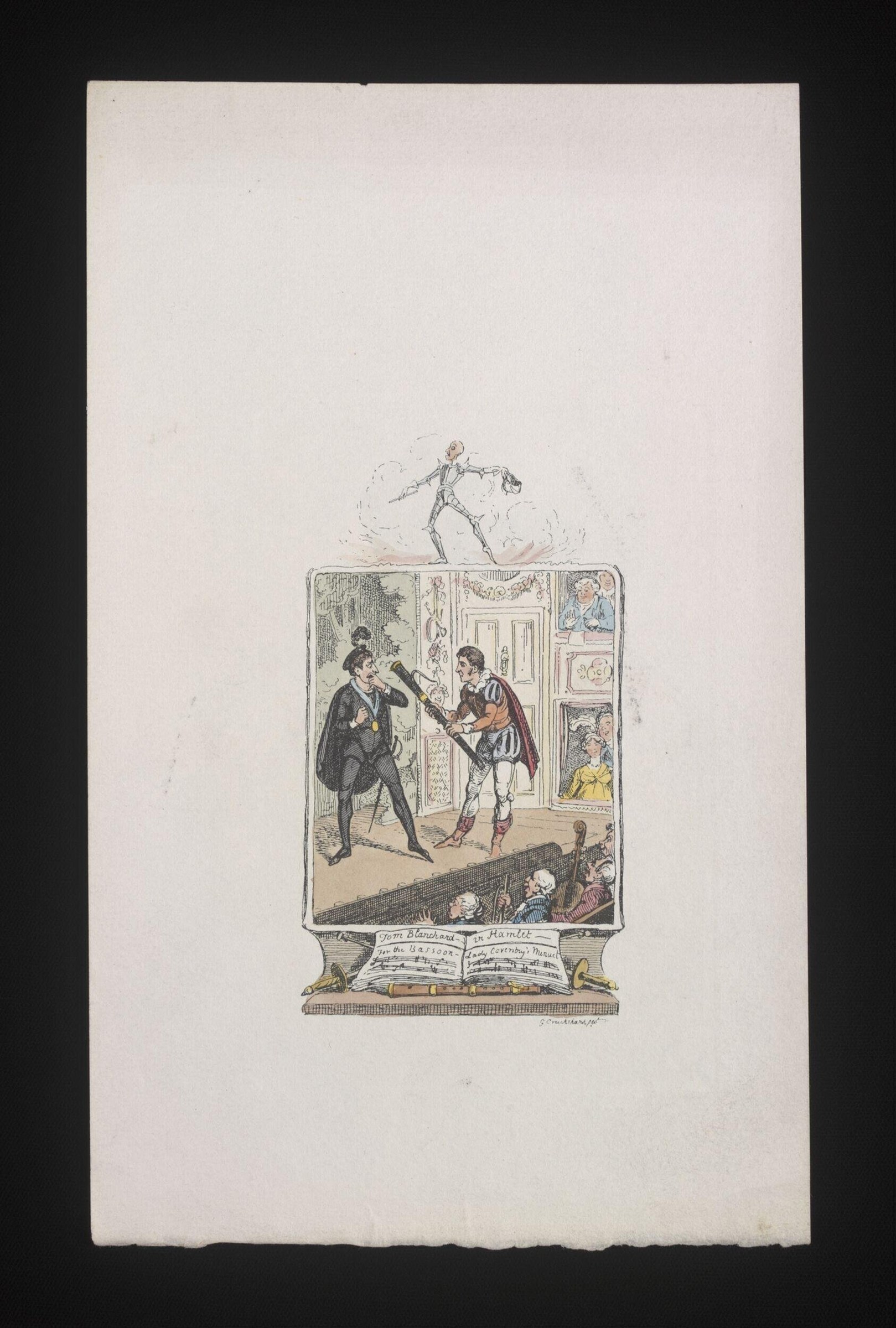
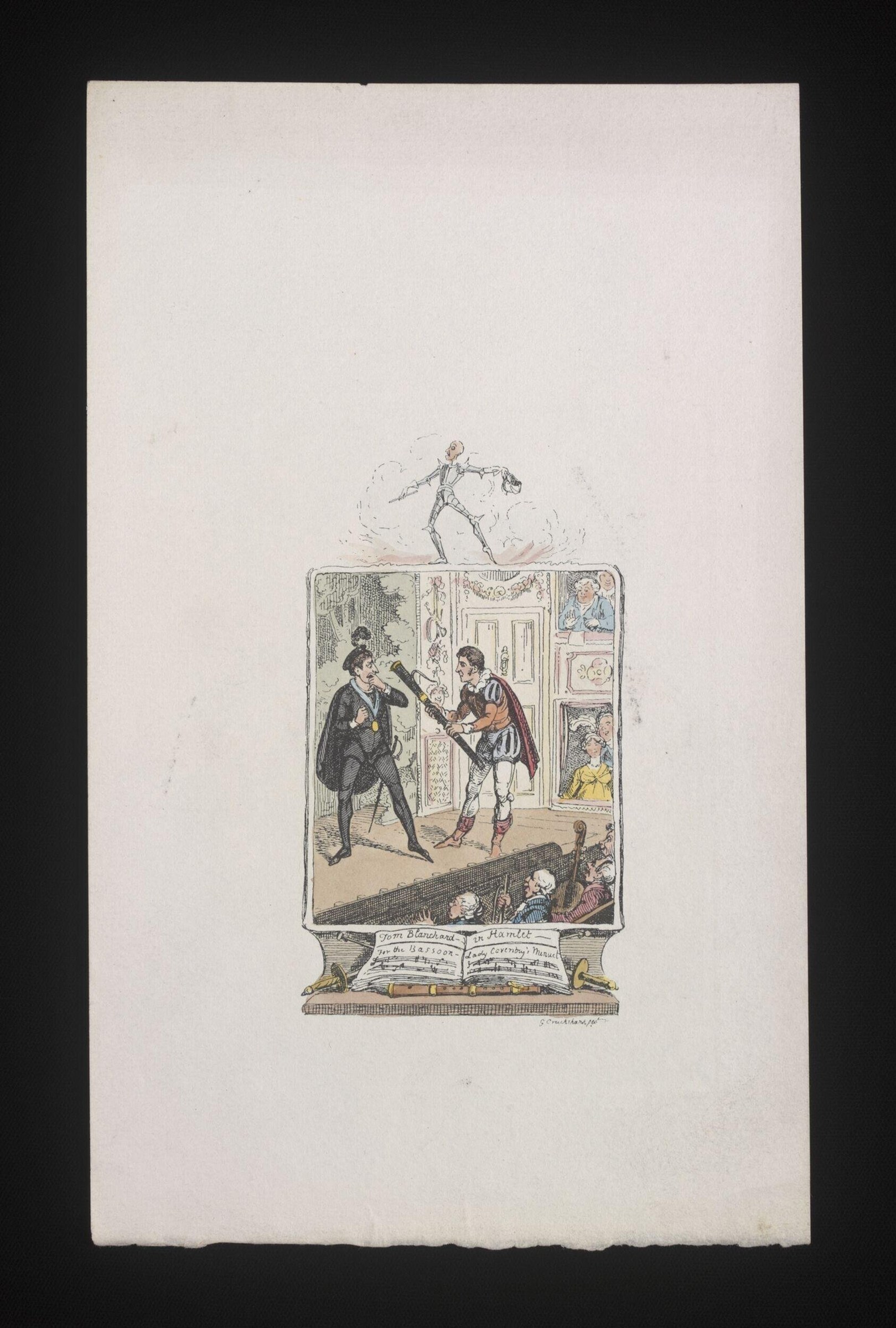
Tom Blanchard in Hamlet. For the Bassoon. Lady Coventry's Minuet
Cruikshank, George
- Dance:
- Minuet
- Era:
- 1700s (Enlightenment/Minuet Era)
- Source:
- Victoria and Albert Museum
- Rights:
- Rights vary by item — check the source record before reusing this image. Source record ↗
- Recorded as:
- Check V&A creditLine
For historians of theatrical satire and social comedy in the 1790s, this print reveals how performance and music were mocked through visual wit. For dance historians, it serves as a cautionary example of how prints with dance-related titles in their inscriptions may not depict actual dance, and how context and contemporary gossip are essential to interpretation.
What you are looking at
A hand-colored engraving of a scene within a decorative framed vignette topped by a skeleton figure. Inside the frame, two men in early 19th-century dress—one in dark coat and breeches, the other in burgundy breeches and jacket—face each other in what appears to be an interior room with elegant furnishings. The man on the left holds a long bassoon horizontally between them like a weapon or staff, while the other man gestures toward it with his hand raised. Behind them, visible through a doorway, are three elegant interior spaces with decorated walls and hanging pictures. At the base of the composition, an open book or manuscript carries inscriptions. The skeleton balanced on top of the frame suggests this is a satirical or theatrical scene, possibly commentary on musical performance or masculine display.
The dancing
The two central male figures stand at chest-to-chest distance in a confrontational stance, neither in a formal dance hold. The man on the left is more rigidly posed; the figure on the right is animated, with one arm raised and bent at the elbow in a gesturing position. Neither figure shows the upright carriage, turned-out legs, or aligned frame of a trained dancer. Their body angles and arm positions suggest theatrical posture rather than balletic training. The skeleton figure above operates as a visual commentary, standing in a caricatured wide stance with one arm extended.
The dance depicted
The catalogue record identifies this as depicting a minuet (Lady Coventry's Minuet), yet nothing in the image supports this reading. There is no visible dance hold, no opposing body angles, no gathering of skirts, no musical accompaniment visible except the prominent bassoon. The two male figures do not stand in minuet position. If this is satirical commentary on "Tom Blanchard in Hamlet" as a performer, the bassoon may be a visual pun on the name or his role rather than evidence of choreography. The title's references to both Hamlet and a minuet, combined with the skeleton and theatrical setting, suggest this is a satirical print about theatrical or musical performance rather than a record of actual dance.
How it was made
This is a hand-colored engraving, as established by the fine line work, crosshatching for shading, and the characteristic appearance of printed outline with watercolor infill. The technique allowed for rapid reproduction and wide circulation of satirical commentary, common practice for theatrical criticism in early 19th-century London. The delicate cross-hatching and attention to interior detail suggest skilled commercial printmaking. The decorative frame, book cartouche, and skeleton figure are all characteristic conventions of theatrical satire prints of the period.
About this work
This is a theatrical satire engraving from the 1790s, likely mocking or commenting on a performer named Tom Blanchard in a production of Hamlet, with the cryptic reference to 'Lady Coventry's Minuet' and a bassoon as satirical elements. The catalogue's dance identification may stem from the word 'minuet' in the inscription rather than visual evidence of the dance itself. The work belongs in a dance history collection only if the bassoon or minuet reference was well-known satirical code for a specific performance or controversy; otherwise it documents theatrical culture rather than dance practice.
How to look at it
Attend first to what is *not* present: the intimate side-by-side frame, the shared gaze, and the physical separation that define an actual minuet. Observe instead the confrontational spacing, the object (the bassoon) that separates rather than connects the figures, and the skeleton above, all signs this is theatrical commentary or farce rather than a dance scene. The decorative book cartouche at the base is the key to understanding the work's meaning; the inscriptions there carry the satire's punch line, now often illegible in reproduction.
The artist
George Cruikshank (1792–1878) was one of the pre-eminent satirical engravers of early 19th-century Britain, known for political and social commentary through theatrical and grotesque imagery. He was a prolific commercial printmaker working in the tradition of Rowlandson and Gillray, producing works that circulated widely and commented sharply on contemporary personalities and events.
The period
This engraving dates to 1792, the height of Cruikshank's early career and a period of intense theatrical and musical culture in London. The 1790s saw flourishing satire prints targeted at performers, composers, and theatrical trends. The minuet, while still a fashionable dance, was by this date associated with older courtly elegance and was often the subject of nostalgic or mocking reference in contemporary print culture.
Where it lives
Held by the Victoria and Albert Museum. This is a commercial satirical engraving, a print produced for sale to a literate, theater-going public and designed for rapid circulation and topical commentary.
Questions about this work
Does this print actually show a minuet being danced?
No. While the title includes 'Lady Coventry's Minuet,' the image shows no dance frame, hold, or body positions associated with the minuet form. The figures are posed confrontationally around a bassoon and appear to be engaged in theatrical mockery rather than dance. The minuet reference may be a satirical joke rather than a description of depicted action.
What is the skeleton doing?
The skeleton balanced atop the framed scene is a conventional device of theatrical satire and memento mori commentary. It stands in exaggerated, grotesque posture and serves as visual commentary on the scene below, likely mocking the performance or persons depicted.
Who was Tom Blanchard?
The print identifies one figure as Tom Blanchard in Hamlet, likely a performer in a contemporary production. Without additional theatrical records or commentary, it is difficult to establish whether this print documents an actual Hamlet production or is entirely a fictional or satirical creation.
More Minuet artwork