43 works in this view — arrow keys or swipe to move between them.
Dance in Art
Minuet dancer
William Duesbury & Co.
- Dance:
- Minuet
- Era:
- 1700s (Enlightenment/Minuet Era)
- Source:
- Victoria and Albert Museum
- Rights:
- Rights vary by item — check the source record before reusing this image. Source record ↗
- Recorded as:
- Check V&A creditLine
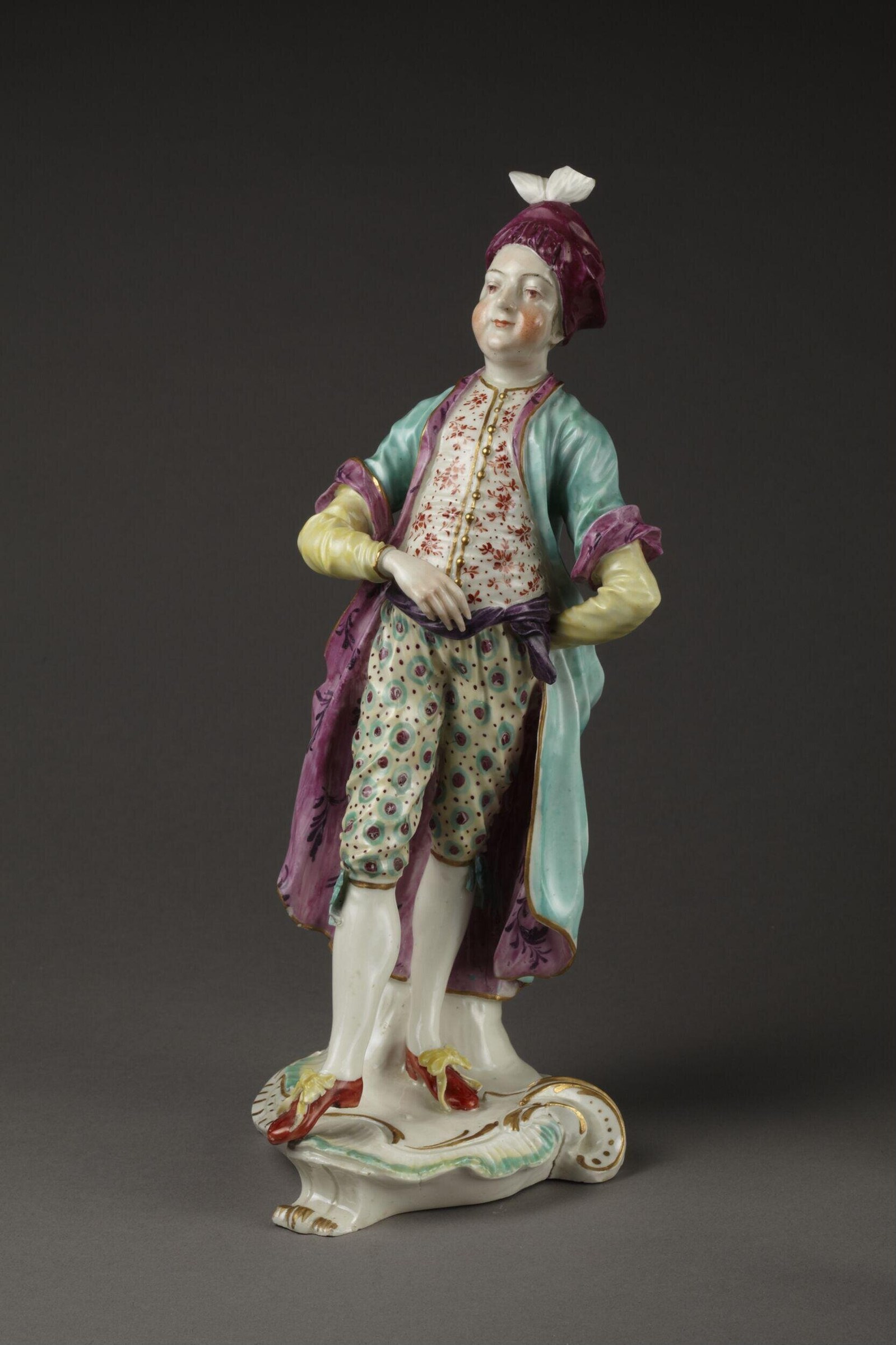
This figure is evidence of how the minuet was commodified and celebrated in 18th-century consumer culture. It shows what a minuet dancer was expected to look like—posture, dress, gesture, carriage—and proves that dance was important enough to warrant reproduction in an expensive, prestigious medium. For historians of dance, costume, and social practice, it documents the visual language of courtly deportment and the minuet's cultural prestige in the era of its greatest influence.
What you are looking at
A porcelain figure of a young male dancer stands in an elegant pose against a dark ground. He wears the costume of an 18th-century gentleman: a patterned waistcoat in cream with red and green sprigs, a turquoise-green coat with purple-pink cuffs and lining, cream breeches, and white stockings. A purple-pink cap sits atop his head, crowned with a white silk bow. His posture is upright and composed, one arm relaxed at his side while the other gestures gracefully. He wears red-heeled shoes. The figure stands on a scrolled white base painted with turquoise and gold accents, typical of mid-18th-century porcelain manufacture. The modelling is precise and the painting refined, with careful attention to the textures of silk, wool, and linen.
The dancing
The dancer is modelled in the round, a single standing figure captured in a moment of refined repose rather than active movement. His weight appears evenly distributed, with a slight turn of the torso that suggests he is mid-conversation or mid-performance. His right arm hangs naturally while his left is raised with the palm open—a classical gesture of address or acknowledgement typical of formal courtly deportment. There is no dramatic extension or balletic pointed foot visible; instead, the stance conveys the upright, dignified carriage of a gentleman dancer of the period.
The dance depicted
This figure represents a minuet dancer, the most fashionable social and theatrical dance of the mid-18th century. The minuet was danced by gentlemen and ladies in court dress, and was equally at home in the theatre and the ballroom. The costume here—elegant coat, patterned waistcoat, breeches, and buckled shoes—is consistent with stage representations and engravings of minuet dancers from the 1750s–1770s. The porcelain figure does not freeze a moment of spectacular footwork or turning; instead it captures the composed, mannered presence that the minuet demanded. The pose suggests a moment of presentational stillness, the kind of moment that occurs between the ornamental passages of the dance.
How it was made
This is a porcelain figure, hand-modelled and slip-cast, then hand-painted with overglaze enamels and gilding. The technique—which allows for fine detail and a glossy, durable surface—was perfected by English porcelain factories in the mid-18th century, particularly by Derby (Duesbury's manufactory). Porcelain figures such as this one were luxury objects made for the homes of the wealthy and served as tokens of taste and fashionable knowledge. They were produced in moulds and could be reproduced, making them more accessible than unique paintings or sculptures, yet still costly enough to signal gentility. The dancing figure was a popular subject in European porcelain; such figures often commemorated famous dancers or celebrated the fashion for ballroom and stage dance among the upper classes.
About this work
This is a porcelain figure of a minuet dancer, made by William Duesbury & Co. at the Derby factory around 1760. It represents one of the most enduring forms of dance imagery in the 18th century: the gentleman or lady in minuet dress, modelled for display in a fashionable home. The figure does not attempt to show the minuet in motion, but rather presents the dancer as an object of taste—refined, well-dressed, and composed. It is a work of both decorative art and dance documentation, recording not just the dance but the costume, posture, and social meaning attached to one of the century's most important dances.
The minuet was taught to all children of gentle birth and was the foundation of all ballroom dancing from the 17th century into the 19th. By the 1760s, when this figure was made, the minuet was already becoming old-fashioned for social dancing—faster dances like the cotillion and country dances were gaining ground—but it remained a showpiece, the mark of a well-trained dancer. Porcelain figures like this one helped to immortalize and celebrate the minuet at a moment when it was beginning to fade from living practice.
How to look at it
Look first at the upright posture and the careful balance of the figure's weight. The minuet demanded a straight back, a lifted carriage, and an appearance of effortless grace—all visible here. Notice the position of the arms: neither limply at the sides nor dramatically raised, but held with a restrained elegance. The costume is equally important: the colours, the cut of the coat, the breeches, the heeled shoes, and the head ornament all signal the fashion of the 1760s and the social status of the wearer. The figure does not represent a moment of vigorous movement but rather the composed, presentational stillness that punctuated the minuet. This is a portrait of a type—the minuet dancer as a figure of taste and refinement—rather than a snapshot of action.
The artist
William Duesbury (1725–1786) was the founder of the Derby porcelain factory, one of the major English porcelain manufacturers of the 18th century. Derby was known for naturalistic, well-modelled figures and for ornate, hand-painted tableware and decorative objects. Duesbury's factory produced many figures of dancers, actors, and allegorical characters, often drawn from theatre, commedia dell'arte, and fashionable society. The factory's output was aimed at wealthy consumers who used such figures to furnish drawing rooms and display cabinets, signalling their taste and cultural knowledge. Duesbury's figures are recognised for their anatomical accuracy, fine painting, and sophisticated use of enamel colours.
The period
The minuet dominated European courtly and ballroom dancing from the 1650s through the 18th century. In the mid-18th century, it was the dance of choice for formal occasions and social dancing among the aristocracy and gentry. It was taught by dancing masters to all children of rank and was a standard feature of both court ceremonies and the public theatre. However, by the 1750s–1760s, the minuet was beginning to share the ballroom with newer, faster, more sociable dances such as the cotillion and country dances. Nevertheless, the minuet retained enormous cultural prestige and remained the opening dance of formal balls throughout the 18th century and beyond. In the visual arts, the minuet was a favourite subject: it appears in paintings, engravings, and sculptures, and was celebrated in dance manuals and theatrical prints. Porcelain figures of dancers, particularly minuet dancers, became fashionable collector's items in England and on the continent in the 1750s–1770s.
Where it lives
The figure is recorded in the Victoria and Albert Museum collection. It is a product of the Derby porcelain factory's standard output of the 1760s and would have been one of many similar figures produced in the factory's moulds, making it a typical if refined example of mid-18th-century decorative porcelain.
Dance in this work
Questions about this work
How do we know this is a minuet dancer and not just a well-dressed gentleman?
The title of the work identifies it as a minuet dancer, and the costume and pose are consistent with depictions of minuet dancers in 18th-century prints and paintings. The upright posture, the formal coat and breeches, the heeled shoes, and the overall presentation as a figure of refinement and accomplishment all align with how minuet dancers were represented in the period. The object itself—a porcelain figure for display in a home—suggests a work celebrating a fashionable accomplishment or social practice.
Why does he look so still? Shouldn't a dancer be in motion?
The minuet was a formal, stately dance with many pauses and composed moments. It was not about speed or dramatic movement, but about grace, precision, and the display of good breeding. Porcelain figures were also objects of display for the home, not representations of the dance in full action. By showing the dancer in a moment of composed stillness, the figure captures something essential about the minuet: its emphasis on courtly restraint and elegant presentation.
What do the colours and costume tell us?
The waistcoat, coat, breeches, and cap are all in the fashion of the 1750s–1760s. The vivid colours—turquoise, purple, cream, and red—show what wealthy people wore to balls and theatrical performances. The precision of the enamel painting and the use of gilt accents indicate that this was an expensive, luxury object. The costume also signals that this is a gentleman or perhaps a theatrical performer of some rank; only people of means would wear such fine clothes or pay to learn such an accomplishment.
Who would own a figure like this?
Porcelain figures were collected by wealthy people with fashionable tastes. They were displayed in drawing rooms, on mantlepieces, and in cabinets as signs of taste, wealth, and cultural knowledge. Owning a figure of a minuet dancer meant you admired the minuet, understood its importance as a marker of good breeding, and wanted to display that understanding in your home.
More Minuet artwork