33 works in this view — arrow keys or swipe to move between them.
Dance in Art
Minuet
Paquin, Jeanne
- Dance:
- Minuet
- Era:
- 1900-1920 (Ragtime/Early Jazz)
- Source:
- Victoria and Albert Museum
- Rights:
- Rights vary by item — check the source record before reusing this image. Source record ↗
- Recorded as:
- Check V&A creditLine
For dance historians, this work matters not as evidence of minuet technique, but as a window into how fashion and formality shaped the bodies and bearing of early-20th-century ballroom society. For historians of dress and design, it is a rare signed fashion study by one of the period's most influential couturiers, showing the precision with which a haute couture house documented its designs.
What you are looking at
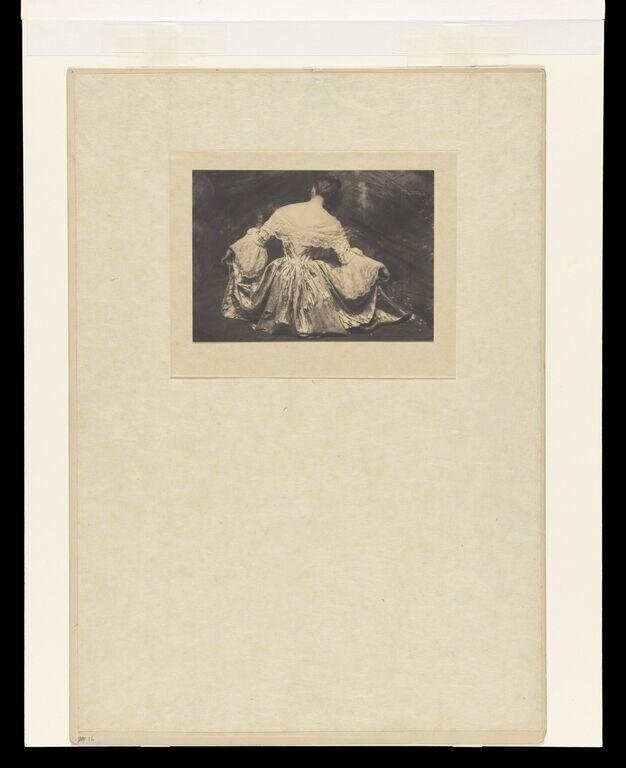
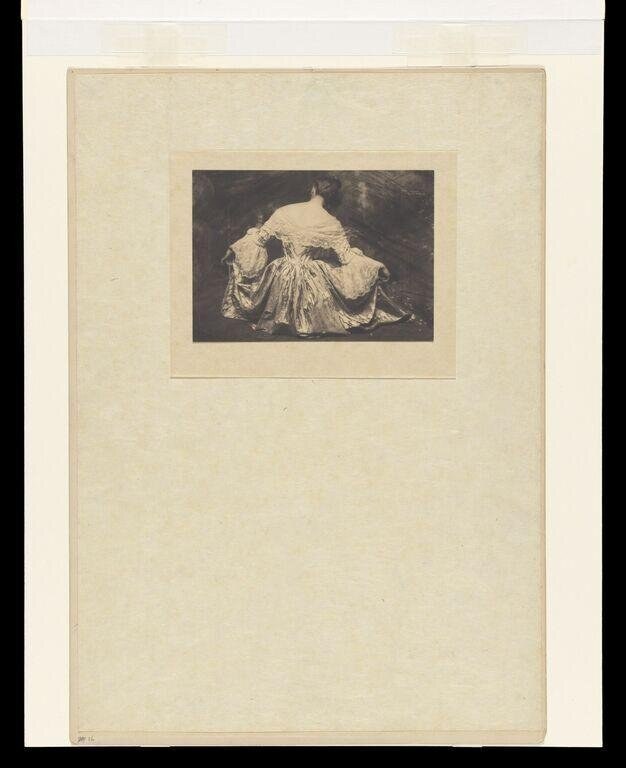
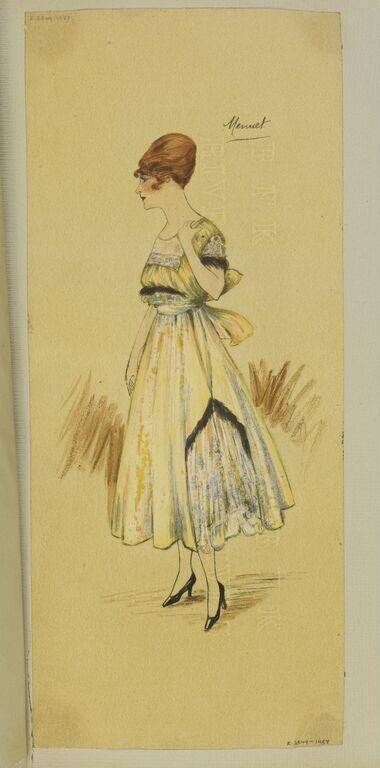
A fashionable woman stands in elegant profile against a pale yellow ground, wearing a high-waisted dress in pale cream or ivory with black trim and details. The garment features a full, gently gathered skirt that falls to mid-calf, revealing black heeled shoes, and short puffed sleeves with contrasting black bands at the shoulder. Her reddish-brown hair is styled in an upswept Edwardian coiffure. She holds a large fan in one hand and wears what appears to be a decorative brooch or corsage. The background is minimally detailed—spare cross-hatching suggests a neutral interior space—allowing the figure and the precision of the costume to command full attention. The drawing is signed 'Paquin' in the upper right.
The dancing
The woman stands in a poised contrapposto stance with her weight gently shifted, one foot slightly forward, suggesting a moment of preparation rather than active motion. Her posture is upright and refined, her shoulders drawn back in the formal bearing expected of Edwardian society. The arms hang naturally with the fan held loosely, and the overall frame conveys restrained elegance rather than dance momentum. This is the body at ease in formal dress, not mid-step.
The dance depicted
The catalogue identifies this as a minuet, but the image contradicts that claim. The figure wears 1910s haute couture—the silhouette, the black trim details, the length of the skirt, and the style of the shoe are all distinctly modern Edwardian, not the formal wear of the 18th century when the minuet was danced. The woman's pose and demeanor, while graceful, show no sign of the sprung footwork, the turned-out positions, or the geometric floor patterns that characterize even a stylized representation of minuet technique. This appears instead to be a fashion study or design sketch for an evening or reception dress, possibly capturing a moment of social grace or readiness to dance, but not a representation of minuet dancing itself.
How it was made
The work is executed in watercolor and ink on paper, a technique well suited to fashion illustration. The dress is rendered with careful attention to fabric texture and the play of light—the cream color is achieved through the paper itself, with shadows and folds defined by pale gray washes and firm ink outlines. The black trim is crisp and precise. This precision, combined with the figure's slight asymmetry and the refined linework, is characteristic of haute couture design drawings of the Edwardian period, intended for the designer's records or as a presentation piece to a client. The economy of the background keeps visual focus entirely on the garment.
About this work
This is a fashion design drawing attributed to Jeanne Paquin, one of the most celebrated couturiers of the Belle Époque and early 1910s. It depicts a woman in an elegant high-waisted gown with characteristic Edwardian proportions, rendered in watercolor and ink. The work sits within the tradition of fashion illustration rather than dance documentation. While the catalogue record names it a minuet and dates it to the Victorian era, the garment itself and the draftsmanship place it firmly in the 1910s—after the minuet's revival as a drawing-room formality had largely faded from practice. What emerges is a portrait of modern elegance: the dress of a woman prepared for social dancing, but not a record of any particular dance being performed.
How to look at it
Attend first to the dress itself—its construction, proportions, and details—and to the quality of the draftsmanship. The figure's pose is neither dynamic nor frozen in a recognizable dance position; rather, it captures a moment of social readiness, the body prepared for interaction. Notice the restraint of the background and the precision of the line, which are hallmarks of professional fashion illustration. The work invites study of costume rather than observation of movement.
The artist
Jeanne Paquin (1869–1936) was a French fashion designer and one of the first women to found and direct a major couture house. She was known for her elegant evening wear, her use of rich fabrics, and her innovative high-waisted silhouettes that anticipated postwar fashion. Paquin was influential in establishing the authority of female designers in haute couture. Her house in Paris produced designs for nobility, actresses, and wealthy society women throughout the Belle Époque and the years before World War I.
The period
The early 1910s saw the tail end of the Edwardian silhouette—the high waist, the Gibson Girl proportions, the full skirt—before the slimmer, more angular fashions of the 1920s took hold. In ballroom dance, this was a moment of transition: the waltz, the foxtrot (newly imported from America), and various one-steps and two-steps dominated fashionable dancing. The minuet, by contrast, had become a nostalgic curiosity, occasionally revived at formal balls or in theatrical contexts as a nod to 18th-century elegance. The disconnect between the catalogue's identification and what the image shows reflects the period's complex relationship to historical dance.
Where it lives
The work is held by the Victoria and Albert Museum, London, and is listed in their collection as a drawing attributed to Jeanne Paquin. The museum's era classification as 'Late 1800s (Victorian Ballroom)' appears to be inaccurate; the garment and style of draftsmanship point to the 1910s.
Questions about this work
Is this actually a minuet?
The catalogue calls it one, but the image suggests otherwise. The dress is 1910s haute couture, not 18th-century court wear; the pose is social and graceful, not a depiction of minuet footwork or frame. This appears to be a fashion design drawing, possibly titled after the formality and elegance of the gown rather than as a document of the dance itself.
Who was Jeanne Paquin?
A pioneering French couturier (1869–1936) who was one of the first women to found and lead a major fashion house. Her designs were worn by society women, actresses, and nobility. She was influential in establishing female authority in haute couture and in shaping the silhouettes of the Belle Époque and early 1910s.
What dance would someone in this dress actually dance?
A woman in 1910s haute couture like this would have danced the waltz, the foxtrot, the one-step, or the two-step—the fashionable ballroom dances of the era. The high waist and full skirt, while restrictive by modern standards, were designed to accommodate these dances while projecting elegance and refinement.
Why does the Museum label say Victorian Ballroom?
The era classification appears to be an error. The garment and the style of the drawing are both clearly Edwardian (circa 1910), not Victorian. The association with ballroom dancing may have prompted the label, but the date is off by a decade or more.
More Minuet artwork