35 works in this view — arrow keys or swipe to move between them.
Dance in Art
Minuet
Eugene, Frank
- Dance:
- Minuet
- Era:
- 1900-1920 (Ragtime/Early Jazz)
- Source:
- Victoria and Albert Museum
- Rights:
- Rights vary by item — check the source record before reusing this image. Source record ↗
- Recorded as:
- Check V&A creditLine
The work documents a moment when the minuet was transitioning from social practice to historical fancy—danced not for courtship or protocol but for aesthetic effect or theatrical experiment. For historians of Romantic-era aesthetics, the image shows how early modern artists reinterpreted historical dances to express contemporary ideas about beauty, emotion, and the expressive body. For dancers, it is evidence of how the minuet could be performed outside its original social and technical context, a phenomenon that would accelerate through the 20th century.
What you are looking at
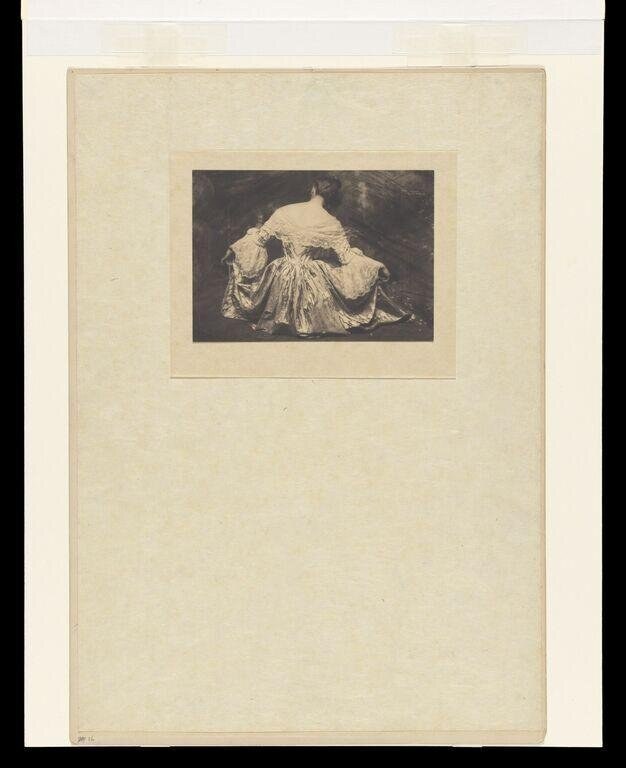
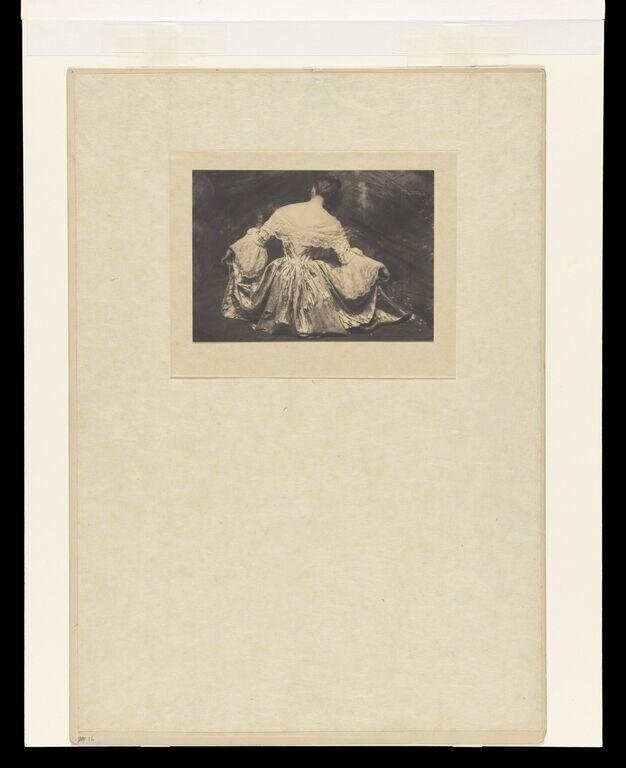
A solitary figure in a billowing white gown occupies the center of a dark ground, viewed from behind and slightly to one side. The dancer's pose suggests a moment of suspension or arrested motion: the body inclines forward, arms raised and spread wide, the voluminous skirts caught mid-swirl around the legs. The white drapery creates a luminous focal point against the deep shadow, with the fabric's folds catching light in a way that suggests movement even as the pose freezes an instant. The composition is intimate and theatrical—a single moment extracted and held, without narrative context or setting beyond the void of the background. The quality of the line and tone suggests an engraving or etching, with careful attention to the play of light across fabric and form.
The dancing
One dancer, female, shown from behind in a pose of dynamic extension. The upper body inclines forward at the waist with arms raised at shoulder height or higher, spread wide in an open frame. The legs appear to be in motion or poised for it, with the heavy skirts defining their position more than direct sight of the limbs. The stance and arm carriage suggest neither the turned-out positions of ballet nor the held formality of ballroom; instead, there is a quality of expressive, almost romantic abandon in the extension and the body's forward tilt.
The dance depicted
The catalogue identifies this as a minuet, and the date of circa 1900 places it at the very end of that dance form's viable social life. However, the pose and costuming do not align with documented minuet technique or presentation. The minuet of the 18th and 19th centuries was danced upright, with precise footwork, measured steps, and restrained arm gestures; it was a dance of formal courtesy and defined social role. This figure's forward inclination, wide arm extension, and the emphasis on expressive gesture suggest instead a late 19th-century romantic or theatrical interpretation—a "minuet" reimagined through the lens of modern dance or theatrical expressivity, or possibly a misnaming of another dance form entirely. The work may document a transitional moment when the minuet was being romanticized for aesthetic or theatrical effect rather than preserved as social practice.
How it was made
The work is executed as an engraving or etching, executed with considerable sophistication in the handling of tone and light. The print medium allowed the artist to work with strong contrasts between the illuminated figure and the dark surround, creating an almost sculptural presence. The fine linear work visible in the drapery and the controlled gradations of tone suggest engraving rather than the looser technique of etching. As a print, this would have circulated beyond the original exhibition context—it was reproducible, collectible, and relatively affordable, making it accessible to the educated middle-class audience interested in dance, art, and aesthetic theory. The technique implies this was not a unique sketch but a finished work intended for publication or portfolio distribution.
About this work
This is a late 19th-century engraving or etching depicting a single figure in a pose labeled as a minuet but executed with a freedom and expressivity that contradicts the historical dance form. The image captures a moment of romantic or theatrical reinterpretation, when older dances were being revived and reimagined through contemporary artistic sensibilities. The work sits at a pivot point in dance history: the minuet as a living social practice was nearly extinct by 1900, yet it retained enough cultural resonance to merit artistic attention. The print format and the museum collection suggest this belonged to a broader fin-de-siècle interest in dance as a subject for serious artistic representation, part of the movement toward dance as a form worthy of fine art attention.
How to look at it
Attend to the moment the artist chose: not the formal beginning or ending of a phrase, but a moment of suspension and extension. The pose is not a resting position but an instant within motion, with the body leaning forward and the arms spread wide, suggesting momentum and emotion. Notice how the artist has used the white drapery as the main vehicle of expression—the skirts carry the sense of swirl and motion, while the body's lean and arm carriage convey reaching, yearning, or expressive abandon. This is a very different visual language from the contained, upright postures that would characterize a historical minuet; it reflects late 19th-century ideas about dance as an expressive and emotional art form.
The artist
Frank Eugene (1856–1936) was an American photographer, painter, and printmaker active in pictorialist circles. He was known for experimental techniques in both photography and printmaking, often working to achieve painterly effects. His work frequently depicted figures, drapery, and allegorical subjects, and he was active in aesthetic and artistic circles in both the United States and Europe. The handling of drapery and light in this print is consistent with pictorialist interests in beauty, form, and the expressive potential of the human figure.
The period
By 1900, the minuet had been absent from ballroom practice for nearly a century, displaced first by the waltz and later by one-steps and other modern dances. However, the Romantic movement of the 19th century had created a taste for the historical and the aesthetic—dances, costumes, and styles from earlier periods were revived for theatrical, educational, or artistic purposes. The 1890s saw a growing interest in dance as a subject for serious artistic representation, partly influenced by the success of Loïe Fuller's experimental dance and by Symbolist and aestheticist movements that valued dance for its formal and expressive properties. In this context, the minuet could be reinterpreted as a vehicle for beauty and emotional expression rather than as a social convention.
Where it lives
The work is recorded as part of the Victoria and Albert Museum collection. The V&A's holdings in dance-related prints and photographs include works from major printmakers and photographers of the late 19th and early 20th centuries, reflecting the museum's role in documenting aesthetic and artistic movements of the period. This print would have been collected as an example of artistic representation of dance rather than as documentary evidence of social dance practice.
Questions about this work
Is this actually a minuet?
The catalogue identifies it as such, but the pose and styling do not match historical minuet technique or presentation. The minuet was danced upright with restrained gestures; this figure displays forward inclination, wide arm extension, and an expressive quality more consistent with Romantic or experimental dance interpretation. The title may reflect the artist's intention to invoke the minuet as a historical reference, or it may be a misidentification. What we see is a reimagined or theatricalized version rather than documentary representation of actual minuet practice.
Why is a minuet being depicted in 1900?
By 1900, the minuet had been out of social practice for nearly a century. However, it retained romantic and historical associations that made it appealing to artists and audiences interested in aesthetics and the past. Theatrical revivals, historical costume balls, and artistic movements celebrated older dances as sources of beauty and cultural memory. This print belongs to that fin-de-siècle interest in dance as a fine art subject worthy of serious representation by skilled printmakers.
What does the engraving technique tell us?
Engraving or etching was an established medium for reproducing images for circulation among educated, affluent audiences. It was more permanent and widely distributable than a drawing, but less immediate than a photograph. The technique allowed fine control over tone and line, creating the dramatic contrast between the illuminated figure and the dark ground. The work's presence in the V&A collection suggests it was valued as both an artwork and a document of contemporary artistic interest in dance.
More Minuet artwork