25 works in this view — arrow keys or swipe to move between them.
Dance in Art
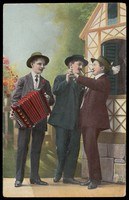
Two Dutch men dancing together, accompanied by an accordionist. Colour photographic postcard, 190-.
Unknown artist
- Dance:
- Tango
- Source:
- Wellcome Collection
- Rights:
- Rights vary by item — check the source record before reusing this image. Source record ↗
- Recorded as:
- Check
This image reveals the gap between how we think of tango (as an Argentine dance with specific instrumentation and aesthetic) and how it actually circulated and was adapted in early 20th-century Europe. It also documents the crucial role of the photographic postcard in making dance visible and shareable to mass audiences before film became dominant—a technology that democratized access to dance documentation but also allowed constant misidentification and recontextualization.
What you are looking at
A color photographic postcard shows three men in early 20th-century dress in what appears to be an interior space with green-tinted walls and wooden furnishings visible in the background. Two men in dark suits face each other in a dance position, while a third man wearing a lighter-colored jacket sits or stands to the left, holding an accordion. The standing dancers are engaged closely, their bodies angled toward one another in a characteristic ballroom frame. The photograph has the soft focus and hand-tinted quality typical of postcards from the 1900s–1910s era.
The dancing
The two dancers occupy a closed position with the man on the right leading and the man on the left following. Both maintain an upright posture with their bodies held in a ballroom frame, arms positioned for partner dancing. The accordion player to the left is separate from the dance action, positioned as an accompanist. The dancers' weight appears centered, their feet close together, suggesting a moment between steps or a stationary pose for the photograph rather than captured mid-movement.
The dance depicted
The catalogue identifies this as tango, but the evidence is weak. The closed ballroom frame and formal dress align with early tango, which emerged in Argentina in the 1880s–1890s and spread rapidly to Europe and North America in the 1910s. However, the frame alone is not distinctive to tango—it was standard in many ballroom dances of the period. The accordion is puzzling: tango orchestras of the era used violin, cello, flute, and bandoneon (a button accordion), not the piano accordion visible here. The two men dancing together is not inherently gendered; early tango was danced by same-sex couples in practice, but the lack of visible Latin American or Argentine cultural markers, combined with the northern European appearance of the subjects and the accordion, suggests this may document a European or North American ballroom dance tradition rather than Argentine tango.
How it was made
This is a color photographic postcard, a mass-produced format that dominated visual communication in the early 20th century. The hand-tinting process—applied in transparent oils or watercolors over a black-and-white photographic print—is evident in the soft, slightly uneven coloring of the walls and clothing. Postcards were inexpensive to produce and distribute, making them the primary medium for documenting daily life, entertainment, and social practice. Their small size and reproductive nature meant wide circulation and accessibility, though individual prints are fragile and often faded.
About this work
This postcard documents a moment in ballroom dancing culture in the early 20th century, when formal partner dance was a central social practice across Europe and North America. The image records not a theatrical performance but an informal or semi-professional demonstration—possibly for the postcard itself—showing how ballroom dance was actually done by ordinary people. The presence of the accordion player raises questions about regional dance practice: the instrument and the all-male grouping suggest this may represent a European folk or social dance tradition that the catalogue has misidentified as tango, or conversely, a tango performance adapted for a northern European audience with unfamiliar instrumentation. Either way, the postcard is valuable as evidence of how dance was photographed, circulated, and understood in the early postcard era.
How to look at it
Attend to the posture and frame of the dancers: the upright, formal closed position was standard across European ballroom dances of the period, from waltz to foxtrot to tango. Notice the accordion—an instrument that would be unusual for an Argentine tango ensemble but common in European folk and popular music. Observe that this is a still photograph posed for the camera, not a candid capture of movement; the dancers have stopped to be documented, which was normal practice for early dance photography. The fact that two men are dancing together was unremarkable in this era, when same-sex practice dancing was routine.
The period
The early 1900s saw an explosion of ballroom dancing as a mass social practice in Europe and North America, driven by urbanization, affordable dance halls, and commercial entertainment. Tango arrived in Europe around 1912–1913 and became an instant craze, though it was often exoticized and reinterpreted by European dancers and musicians unfamiliar with its Argentine origins. The photographic postcard was the dominant technology for documenting and marketing entertainment and social life; millions were produced and collected. Hand-tinted color postcards were a premium product, suggesting this image had commercial value and was intended for distribution to a broad audience.
Where it lives
This hand-tinted color photographic postcard is held by the Wellcome Collection, a London-based institution that collects and documents images related to medicine, science, and social history. Its presence in Wellcome's holdings may reflect an interest in dance as a health or fitness practice, or simply as a document of daily life and entertainment.
Dance in this work
Questions about this work
Why would two men dance together?
In the early 20th century, same-sex partner dancing was routine practice, especially in dance halls and at social events where there were more interested dancers than available partners of the opposite sex. Men practiced with men to learn steps and technique. This was not marked or unusual and does not indicate the dancers' sexual orientation.
Is this really tango?
The catalogue says so, but the evidence is circumstantial. The closed ballroom frame is shared by many dances of the period. The accordion is problematic: Argentine tango used the bandoneon, a different button accordion. The all-male group and the northern European appearance of the subjects suggest this may be a European ballroom or folk dance that was misidentified, or a tango performance adapted for a European audience with unfamiliar instrumentation.
What is a hand-tinted photographic postcard?
A postcard is a small printed card intended for mailing. Early photographic postcards were black-and-white prints made from photographs, then hand-colored with transparent oils or watercolors applied by workers in a factory. This made them inexpensive, mass-produced, and widely collectible. The color was applied by hand, so each card is slightly different and often uneven.
More Tango artwork
![[Les noces de trottoir, par les compagnies Tango Sumo et Vendaval. Chalon dans la rue. 2007 / photographies de Joël Verhoustraeten] by Verhoustraeten, Joël (1954-2019). Photographe](https://gallica.bnf.fr/iiif/ark:/12148/bc6p058zgkc/f1/full/800,/0/native.jpg)