49 works in this view — arrow keys or swipe to move between them.
Dance in Art
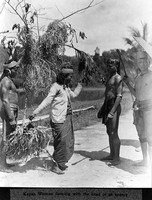
M0005509: Kayan woman dancing, Borneo
Unknown artist
- Source:
- Wellcome Collection
- Rights:
- Rights vary by item — check the source record before reusing this image. Source record ↗
- Recorded as:
- Check
This photograph is one of very few surviving visual records of twentieth-century Kayan dance practice from the performer's perspective and in context—not restaged or interpreted by outsiders. It demonstrates that indigenous Bornean dance integrated natural materials and grounded, weight-based movement in ways distinct from both colonial-era European dance and from the codified classical dance forms of neighboring regions. For dancers and historians, it is evidence that dance was a living, embedded cultural practice in Kayan life, and that the integration of objects and materials into movement was a sophisticated and intentional part of the form.
What you are looking at
A black and white photograph of a woman identified as Kayan, from Borneo, captured mid-movement outdoors. She wears a light-colored sleeveless top and a dark patterned wrap skirt characteristic of Kayan dress, with her dark hair loosely bound or loose. Her posture is dynamic: the torso is inclined slightly forward with one leg extended and the other supporting her weight, creating a forward-stepping momentum. She holds what appears to be foliage or branches—a tree with leaves and small branches—in front of her body with both hands. The setting is rural and bare, with minimal vegetation visible in the soft-focus background. The photograph is taken in natural light with no apparent studio equipment, capturing a moment of movement that suggests active participation in a dance or ritual practice rather than a posed portrait.
The dancing
A single female figure in a dynamic stepping or lunging position, with forward movement and weight shifting through the legs. Her upper body is engaged as she manipulates the branch or foliage she holds, bringing it into play as part of the movement. The stance suggests both control and fluidity—the extended leg and forward lean indicate active propulsion through space, not a static pose. Her arms and hands work the plant material in front of her rather than extending outward in a balletic frame, anchoring the dance to the object.
The dance depicted
This appears to be a Southeast Asian indigenous or ceremonial dance, likely part of Kayan cultural practice from Borneo. The integration of the plant material—held and manipulated as an active element of the movement rather than worn as costume—suggests this may be a fertility rite, harvest ritual, or vegetation-related ceremonial dance common to many indigenous Austronesian cultures. The stepping and forward-lunging action, combined with the focus on the foliage, indicates a grounded, earth-connected movement vocabulary rather than elevated or turn-based forms. Without more specific documentation, the exact dance name and its ritual context cannot be determined, but the image confirms a living dance practice embedded in material culture and seasonal or spiritual practice.
How it was made
This is a monochrome photograph, likely gelatin silver print or similar process from the early-to-mid twentieth century, based on the grain, contrast, and outdoor lighting quality. The photograph was taken outdoors in natural daylight with no artificial lighting, which means the photographer had to work with available light and the movement of the subject. The soft background and sharper focus on the figure suggest a moderate focal length and fast film or shutter speed adequate to freeze motion without blur. As a documentary photograph in an ethnographic collection, it belongs to the tradition of anthropological image-making, where the photograph serves as evidence and documentation of cultural practice rather than artistic composition.
About this work
This photograph documents a Kayan woman performing a dance that integrates plant material into the movement vocabulary—a characteristic feature of many Southeast Asian indigenous ritual or seasonal dances. The image captures a moment of dynamic stepping and body weight transference, with the foliage held and manipulated as an integral element rather than ornament. It is a rare visual record of a living cultural practice as it was performed, rather than a staged recreation, and represents the ethnographic documentary photography tradition that preserved evidence of indigenous dance forms during the early-to-mid twentieth century. The photograph belongs in a gallery of dance in art because it is both documentary evidence and evidence of aesthetic and ritual knowledge embedded in movement, and because it represents a form of dance that sits outside European theatrical and ballroom traditions but deserves equal attention.
How to look at it
Watch the weight and the legs: the extended leg and the forward-leaning torso tell you this is a movement of propulsion and momentum, not a held position or a pose. Notice how the plant material is not simply carried but actively held in front of the body and engaged by both hands—it is part of the dance, not a costume accessory. The photograph captures a moment mid-stride, which is the artist's choice; we see the work of moving through space, not a climactic or stationary moment. This freezing of the walking or stepping action is the photographic technique that allows us to see the body position and the integration of the object in a way that would be blurred or missed in real time.
The period
This photograph was made during a period when anthropological and ethnographic documentation was becoming more widespread in colonial and early postcolonial Southeast Asia. The early-to-mid twentieth century saw increased Western interest in documenting indigenous cultural practices, often as part of imperial or missionary projects. In Borneo specifically, colonial administration and increasing contact with the outside world were beginning to change Kayan life and practice. The photograph is evidence of a moment when such documentation was still possible and was being undertaken, though often through the lens and framing of colonial-era observers and collectors. The Wellcome Collection's inclusion of this image reflects the broad mandate of early twentieth-century medical and ethnographic collecting, where dance, ritual, and cultural practice were recorded as part of broader documentation of human societies.
Where it lives
The photograph is held by the Wellcome Collection, a major archive of medical and anthropological material from the late nineteenth and twentieth centuries. It entered the collection as part of a broader ethnographic archive, but its original photographer, date of capture, and context of commission are not recorded in the available catalogue. The image is now available as part of the Wellcome Collection's public archive.
Dance in this work
Questions about this work
Is this a ritual dance or a social dance?
Based on the use of plant material as an integral element and the outdoor, seemingly unprompted context, this appears to be a ritual or ceremonial dance rather than a social form. Fertility rites, harvest dances, and seasonal ceremonies in Southeast Asian indigenous cultures often incorporate vegetation and grounded, earth-connected movement vocabularies. The photograph does not provide enough context to determine the specific ritual purpose, but the integration of the foliage into the movement suggests a sacred or ceremonial rather than purely recreational function.
What is the Kayan group and where are they from?
The Kayan (also known as Kayans) are an indigenous Austronesian ethnic group primarily from Sarawak and parts of Kalimantan in Borneo. They have a rich cultural heritage including distinct dress, social structures, and ceremonial practices. The Kayan were and remain known for their weaving, tattooing, and cultural knowledge embedded in ritual and seasonal practice.
What does the plant material represent?
Without documentation, the specific meaning of the foliage cannot be stated with certainty. However, in many Southeast Asian indigenous dances, plant material can represent fertility, seasonal change, communion with land, or connection to forest and agricultural cycles. The active manipulation of the foliage by the dancer suggests it is a meaningful and intentional part of the movement vocabulary, not merely decorative.
When was this photograph taken?
The catalogue record lists the date as unknown. Based on the photographic process, the style of the image, and the colonial context of the Wellcome Collection, the photograph was likely taken in the early-to-mid twentieth century, but this cannot be confirmed without additional documentation.
More dance artwork