49 works in this view — arrow keys or swipe to move between them.
Dance in Art
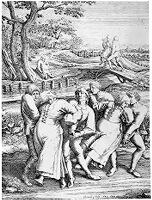
M0013485: Scene depicting the dancing mania
Unknown artist
- Source:
- Wellcome Collection
- Rights:
- Rights vary by item — check the source record before reusing this image. Source record ↗
- Recorded as:
- Check
The dancing mania represents a crucial moment in the history of how bodies move when the mind loses control—a phenomenon that fascinates historians of medicine, psychology, and culture. For dancers and movement historians, the image poses questions about embodiment, agency, and the difference between performing a dance and being compelled to move. It is also a rare historical instance where visual art documents mass movement in crisis rather than in celebration or ceremony.
What you are looking at
This engraving depicts a chaotic outdoor scene of the dancing mania, a phenomenon documented in medieval and Renaissance Europe where groups of people danced uncontrollably, often to the point of exhaustion or death. The composition is crowded and animated, with numerous figures scattered across a landscape with trees and buildings visible in the background. The dancers occupy the center and foreground, their bodies contorted in various attitudes of movement—some upright and active, others collapsed or supported by onlookers. The style is characteristic of Northern European printmaking, with fine crosshatching establishing form and shadow. The scene conveys both the frenzy of the dancers and the concern of the witnesses surrounding them; some figures appear to be watching or restraining the afflicted, while musicians or attendants are scattered throughout. The overall impression is of a moment caught between spectacle and crisis.
The dancing
The dancers display a range of postures: some stand with arms raised or extended in wild gestures, heads thrown back; others bend forward at the waist or lean heavily on companions; a few appear to be falling or lying on the ground. There is no unified dance formation or coordinated ensemble work—instead, each figure seems to be moving independently and desperately. The bodies show tension and strain rather than grace; legs are splayed, torsos twisted, limbs flailing. Onlookers and attendants grasp at the dancers or stand witnessing the scene. The weight distribution suggests exhaustion and loss of control rather than intentional choreography.
The dance depicted
This depicts the dancing mania (also called dancing plague), a documented historical phenomenon most famously occurring in Strasbourg in 1518 and other European towns in the medieval and early modern periods. Sufferers danced compulsively for hours or days without rest, often until they collapsed from exhaustion. The image does not represent a codified dance style but rather a medical or religious crisis interpreted through movement. Contemporary accounts attributed it variously to divine punishment, demonic possession, ergot poisoning, or mass hysteria. The engraving presents it as both a spectacle and a tragedy—the dancers are not performing but suffering, and the gathered crowd responds with a mixture of concern and fascination.
How it was made
This is an engraving, a printmaking technique in which an image is incised into a metal plate (typically copper) and then printed. The fine parallel lines (hatching and crosshatching) visible throughout the composition are characteristic of engraved line work and create tonal modeling and shadow. Engravings allowed for mass reproduction and wide distribution, making this an image that circulated among educated audiences across northern Europe. The technique's precision and the composition's complexity suggest this was a work of some ambition, likely designed to document and interpret a significant historical or contemporary event for a literate public.
About this work
This engraving records the dancing mania, a historical phenomenon of compulsive, uncontrollable dancing that struck communities across medieval and early modern Europe. It is not a depiction of a dance style performed for entertainment or ceremony, but rather of a crisis event—a moment when bodies moved against the will of those inhabiting them. The work belongs in a gallery of dance in art because it represents one of the most extreme and troubling intersections of movement and human experience, and because it was the subject of considerable artistic attention in its time. The engraving format indicates this image was created to circulate widely and to serve as a visual record of a phenomenon that challenged medical, theological, and social understanding.
How to look at it
Study the postures of individual dancers and note how they differ from the coordinated symmetry of ceremonial or recreational dancing. Observe how the artist rendered exhaustion and loss of control through twisted limbs, collapsed bodies, and the apparent desperation in the figures' attitudes. The composition's lack of a clear focal point or narrative center reinforces the chaos of the moment. Notice how onlookers and attendants are interspersed with the dancers, suggesting both fascination and medical concern—this was not entertainment but a crisis demanding explanation and intervention.
The period
The dancing mania was most extensively documented in the 15th, 16th, and 17th centuries, with the most famous outbreak occurring in Strasbourg in 1518. By the time this engraving was made, the phenomenon was already historical enough to warrant documentary and moralizing artistic treatment. Northern European printmakers and artists were particularly interested in recording unusual events, medical conditions, and social phenomena—their work served as a form of news distribution and scientific illustration combined. The engraving format reflects the print culture of the Renaissance and early modern period, when newly developed printing technology allowed for rapid reproduction and distribution of images that documented, explained, and sometimes moralized about exceptional human experiences.
Where it lives
This work is held in the Wellcome Collection, a major repository of medical and historical imagery. The Wellcome Collection focuses on the history of medicine, science, and human experience, and this engraving fits that mission as a visual document of a historical medical or psychological crisis.
Questions about this work
What is the dancing mania?
The dancing mania, or dancing plague, was a real historical phenomenon in which groups of people danced compulsively and uncontrollably, often for days, sometimes until they collapsed or died. The most famous outbreak occurred in Strasbourg in 1518, where it began with one woman and spread to dozens of others. Causes remain debated; contemporary sources blamed divine punishment, demons, or poisoning. Modern theories include ergot poisoning from contaminated grain, mass psychogenic illness, or other medical and psychological factors.
Is this a real dance or a fictional event?
The dancing mania was a real historical event, well-documented in chronicles and medical records. However, this engraving is an artistic interpretation of those events rather than a direct eyewitness record. The artist was interpreting written and oral accounts to create a visual representation of how the phenomenon appeared and what it meant.
Why would an artist choose to depict this?
Early modern artists and printmakers recorded unusual, remarkable, or troubling events as a form of documentation and moral instruction. The dancing mania was both medically mysterious and theologically significant, making it a subject of intense interest. Engravings allowed these images to circulate widely among educated audiences, functioning as a combination of news, scientific illustration, and moral commentary.
More dance artwork