49 works in this view — arrow keys or swipe to move between them.
Dance in Art
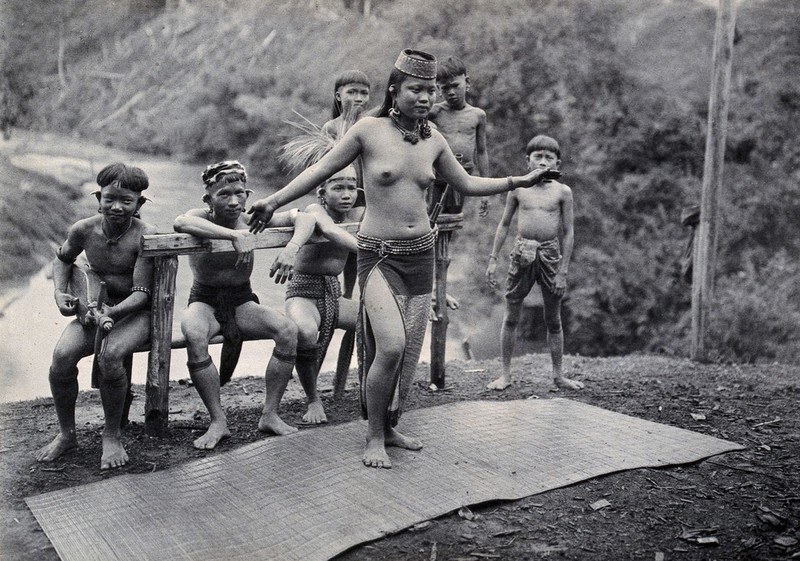
Sarawak: a Kenyah girl dancing. Photograph.
Unknown artist
- Source:
- Wellcome Collection
- Rights:
- Rights vary by item — check the source record before reusing this image. Source record ↗
- Recorded as:
- Check
The image is significant because it documents indigenous Southeast Asian dance at a moment when such practices were rarely recorded photographically, and because it reveals the apparatus of ethnographic documentation itself—the staging, the gaze, the translation of movement into still image. For researchers tracing colonial-era representations of Asian dance, this photograph is a primary source for understanding both the dance tradition and the power relations embedded in how it was recorded.
What you are looking at
A black-and-white photograph shows a young woman in the center of the frame, bare-chested and wearing a woven skirt, with her arms extended outward at shoulder height in a dynamic pose. She stands on what appears to be a woven mat or platform. Around her are several children—also bare-chested and minimally clothed—some seated on a wooden bench or log behind her, others standing to the sides. The background shows dense tropical vegetation and what may be a wooden structure or shelter. The photograph has the quality of early-to-mid 20th-century field documentation, with soft focus and the characteristic tonal range of that era. The composition captures a moment of performance or demonstration, with the central figure commanding attention while the children observe.
The dancing
The primary dancer stands with feet grounded, arms raised to full lateral extension at or slightly above shoulder height, creating an open, expansive frame. The pose suggests weight is centered and balanced. Her torso is upright and the gesture conveys movement quality that is neither constrained nor folded. The children around her—ranging from toddlers to pre-adolescents—are stationary observers, some seated, some standing, creating a circle of attention around the performer. The compositional arrangement suggests this is a teaching or demonstration moment rather than communal participation.
The dance depicted
This appears to be a moment in Kenyah dance, documented as part of ethnographic field recording rather than performance in the Western theatrical sense. The Kenyah people are an indigenous Dayak group from Borneo (now primarily in Sarawak, Malaysia), and their dance traditions are integral to cultural ceremonies, celebrations, and social life. The open arm position and grounded stance are consistent with Southeast Asian indigenous movement vocabularies, though without comparative documentation of Kenyah dance practice, the specific form cannot be precisely identified. The presence of children suggests this may be cultural transmission or a social gathering rather than a formal ceremonial dance.
How it was made
This is a silver gelatin or albumen photographic print, characteristic of early-to-mid 20th-century anthropological and colonial documentation. The soft focus, tonal range, and image quality suggest field photography rather than studio work—likely taken by a visiting photographer, medical officer, or colonial administrator. Photography of this period served as evidence and record in ethnographic discourse, though it also inevitably shaped and simplified what was being documented. The technical limitations and conventions of the medium meant that movement, which is inherently temporal, was frozen into a static pose, emphasizing gesture over the flow of motion.
About this work
This photograph documents a moment in Kenyah dance from Sarawak, captured as part of early-to-mid 20th-century ethnographic recording. The image shows a young woman in a dynamic open pose with extended arms, surrounded by observing children, on what appears to be a community gathering. The work sits within the broader colonial and early anthropological archive of Southeast Asian indigenous cultures—a body of documentation that was simultaneously a record of living practice and a colonial act of representation that flattened complexity into visual evidence.
For dance historians, the photograph raises questions about how indigenous movement was documented, staged, and interpreted by outsiders. The formal pose, the presence of observers, and the documentary framing all suggest that what we see may be a demonstration created for the camera rather than a moment of unrehearsed cultural practice. The work is valuable precisely for these tensions: it shows us not simply Kenyah dance, but how Kenyah dance was made visible to Western observers in the colonial period.
How to look at it
Observe the balance and weight distribution in the dancer's stance—the feet appear planted, suggesting stability beneath the expansive arm gesture. Notice the choice to photograph the dancer mid-gesture rather than at rest, which conveys dynamism even in a still image. The presence of the children and the wooden structure in the background grounds this in a specific social context rather than presenting dance in isolation. The soft photographic focus and the posed quality of the composition suggest this was a documented moment rather than candid capture, inviting questions about what was asked of the dancer and what the camera chose to frame.
The period
This photograph dates to an era when ethnographic photography was becoming established as a tool of anthropological knowledge-making, though the exact date is uncertain. In the early-to-mid 20th century, Sarawak was under British rule, and photography of indigenous peoples was frequently conducted by colonial administrators, medical officers, missionaries, or visiting scholars. The Kenyah, like other Dayak peoples, maintained rich dance traditions tied to harvest festivals (Gawai), healing rituals, and community celebrations, but these were rarely documented in ways that centered the dancers' own understanding. The photograph reflects the conventions of colonial-era ethnography: the framing of indigenous culture as static, observable, and separable from context.
Where it lives
The photograph is held in the Wellcome Collection, a major repository of historical medical, scientific, and anthropological materials accumulated through the 20th century. Within that archive, photographs of non-Western peoples and practices were often acquired as documentation of 'exotic' cultures from a medical and colonial perspective.
Dance in this work
Questions about this work
What is Kenyah dance?
The Kenyah are an indigenous Dayak people of Borneo, primarily in what is now Sarawak, Malaysia. Their dance traditions are part of cultural ceremonies and social gatherings, particularly associated with harvest festivals and celebrations. Movement typically emphasizes grounded, balanced stances with arm gestures that can be expansive and articulate, often performed in community settings rather than as solo theatrical performance.
Why does this look staged?
The posed quality—the formal stance, the arrangement of observers, the centered composition—suggests this was created for the camera rather than captured candidly. Colonial-era ethnographic photography often involved requesting people to 'perform' their culture for documentation. The resulting images are valuable historical records, but they show us mediated representations rather than unrehearsed practice.
Who took this photograph?
The photographer is not recorded. In the colonial period, photographs of Sarawak's indigenous peoples were often taken by administrators, missionaries, or medical personnel. The Wellcome Collection's holdings suggest this may have been acquired as part of medical or scientific documentation, but the specific context of its creation is not documented in the available record.
More dance artwork