49 works in this view — arrow keys or swipe to move between them.
Dance in Art
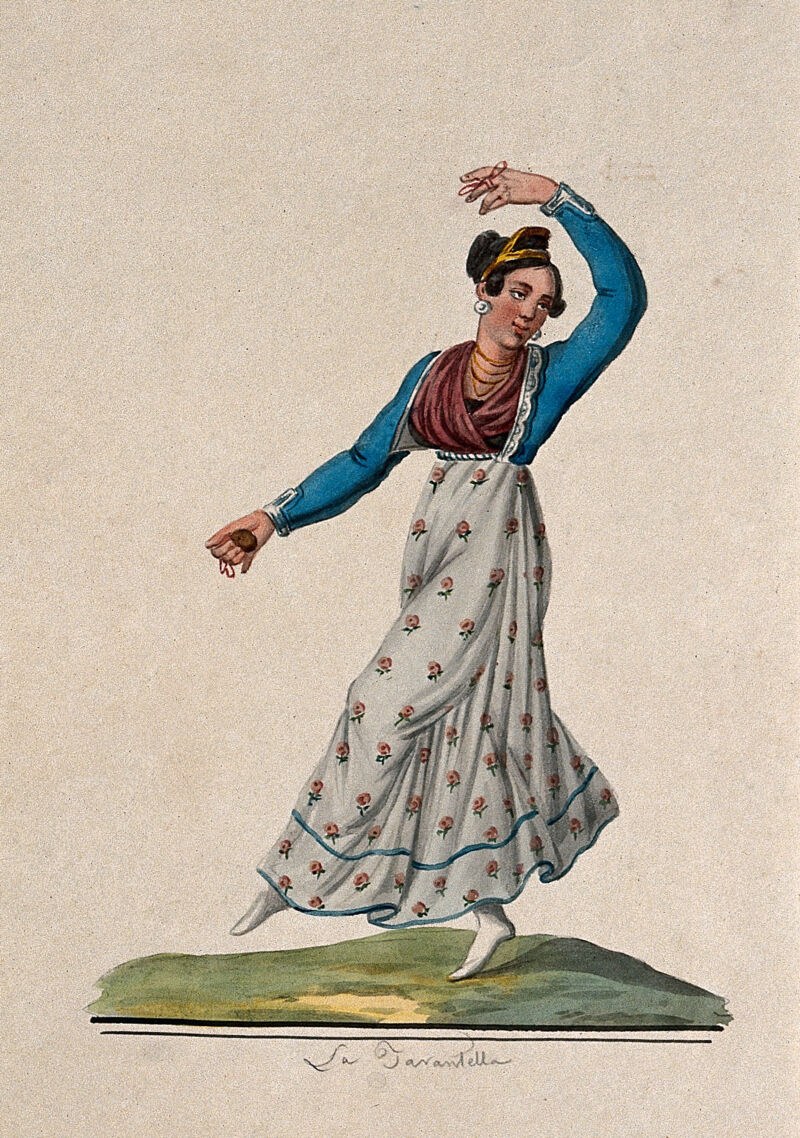
A young woman dancing the tarantella. Watercolour.
Unknown artist
- Source:
- Wellcome Collection
- Rights:
- Rights vary by item — check the source record before reusing this image. Source record ↗
- Recorded as:
- Check
The tarantella was a powerful and contested dance in the 19th-century European imagination—associated with southern Italy, femininity, contagion, and transgressive energy—and this image captures how the dance was visually documented and circulated among the educated public. For dancers and historians, it provides concrete evidence of how a living, improvisatory folk practice was understood, posed, and represented when filtered through the conventions of scientific illustration and costume study.
What you are looking at
A single female dancer is shown in a moment of spirited movement, posed against a plain cream background with a green ground line beneath her feet. She wears a blue long-sleeved bodice with a high neckline trimmed in cream, and a pale grey skirt with a repeating pattern of small red floral motifs and a blue hem border. Her dark hair is styled up with a yellow or gold band or ribbon, and she wears pearl earrings. Her arms are raised in an asymmetrical position—the right arm extends upward with fingers splayed, while the left arm is bent with the hand at shoulder height—and her body leans back slightly in an attitude of abandon. Her posture and the slight lift visible in her stance suggest active movement. The composition is a formal figure study, with the dancer isolated and centered against the neutral background in the manner of a costume or character study illustration.
The dancing
The dancer stands in a posed attitude rather than a captured moment of balletic technique. Her weight appears to be distributed unevenly, with her torso tilted backward and her arms raised in an expressive rather than formally controlled manner. The asymmetrical arm position—one raised high, one lower—creates a sense of movement and pleasure rather than the symmetry typical of courtly dance. Her knees show a slight flex, and the overall frame suggests a folk or social dance rather than classical training. She is a soloist, commanding the entire pictorial space.
The dance depicted
The inscription beneath the figure reads 'La Tarantelle' (The Tarantella), a southern Italian solo or paired dance traditionally performed, especially by women, and associated with both festive celebration and purported therapeutic ritual. The tarantella is characterized by rapid footwork, rotating movement, and an increasing tempo. The posture and arm position shown here—open, asymmetrical, and expressive—are consistent with the energetic and improvisatory spirit of the tarantella, though the artist has chosen a moment of extended pose rather than documenting the rapid footwork the dance demands. The costume is broadly consistent with 19th-century southern Italian dress, supporting the identification.
How it was made
This is a hand-colored watercolor on paper, in which pigment is layered transparently or semi-opaquely over a drawn underdrawing. The technique is characteristic of early-to-mid 19th-century costume and character studies, and allowed for both precision of detail and rapid production. The flatness of the background and the careful rendering of dress details suggest this was created for documentation or publication purposes—possibly as a costume reference, a record of a dancer's performance, or an illustration for a periodical or book on dance and national costume. The watercolor medium was well-suited to the circulation of such images among artists, theater practitioners, and educated collectors.
About this work
This is a watercolor figure study of a woman dancing the tarantella, an energetic southern Italian solo dance. The work documents both the dance itself—through the dancer's open, asymmetrical posture and the spirited energy of the pose—and the regional costume associated with it in the 19th century. As a study of a named, identifiable dance performed by a recognizable figure type, it belongs to a significant 19th-century tradition of documenting European folk and national dances through costume illustration and character studies. The Wellcome Collection's holding suggests the work was valued as a document of cultural practice, though it is also a record of how educated Europeans understood and visualized non-courtly dance.
How to look at it
Pay attention to the asymmetry and openness of the arms: this is the opposite of the controlled, symmetrical port de bras of classical ballet being refined and standardized in the same period. The backwards lean and the splayed fingers suggest a dance of exuberance and release rather than restraint. The artist has frozen the figure in a pose that suggests motion—the energy of the tarantella—rather than a static moment. The bright patterns of the skirt and the careful attention to the regional dress are deliberate: the costume is as much the subject as the dance itself.
The period
The early-to-mid 19th century saw an intense European interest in folk and national dances as markers of regional identity and exotic difference. The tarantella held particular fascination: it was documented in scientific and medical literature as well as travel accounts, and was often associated with female sexuality, Orientalism, and the therapeutic or cathartic properties attributed to rhythmic movement. The same period saw the rise of Romantic ballet in the theater, which drew on folk and national dance as material—the sylph, the peasant girl, the Spanish or Italian dancer became stock characters. This watercolor sits at the intersection of these interests: it is neither a theatrical costume design nor a scientific medical document, but a hybrid figure study that documents the dance, the costume, and an imagined moment of performed femininity.
Where it lives
The work is held in the Wellcome Collection, a major holding of medical, scientific, and cultural history objects. Its presence there suggests it was valued as a document of human behavior, cultural practice, or medical/anthropological interest in dance traditions and their regional contexts.
Dance in this work
Questions about this work
What is the tarantella?
The tarantella is a rapid, energetic solo or paired dance from southern Italy, traditionally danced at celebrations and festivals. In the 19th century, it was often performed by women and became famous in European culture as an exotic, passionate, and transgressive dance. The dance is characterized by spinning, rapid footwork, and a tempo that accelerates as the dance continues.
Is this a real dancer or a generic figure?
The watercolor shows a posed, idealized figure rather than a portrait of a specific dancer. It is instead a type study or costume reference—a document of how the tarantella and its associated dress were understood and visualized by educated European audiences in the 19th century. Such studies were used by artists, theater practitioners, and collectors to record and circulate knowledge of dances and regional costume.
Why is this in a medical collection?
The Wellcome Collection documents the history of medicine and science in the broadest sense, including the scientific and medical observation of human practices. The tarantella was the subject of significant medical and anthropological writing in the 18th and 19th centuries, which attempted to explain and classify the dance—sometimes as a therapeutic practice, sometimes as a symptom or pathology. This image likely entered the collection as a document of cultural and bodily practice.
More dance artwork