49 works in this view — arrow keys or swipe to move between them.
Dance in Art
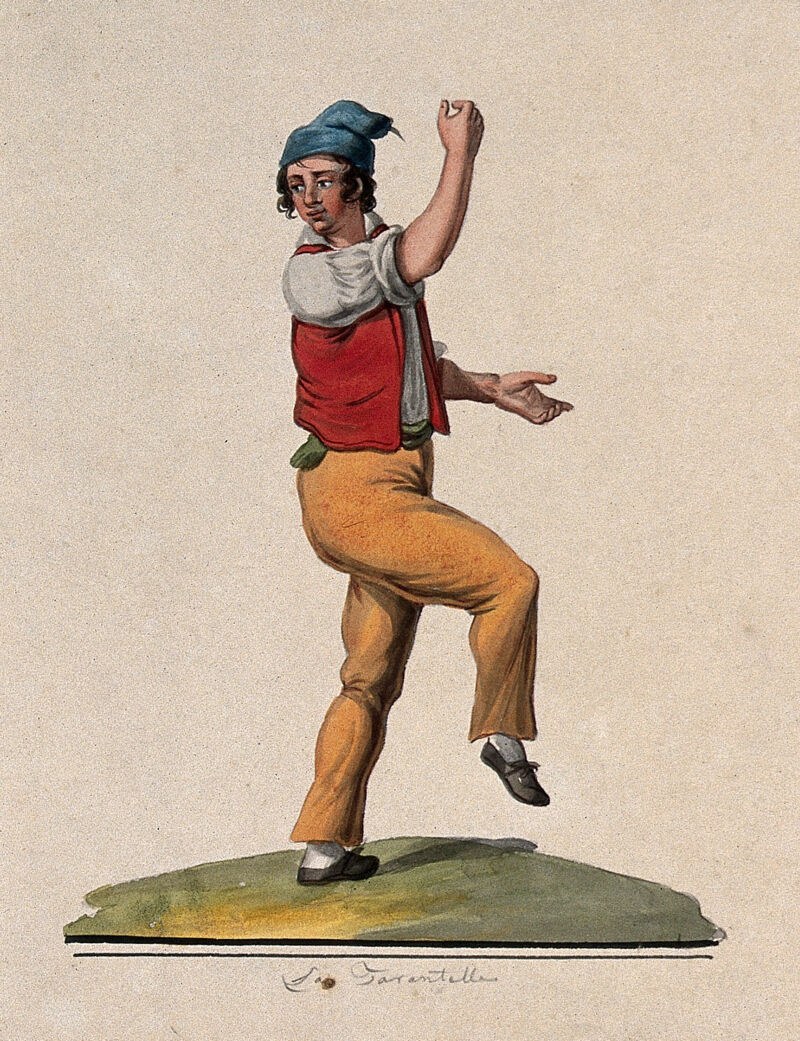
A young man dancing the tarantella. Watercolour.
Unknown artist
- Source:
- Wellcome Collection
- Rights:
- Rights vary by item — check the source record before reusing this image. Source record ↗
- Recorded as:
- Check
The tarantella is one of the most documented dances in Western art history, but this image is unusual in showing it as a solo male performance in folk costume, and in capturing the specific moment of weight and lift that defines the dance's technical character. For historians of Italian regional culture and of 19th-century dance documentation, this watercolour provides a rare window into how the dance was understood and performed outside theatrical contexts.
What you are looking at
A young man in early 19th-century dress performs a dynamic solo dance against a plain cream background. He wears ochre-gold breeches, a red sleeveless tunic with a white draped shoulder cloth, and a blue cap; his feet are in black shoes. His body is captured mid-leap or mid-step, with his right leg raised and bent, his left leg extended downward in a springing position. His upper body twists slightly, with his right arm raised to shoulder height and his left arm extended outward at waist level, palms open in a gesture of exuberance. The figure stands on a shallow green ground line that suggests a stage or performance surface. The painting style is careful and naturalistic; the watercolour technique allows subtle modulation in the fabric textures and flesh tones. The pose itself communicates energy and joy—the dancer appears mid-flourish, captured at the moment of greatest lift.
The dancing
A single male dancer, his weight on the ball of his left foot, his right leg raised with knee bent at roughly 90 degrees. His torso is upright and slightly rotated; his arms are held at different heights in an open, celebratory frame rather than in any closed or partnered hold. The positioning suggests a moment of elevation and pivot—a body moving through space with purpose. The arm positions and raised leg are consistent with folk or social dance conventions of the period rather than with formal theatrical technique.
The dance depicted
The title explicitly identifies this as the tarantella, the rapid southern Italian dance known for its 6/8 time signature, energetic footwork, and open upper-body frame. The tarantella was popular throughout Europe in the 19th century and frequently appeared in theatrical and visual contexts as an emblem of Italian regional character and exuberant social dancing. This image shows the dance as a solo male performance rather than the couple or group form more often depicted. The raised leg, open arm position, and spirited bearing are consistent with tarantella choreography—a dance characterized by quick steps, spins, and a lightness of weight that the artist has attempted to convey through the mid-leap pose.
How it was made
This is a watercolour on paper, a technique that produces luminous transparent colour and requires confident, swift execution—mistakes cannot be fully concealed. The artist has used layered washes to build form, with careful attention to the contrast between the dancer's warm skin tones and the cool blue cap and white cloth. The ground line and background are minimal, focusing attention entirely on the figure and gesture. The technique suggests a work made for reproduction or as part of a larger series on dance types or folk customs—watercolours were popular for such purposes in the early 19th century.
About this work
This watercolour documents the tarantella as a living social dance in early 19th-century Europe, capturing not the couple format but a solo male performer in the exuberant, virtuosic mode that made the dance famous. The artist demonstrates real understanding of the dance's physics—the weight placement, the openness of the frame, the sense of elevation—and has chosen to freeze the dancer at the moment of greatest energy and lift. The work sits within a broader tradition of European interest in regional and folk dance, a tradition that spans from Romantic-era theatre to the ethnographic documentation impulse of the period. It offers evidence of how the tarantella was actually performed outside the operatic stage: as a social dance by individuals, in folk dress, with genuine virtuosity.
How to look at it
Attend to the position of the dancer's weight and the character of his elevation. Unlike ballet, which emphasizes sustained height and turned-out lines, the tarantella in this image is earthier—the dancer springs from a bent knee, the leg rises bent rather than extended and turned out, and the upper body remains relatively square and free. The artist has captured the moment of greatest lift in a single spirited gesture, which conveys the dance's character as rapid, joyful, and unpretentious. The open arm positions and engaged torso—neither the formal frame of ballroom nor the ethereal carriage of ballet—are the visual signature of social dance.
The period
The early 19th century saw intense European fascination with regional and folk dance, coinciding with Romantic interest in authentic culture, national character, and picturesque costume. The tarantella had already achieved wide fame through its inclusion in operas and ballets—notably in operatic scenes of Italian local colour—and had become a standard figure in dance manuals and collections of 'character dances.' This watercolour belongs to that moment when folk dance was being systematically documented, collected, and translated into visual form for educated European audiences. Watercolour was the ideal medium for such work: portable, swift, and suited to commercial reproduction.
Where it lives
This work is held by the Wellcome Collection, which holds watercolours and prints documenting costume, custom, and medical and social history across cultures. Within that collection, it represents the documentary and ethnographic impulse of 19th-century Europe to systematize and visualize human activity and variation.
Dance in this work
Questions about this work
Why is this a solo dance when tarantella is usually danced by couples?
The tarantella exists in several forms: the couple version (most common in ballrooms and theatre) and the solo version (performed in folk contexts and by travelling dancers). This image documents the solo virtuosic tradition, which emphasizes individual footwork and energy rather than partnership. Solo tarantella performance was particularly associated with street performance and folk celebration in southern Italy.
What is the dance step the artist has frozen here?
The artist has captured what appears to be a scissor step or turning moment—the raised knee and extended supporting leg suggest a rapid weight transfer and pivot, which are characteristic of tarantella footwork. The open arm position and upright torso indicate this is a moment of display rather than a preparatory or transition step.
How do you identify the dance from the image alone?
The title states it explicitly. However, the elements that would signal tarantella to a period viewer are: the Italian regional costume (blue cap, ochre breeches, red tunic), the dynamic lifted pose, the open arm frame, and the spirited energy. The pose itself—energetic, weightless, individual rather than partnered—is typical of how tarantella was visualized in 19th-century popular culture.
More dance artwork