49 works in this view — arrow keys or swipe to move between them.
Dance in Art
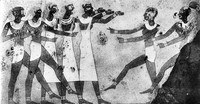
M0006210: Egyptian wall painting showing people dancing
Unknown artist
- Source:
- Wellcome Collection
- Rights:
- Rights vary by item — check the source record before reusing this image. Source record ↗
- Recorded as:
- Check
This is among the earliest extant visual records of organized human dance, predating most written dance documentation by centuries. It demonstrates that ancient Egyptians considered dance significant enough to include in monumental temple and tomb decoration, indicating its central role in religious ceremony and state ritual. For any study of dance history before notation or photography, such images are primary evidence of how bodies moved and what meanings were attached to that movement.
What you are looking at
A monochromatic wall painting in the style of ancient Egyptian art shows a procession of figures arranged in horizontal registers, typical of pharaonic decorative schemes. The composition depicts multiple human figures in profile, their bodies rendered in the characteristic Egyptian convention of head and legs in profile while the torso faces forward. The figures wear simple garments and appear to be arranged in two or more horizontal bands across the surface. Some figures have their arms raised or extended, suggesting movement or gesture. The image quality is grainy and weathered, consistent with a photograph of an ancient artifact rather than the original artwork; the surface shows signs of age and damage typical of recovered tomb or temple wall paintings.
The dancing
The dancers—there appear to be at least six to eight figures visible—are depicted in profile, standing or moving across the register. Several have one or both arms raised or extended outward, suggesting an open arm position rather than a closed partnered hold. The legs and lower bodies are rendered in the strict profile view characteristic of Egyptian convention, making specific footwork difficult to assess. The bodies appear upright and moving horizontally across the space rather than turning or rotating. The spatial arrangement suggests a processional or linear formation rather than coupled pairs or complex floor patterns.
The dance depicted
This appears to be a record of ancient Egyptian ritual or celebratory dance, most likely from a tomb or temple context given the formal register composition and monochromatic wall-painting technique. Egyptian dances of the pharaonic period served religious, ceremonial, and social functions, often performed during festivals, funerary rites, or royal occasions. The raised-arm gestures and horizontal processional arrangement are consistent with documented Egyptian dance forms, though the specific style cannot be named with certainty from this image alone. The lack of visible musicians or specific costume markers makes precise identification difficult, but the formal compositional register and profile rendering indicate this records a dance considered significant enough for permanent monumental record.
How it was made
This is a photograph of an ancient Egyptian wall painting, likely from a tomb or temple dating to the pharaonic period (the exact dynasty cannot be determined from the image). The original would have been executed in pigment on plaster using the buon fresco or tempera techniques typical of Egyptian wall decoration. The monochromatic appearance in this photograph may reflect the original pigmentation or result from age and damage; Egyptian tomb paintings often employed multiple colours. The photograph itself is a gelatin or albumen print typical of early archaeological documentation, suggesting this image was taken during excavation or museum study sometime in the late 19th or early 20th century.
About this work
This artwork documents an ancient Egyptian dance in the conventional form of pharaonic wall painting: a processional arrangement of figures shown in the strict profile-and-frontal convention that dominated Egyptian representational art for over two millennia. The raised arms and horizontal movement suggest a formal, possibly ceremonial dance performed as part of religious or state ritual. As a preserved record from tomb or temple decoration, it represents one of humanity's earliest visual documents of organized dance and offers insight into the movement vocabulary, social status, and ritual significance of dance in ancient Egyptian society.
The work holds particular value for dance historians because wall paintings were among the primary ways ancient Egyptians recorded activities they considered important enough to preserve for eternity. Unlike written descriptions, such images provide direct visual evidence of body position, spatial arrangement, and the relationship between dancers and their social context—information no text could fully convey.
How to look at it
Attend first to the register composition and profile convention: this is how Egyptians chose to show human movement, and the strict adherence to these rules tells us this was a formal, officially sanctioned record. Note the raised arms and open positions of the figures—these are characteristic of Egyptian dance gesture as documented across multiple tomb and temple sources. The horizontal procession and lack of partnering suggest a line or group formation rather than couple dances. The repetition of similar figures is typical of Egyptian compositional method and may indicate either multiple dancers or a convention of showing sequence of movement.
The period
Ancient Egyptian dance served multiple functions across pharaonic civilization: religious ceremonies honoring gods, funerary rites ensuring safe passage to the afterlife, entertainment at royal courts, and celebratory performances at festivals. Dance was predominantly performed by women in many contexts, though men also danced in ritual and military contexts. The formal, processional quality of this image suggests a state or temple occasion rather than informal social dance. Wall paintings in tombs and temples functioned as permanent records ensuring the continuation of these rituals in the afterlife—the painted image itself was believed to possess efficacy.
Where it lives
This work is held in the Wellcome Collection, a major repository of medical, scientific, and cultural artifacts. The Wellcome houses this as part of its broader historical and ethnographic holdings, though the specific original context (which tomb, temple, or excavation) is not recorded in the available catalogue.
Dance in this work
Questions about this work
How do we know this depicts dance and not just people standing?
The raised and extended arms, the dynamic horizontal arrangement of the figures, and the position within a formal register composition all suggest purposeful movement rather than static posture. In Egyptian art, standing figures with specific gestures were the primary way to represent movement. The inclusion of this scene in monumental tomb or temple decoration indicates the activity was significant—Egyptians did not preserve frivolous imagery.
Can we tell what kind of dance this was?
Not with certainty from this image alone. Egyptian dances included processional ritual dances, fertility dances, dances of celebration, and dances for the gods. Without additional context—inscription, location within the tomb or temple, associated imagery of musicians or specific costume—we cannot name the specific type. The formal register arrangement and profile rendering indicate an official, ceremonial context rather than entertainment or social dancing.
Why are all the figures shown in profile?
This is the Egyptian representational convention used across all periods and contexts. The profile view of head and legs combined with a frontal view of the torso was considered the most informative and complete way to show the human form. It was not a limitation but a choice reflecting Egyptian aesthetic and philosophical principles about what mattered to show: the head and direction of movement (profile) and the core of the body (frontal).
When was this painted?
The exact date is unknown from the available catalogue record. Based on style and technique alone, it could range across the pharaonic period—possibly from the New Kingdom (c. 1550–1070 BCE) when such tomb and temple decoration was widespread, but earlier or later periods are also possible. Professional analysis of the original artifact would be required for more precise dating.
More dance artwork