49 works in this view — arrow keys or swipe to move between them.
Dance in Art
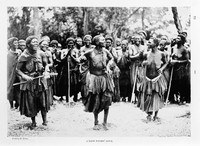
M0001010: Photograph of three African women dancing
Unknown artist
- Source:
- Wellcome Collection
- Rights:
- Rights vary by item — check the source record before reusing this image. Source record ↗
- Recorded as:
- Check
This photograph is valuable as visual documentation of African women's dance practice outside the contexts of tourism or theatrical presentation. It captures movement in a social rather than staged context, preserving evidence of how communities engaged in participatory dance. The image also exemplifies the archive of early twentieth-century ethnographic photography and raises questions about how and why such images were collected, by whom, and what has been lost through incomplete cataloguing.
What you are looking at
A black-and-white photograph showing a group of African women arranged in a loose outdoor gathering, apparently during a dance or ceremonial movement. The image captures approximately a dozen figures wearing wraparound cloths and traditional dress, positioned across the frame in varied stances suggesting active participation in a social or ritual event. The setting appears rural or semi-rural, with minimal architectural elements visible. The photograph's grainy quality and composition suggest early-to-mid twentieth-century documentation, though the exact date remains unknown. The women are distributed across the space rather than in formal lines, some with arms raised or extended, others with bodies angled toward one another, creating a sense of collective, participatory movement rather than staged performance.
The dancing
The dancers display a range of body positions: several women have arms raised or extended outward, while others stand with more neutral postures. No two figures adopt identical positions, suggesting this captures spontaneous or improvisational movement rather than choreographed unison. The weight distribution visible in the photograph indicates the dancers are upright and mobile rather than static, with some figures appearing mid-stride or mid-gesture. The clothing—loose wraps and traditional dress—moves freely with the bodies, suggesting movements that involve torso rotation, hip articulation, and lateral weight shifts rather than the controlled, turned-out frame of ballet or European ballroom styles.
The dance depicted
This appears to document an African social or ceremonial dance, most likely from the early twentieth century based on the photographic style and context. The loose formation, varied individual movement, and apparent community participation are consistent with patterns of African traditional dance where multiple dancers move together without rigid synchronization or hierarchical formation. The image captures participatory movement rather than performance for an audience—the dancers engage with one another and the space rather than presenting toward a camera. Without documentation of specific music, location, or cultural context, identifying a precise dance tradition is not possible from the image alone, though the movement quality and social structure suggest sacred-ceremonial or global-african contexts.
How it was made
This is a black-and-white photograph, likely silver gelatin print or similar early twentieth-century photographic process, based on the tonal range and grain structure visible. The photograph is not a studio portrait but rather documentary or ethnographic in intent, capturing figures outdoors in what appears to be their living context. The medium allowed the photographer to freeze motion, preserving gestural and postural information that would have been impossible in earlier visual media, though the exposure time was still slow enough to risk some motion blur in active bodies. The image's inclusion in the Wellcome Collection suggests it entered a scientific or medical archive, where such photographs were often catalogued as anthropological documentation.
About this work
This photograph documents an African women's dance or ceremonial gathering from an unknown date and location. The image captures a group engaged in participatory movement, their varied postures and raised arms suggesting active involvement in a social or ritual event. The photograph's documentary style and archival context indicate it was made for purposes of record or study rather than artistic performance capture. For historians of African dance and ethnographic photography, the image preserves visual evidence of movement practice in a community setting, though the loss of date, location, and photographer identity limits what can be definitively stated about the specific dance tradition, cultural context, or historical moment.
How to look at it
Attend to the distribution of the dancers across the frame and the variety of individual gestures rather than looking for unified choreography or symmetry. Notice how the women relate to one another through proximity and orientation—some face toward others, some have arms extended toward the group. The clothing and the way it moves with the bodies tells you something about the character of the movement: the loose wraps allow for hip and torso rotation and respond to momentum and weight shift. The grainy quality of the photograph itself is part of the historical document—this is how the movement looked through the lens of early twentieth-century technology, filtered through an archive.
The period
This photograph likely dates from the early twentieth century, a period when ethnographic photography flourished as a tool of colonial documentation and scientific study. African dance was simultaneously invisible in mainstream Western concert and theatrical contexts and hypervisible in ethnographic archives, often presented through the lens of 'primitive' or 'tribal' culture. The photograph's lack of attribution and minimal documentation is typical of how such images were treated in Western archives—the dancers' identities, location, and dance tradition were considered less important than the fact of the photograph's existence as a record.
Where it lives
The photograph is held in the Wellcome Collection, a major archive of medical, scientific, and ethnographic imagery. Its entry into a medical or scientific collection rather than an art or dance archive suggests it was originally catalogued for documentary or comparative purposes rather than aesthetic or cultural appreciation.
Dance in this work
Questions about this work
Where and when was this photograph taken?
The catalogue record provides neither date nor location. The photographic technique and aesthetic suggest early-to-mid twentieth century, but this cannot be confirmed. Without additional documentation, the specific cultural context and dance tradition remain unidentified.
What is the difference between this kind of social dance and 'tribal' stereotypes?
This photograph appears to show participatory community dance—movement in which many people engage together without training or formal choreography. The varied postures and informal grouping distinguish this from staged performance. However, ethnographic photography of this era was often presented to Western audiences through a lens of 'primitivism' that distorted how such practices were understood.
Why is the photographer unknown?
Ethnographic photographs from this period were often collected and archived with attention to the objects or subjects of study but minimal documentation of the photographer's identity, intentions, or relationship to the subjects. This reflects both the archival practices and the power dynamics of colonial-era documentation.
More dance artwork