49 works in this view — arrow keys or swipe to move between them.
Dance in Art
Dancing (fancy)
Unknown artist
- Source:
- Internet Archive
- Rights:
- Rights vary by item — check the source record before reusing this image. Source record ↗
- Recorded as:
- Check
This work documents the emergence of photography as a tool for understanding dance technique and movement analysis, a shift that transformed how choreography was created, taught, and preserved. For dancers and historians, it illustrates the early twentieth-century moment when dance moved from being primarily a live, ephemeral art to one that could be captured, analyzed, and reproduced through mechanical means. The sequential format is a direct ancestor of modern video analysis and Laban notation, making it a key document in the history of how we think about and record movement.
What you are looking at
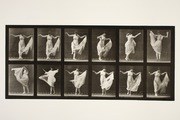
This is a contact sheet or film strip of sequential photographic frames arranged in two rows of six images each, documenting a dancer in motion against a plain background. The frames capture a continuous movement sequence, likely from a single performance or practice session. The dancer wears a light-colored (white or cream) costume that reads as a simple dress or tunic. The sequential framing—a characteristic of early motion study photography—freezes different moments of a single movement phrase, allowing the viewer to reconstruct the complete arc of the gesture by reading left to right across the frames. The lighting is even and frontal, typical of studio photography, with no shadows or scenic elements to distract from the body itself. The quality and presentation suggest this is archival material rather than a finished artwork for exhibition.
The dancing
The dancer appears to be a solo female figure, photographed from approximately mid-thigh up, centered in each frame. Across the sequence, her body moves through what appears to be a turning or twisting motion, with the arms rising, crossing, and descending in different positions across the frames. The movement is controlled and deliberate rather than spontaneous; the body alignment and the progression suggest trained technique. The costume is simple and permits clear visibility of the body line. The sequence method itself—showing the dancer in 12 distinct positions—is diagnostic of early twentieth-century dance documentation practices.
The dance depicted
The specific dance style cannot be determined with certainty from the frames alone. The movement phrase—a rotation with arm positions that vary across the sequence—could belong to modern dance, theatrical dance training, or vaudeville/performance dance of the early twentieth century. The sequential photography method used here was pioneered for motion study by photographers like Eadweard Muybridge and became a tool for both documenting movement and analyzing technique. Without context for the original performance, costume detail, or musical accompaniment, the dance form remains unidentifiable, but the presentation suggests this was intended as a study of movement rather than a narrative or decorative dance scene.
How it was made
This is a gelatin silver print or similar photographic contact sheet, likely produced from motion picture film or sequential still photography. The twelve frames in two rows are a standard format for archival or documentary photography of the early-to-mid twentieth century. The printing method and spacing are consistent with darkroom contact printing, where negatives are placed directly on light-sensitive paper. This format was used extensively for dance notation, choreographic documentation, and performer record-keeping. The technical clarity and archival presentation suggest this was made for institutional or professional purposes—studio records, notation systems, or choreographic reference—rather than for public display.
About this work
This is a photographic study of a solo dancer captured across twelve sequential frames, a method of motion documentation that became standard in early twentieth-century dance practice. The work is neither a finished artwork nor a single photograph, but a working document—a tool for analyzing, recording, or notating movement. It belongs in a gallery of dance imagery because it represents a crucial moment when dance began to be systematized through mechanical reproduction: the body frozen in time not for aesthetic effect but for scientific or technical understanding. The catalogue assigns it to the Swing Era (1920–1950), but the photographic technique and the absence of clear period costume markers make the date and context difficult to confirm visually. What is certain is that this image shows dance as a subject of study—movement broken into teachable, repeatable units.
How to look at it
Read this image as a flipbook or a stroboscopic sequence: let your eye travel left to right, top to bottom, and the still frames will reconstruct a continuous movement. Notice how the photographer has positioned the dancer consistently in the frame across all twelve shots, maintaining the same distance, angle, and lighting. This compositional discipline reveals the intent: not to create beautiful individual images, but to create a transparent record of pure movement. Pay attention to what remains constant (the body's axis, the dancer's orientation) and what changes (the position of the arms, the rotation of the torso). This contrast is exactly what a dance teacher or choreographer would need to analyze technique.
The artist
The photographer and the dancer are both unrecorded in the available documentation. The style of printing and archival presentation suggests this came from a professional dance studio, a motion study laboratory, or an institutional collection focused on performance documentation. Without further provenance, the identities and contexts cannot be established.
The period
The 1920s–1950s saw the consolidation of several new approaches to dance: the rise of modern dance in the United States as an alternative to classical ballet; the professionalization of dance notation systems (Laban notation emerged in the 1920s); and the widespread use of photography and early film for motion study. This image sits at the intersection of all three. The sequential photographic method was borrowed from scientific motion analysis but repurposed for artistic and pedagogical ends. Simultaneously, dance was gaining legitimacy as an object of serious study—no longer purely entertainment, but a form amenable to documentation, analysis, and pedagogy.
Where it lives
This work comes from the Internet Archive digital collection and is identified as originating from the Swing Era (1920–1950) period. No institutional holding, accession number, or collection name is provided in the catalogue record. The format and style suggest it is archival material—probably studio documentation or institutional records—rather than a work created for public exhibition.
Questions about this work
Is this a single photograph or multiple photographs?
This is a contact sheet: twelve individual photographic frames arranged together, likely printed from film negatives on a single sheet of photographic paper. It functions as a single object but contains twelve distinct moments in time.
What dance is being performed?
The specific dance form cannot be identified from the image alone. The movement appears to be a controlled turning or twisting phrase, but without costume detail, musical context, or documentation, the style remains uncertain. It could belong to modern dance, classical dance training, or vaudeville performance.
How should I interpret the sequential frames?
The frames document continuous movement broken into discrete moments. To understand the complete gesture, read them in sequence from left to right and top to bottom, as if watching the dancer perform. This method of documenting movement became standard in early twentieth-century dance pedagogy and notation.
Why is the background blank?
A plain background isolates the dancer's body from distraction, allowing the viewer to focus entirely on the movement and making the frames easier to use for teaching or notation purposes. This is a deliberate choice for documentation, not a limitation.
More dance artwork