49 works in this view — arrow keys or swipe to move between them.
Dance in Art
Dancing Satyr Group
Unknown artist
- Source:
- Internet Archive
- Rights:
- Public domain — free to use, share and adapt.
- Recorded as:
- https://creativecommons.org/publicdomain/zero/1.0/
This work documents an ancient dance tradition that existed primarily in myth and performance rather than in written choreographic notation, preserving a visual record of how satyr dances were imagined and valued in antiquity. For dancers and choreographers, it offers evidence of how extreme flexibility, twisting spinal movement, and expressive physicality were conceptualized in the ancient world—categories of movement that transgressed the formal ideals of contemporary classical athletics and theater.
What you are looking at
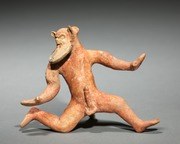
A terracotta figurine depicts a single male dancer in a dynamic, contorted pose suggesting rapid movement or playful exertion. The figure sits on his haunches with his torso twisted and one arm raised high above his head, the other extended outward for balance. His head is thrown back and his body curves in an arc that conveys flexibility and comic strain. The terracotta is warm ochre in color, unglazed, with visible modeling marks that emphasize the musculature of the chest, arms, and legs. The figure's anatomy is rendered with care—defined pectoral muscles, clear articulation of the limbs—but the exaggerated pose and expression suggest caricature or burlesque rather than idealized form. The satyr's identity is suggested by animalistic features and the uninhibited physicality of his movement.
The dancing
A single male figure in a kneeling-squat position with his pelvis grounded and his torso rotated sharply. His right arm reaches overhead with the elbow bent, creating height and openness; his left arm extends laterally at shoulder height, the hand open. His head is tilted back, mouth open, suggesting vocalization or ecstatic expression. The pose demands extreme spinal rotation and hip flexibility, placing significant weight on the thighs and feet. The musculature is fully articulated, showing tension throughout the body.
The dance depicted
This appears to represent a satyr—a creature from Greco-Roman mythology—engaged in a frenzied, uninhibited dance associated with the retinue of Dionysus. Satyrs in ancient sources were depicted as dancers of chaotic, orgiastic, and physically extreme character, their movement characterized by twisting, leaping, and playful agility rather than formal structure. The contorted, acrobatic pose shown here is consistent with ancient descriptions of satyr dances as riotous and flexible. This is not a depiction of a specific named dance form but rather a figure from mythological contexts in which dance was a symbol of revelry, altered states, and transgression of human norms.
How it was made
This is terracotta—fired clay—a medium that requires hand modeling and carries the marks of the sculptor's fingers and tools. The small scale and finished detail suggest this was a figurine made for domestic or religious use rather than architectural ornament. Terracotta was a common medium for Greek and Greco-Roman figurines from the Classical period onward; its fragility and the ease of hand-modeling made it ideal for dynamic poses that would be difficult to carve in stone. The visible surface irregularities and modeling traces are characteristic of the medium and period technique.
About this work
This is a terracotta figurine representing a dancing satyr, likely Greco-Roman in origin, frozen in a moment of extreme physical abandon. The satyr—a hybrid creature of myth—embodies the uninhibited, frenzied movement associated with Dionysian revelry and the transgressive spaces where dance was understood as ecstatic and animal rather than civilized and ordered. The work sits at the intersection of mythology, performance, and sculptural practice, showing how ancient artists used the dancing body as a vehicle for representing the boundaries between human and divine, reason and intoxication, order and chaos.
For a dance history gallery, the piece is significant because it captures an ancient understanding of a distinct movement vocabulary—the satyr's dance—as something physically extreme, flexible, and conceptually linked to states of consciousness and social transgression. The artist has rendered this not as a idealized athlete but as a creature whose body is contorted, playful, and excessive.
How to look at it
Note the impossibility of the pose: the spinal rotation combined with the grounded squat requires simultaneous flexibility and strength, and the lifted head and open mouth suggest vocalization or breath. This is not a pose of rest but of climactic movement—the artist has chosen to capture not a step or a phrase but a moment of maximum exertion and expressive intensity. The open mouth and backward tilt of the head are key: they signal that this is movement tied to sound, ecstasy, and the loss of self-control that satyr dances were understood to invoke.
The period
Terracotta figurines of satyrs and mythological dancers were produced throughout the Greek Classical and Hellenistic periods and continued to be made under Roman rule. These small objects were often used as votive offerings in sanctuaries dedicated to Dionysus, or as domestic items reflecting the owner's familiarity with cult and mythology. Satyr imagery proliferated in the context of the symposium (drinking party) culture, where satyrs represented both the ideal companion—playful, musical, uninhibited—and a cautionary figure embodying the loss of civilized restraint. The dance tradition they represent was kept alive in mime, pantomime, and dramatic performance throughout antiquity.
Where it lives
The object is recorded as part of the Internet Archive digital collection, with no accession number, holding institution, date, or artist attribution preserved in the catalogue record. It is presented as documentary material without further contextualization.
Dance in this work
Questions about this work
What is a satyr and why did ancient artists depict them dancing?
Satyrs were hybrid creatures in Greco-Roman mythology—partly human, partly animal—associated with the god Dionysus and his retinue. They represented uninhibited pleasure, fertility, music, and wine, and were frequently shown dancing as a symbol of ecstatic transgression and revelry. They embodied a mode of being opposed to the rational self-control valued in civic life, making them ideal figures for exploring the transformative and dangerous possibilities of dance and intoxication.
Is this depicting a real dance or a mythological fantasy?
Both. Satyr dances were performed by human dancers in theatrical and ritual contexts—in satyr plays, in cult festivals, and in private entertainments—but those dances were understood through the lens of myth. The extreme flexibility and contorted pose shown here represents how ancient artists imagined satyr movement: animal-like, excessive, impossible by the standards of human dance training, and fundamentally transgressive.
What does the open mouth and thrown-back head tell us?
These details signal that the dance is inseparable from vocalization, breath, and emotional intensity. The satyr is not performing a measured, silent choreography but rather a full-bodied expression involving sound, ecstasy, and loss of composure. This connects the dance to states of intoxication and divine possession rather than to trained technique.
More dance artwork