25 works in this view — arrow keys or swipe to move between them.
Dance in Art
Cielito tango utrecht www.cielito.nl
Unknown artist
- Dance:
- Tango
- Source:
- Internet Archive
- Rights:
- Rights vary by item — check the source record before reusing this image. Source record ↗
- Recorded as:
- Check
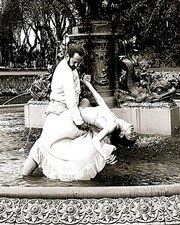
This photograph is rare documentary evidence of Argentine tango as a living social practice in 1950s–60s Europe, capturing the moment when the dance was being codified and taught outside its birthplace. It shows the bodily knowledge and emotional intensity of tango through the precision of the dancers' hold and positioning, demonstrating that the dance's sophistication was accessible to amateurs and social dancers, not confined to professionals or stage performance.
What you are looking at
A black and white photograph showing two dancers in close embrace outdoors, positioned on gravel or pebbled ground. The dancer on the left wears a light-colored (white or cream) long-sleeved shirt and dark trousers; the dancer on the right wears a white dress. They are locked in an intimate closed hold characteristic of tango, with the man's right arm around the woman's back and their bodies in a compressed, forward-leaning frame. The background shows a garden setting with dense foliage and what appears to be a classical urn or planter on a pedestal, suggesting an aristocratic or formal garden. The photograph is shot in strong daylight, creating clear shadows that emphasize the three-dimensionality of their posture and the weight distribution between the partners. The moment captured is one of deep connection and controlled tension—the hallmark of tango's emotional vocabulary.
The dancing
Two dancers in a closed ballroom hold with marked forward body line and compression. The man leads from a position slightly offset to the right of his partner, his frame vertical but his torso angled into hers, creating the characteristic tango 'contra-body movement.' The woman's body molds into his, her weight distributed to accommodate both her own momentum and his lead. Their heads are very close, nearly touching. The positioning and musculature visible suggest both dancers are experienced: there is no visible strain or awkwardness, and the compression of space between them—essential to tango technique—is precise.
The dance depicted
This is Argentine tango, almost certainly social rather than stage tango, given the informal garden setting and the photograph's documentary rather than performative character. The catalogue attributes it to 'Cielito tango' (a dance school or organization based in Utrecht), which aligns with the emergence of tango as a social and competitive ballroom practice in northern Europe from the mid-20th century onward. The hold, body line, and embrace are consistent with Argentine tango as it was danced in the post-1950s revival when the dance spread beyond Buenos Aires and became institutionalized in ballroom culture. The intimate frame and close connection suggest social tango, where improvisation within hold is central, rather than the more structured choreography of competitive International Standard tango.
How it was made
This is a black and white photograph, likely gelatin silver print or similar period photographic medium based on the grain and tonal range visible. The image appears to have been taken outdoors in natural daylight with a hand-held camera, allowing the photographer to capture an unguarded moment of dancing rather than a posed studio shot. The photographic medium lends documentary credibility to the image—this is a record of actual practice rather than artistic interpretation. The choice of outdoor setting and natural light, combined with the informal framing, suggests this may have been taken for instructional, promotional, or archival purposes rather than fine art exhibition.
About this work
This photograph documents Argentine tango as it was being danced in Utrecht in the mid-to-late 20th century, likely under the aegis of the Cielito organization. It captures the dance in its social context—outdoors, in daylight, without theatrical lighting or staged composition—which makes it valuable precisely as a record of how tango was embodied and taught outside Buenos Aires. The image shows tango at a moment of global expansion and institutionalization, when the dance was moving from working-class street culture and elite salon practice into formal ballroom and instructional frameworks across Europe. For dancers and historians, it offers visual evidence of how the embrace, frame, and body mechanics of Argentine tango were transmitted and interpreted in a Northern European context.
How to look at it
Observe the precise compression and forward tilt of the dancers' spines—this is the 'contra-body' frame that defines Argentine tango and distinguishes it from ballroom waltz or foxtrot. Notice how the woman's body does not stand vertical but leans into and follows the man's lead, a submission that is not passive but highly active and skilled. The closeness of their heads and the intimacy of the embrace reveal tango's emotional content: it is a dance about connection, not display. Look at the garden setting and the pedestrian quality of the photograph—this is not a stage production or artistic fantasy, but a record of how the dance was actually danced in social life.
The period
Argentine tango experienced a major revival and internationalization in the 1950s and 1960s, after decades of decline in its homeland following the death of Carlos Gardel and the cultural repression of the Perón era. European ballroom dancing, which had absorbed many Latin and Latin-influenced dances (rumba, samba, mambo, cha-cha), turned to tango as both a competitive form and a social practice. The Netherlands and other Northern European countries became centers of tango instruction and competition during this period. Simultaneously, photography was becoming the dominant medium for documenting dance, replacing earlier engraving and painting practices, and outdoor, documentary-style photography of dancers in informal settings (gardens, studios, streets) became a way of recording and promoting social dance practices. This photograph sits at the intersection of these two trends: the globalization and institutionalization of Argentine tango, and photography's new role in documenting lived dance.
Where it lives
This photograph comes from the Internet Archive's digital collections and is attributed to Cielito tango, a Utrecht-based tango school or social organization. No photographer, date, or original holding institution is recorded in the catalogue.
Dance in this work
Questions about this work
Is this Argentine tango or ballroom tango?
Argentine tango, based on the hold, frame, and body compression visible in the photograph. Ballroom (International Standard) tango uses a more open frame and structured choreography, whereas Argentine tango emphasizes improvisation within a close embrace. This photograph shows the embrace and contra-body mechanics characteristic of Argentine tango.
Where was this photograph taken?
In a garden, most likely in or near Utrecht, Netherlands, where Cielito operated a tango school or social venue. The formal garden setting with a classical planter suggests a private or semi-public garden space, possibly associated with the school or a venue where social tango was taught and danced.
When was this photograph taken?
The catalogue record does not provide a date. Based on the photograph's style, clothing, and the historical context of tango's expansion in Northern Europe, it likely dates to the 1950s–1970s, but this is an educated guess rather than a documented fact.
What does 'contra-body' mean, and why is it important in tango?
Contra-body movement is a rotational displacement of the upper and lower body: the dancer's hips and legs move in one direction while the torso rotates slightly in the opposite direction, creating a dynamic line and enabling the leader to communicate changes of direction through the center of the body rather than the limbs. It is central to tango technique and is visible in this photograph in the way the man's torso angles into his partner's while their centers remain connected.
More Tango artwork
![[Les noces de trottoir, par les compagnies Tango Sumo et Vendaval. Chalon dans la rue. 2007 / photographies de Joël Verhoustraeten] by Verhoustraeten, Joël (1954-2019). Photographe](https://gallica.bnf.fr/iiif/ark:/12148/bc6p058zgkc/f1/full/800,/0/native.jpg)