49 works in this view — arrow keys or swipe to move between them.
Dance in Art
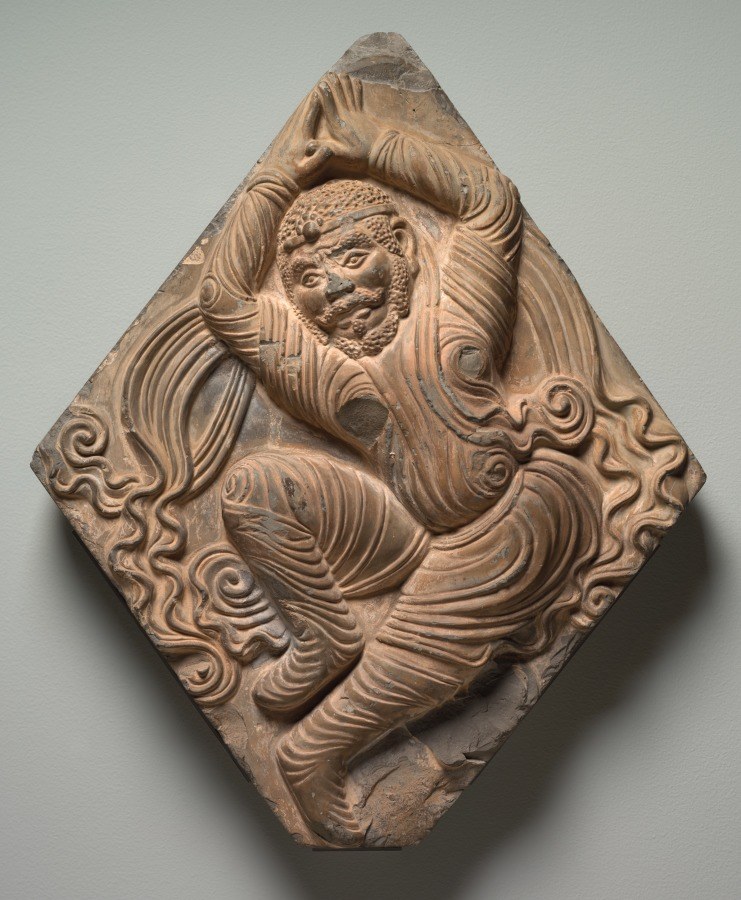
Architectural Brick with Dancer in Relief
Unknown artist
- Source:
- Cleveland Museum of Art
- Rights:
- Public domain — free to use, share and adapt.
- Recorded as:
- CC0 (Public Domain)
This relief preserves an encounter between Renaissance architects and ancient Mediterranean dance practice. It shows how classical images of the body in motion—ecstatic, powerful, celebratory—were recycled into the ornamental language of early modern buildings, encoding the idea that dance was an art worthy of permanent architectural display. For dance historians, it is evidence of how the classical past was reconstructed and reimagined through the decorative arts.
What you are looking at
This is a relief sculpture carved in terracotta or similar clay medium, set in a diamond-shaped architectural panel. The composition centers on a male dancer's head and upper torso, rendered in profile and facing left. The figure wears what appears to be a Phrygian cap or similar Hellenistic headdress, and his face is detailed with sharp features and curled beard. His body is animated and powerful: the torso leans forward, one arm is raised and bent behind his head in an exuberant gesture, while the other extends across his body. The musculature is emphatic and the pose conveys dynamic movement. Surrounding the figure, filling the entire diamond frame, is an elaborate system of swirling, scrolled ornamental elements—acanthus leaves, volutes, and baroque-influenced flourishes that billow around the dancer like wind or like the dancer himself is generating energy that distorts the decorative field. The ornament is deeply carved, creating strong shadows that emphasize the three-dimensionality of both the figure and the frame.
The dancing
A single male figure dominates the composition. His weight appears shifted, the torso angled forward in a lunge or stride, suggesting forward movement. The raised arm bent behind the head is a hallmark gesture of certain ancient and classical dances—an expansive, triumphant pose. His lower body is less distinct in the relief, but the upper body tension and the angle of the torso indicate the dancer is mid-motion, not at rest. The face is individualized and expressive, with a direct gaze; this is not an anonymous figure but someone with character and presence.
The dance depicted
The style of the headdress, the musculature, the pose, and the overall idiom suggest this depicts a dancer from the Hellenistic or Greco-Roman world, possibly a satyr, Pan, or a figure from ancient theatrical or cult dance. The raised-arm-behind-head pose appears in vase paintings and reliefs associated with ecstatic or celebratory movement—satyrs in Bacchic processions, or maenads, or theatrical performers. Without further documentation, a specific dance cannot be named, but the imagery is consistent with sacred-ceremonial or theatrical movement practices of the ancient Mediterranean. The ornamental surround, churning with energy, reinforces the sense of this as a moment of ecstatic, dynamic motion rather than static display.
How it was made
This is a high-relief carving in terracotta or earthenware, likely a brick or tile intended for architectural decoration—the diamond format and the titled reference to 'brick' suggest it was designed as a façade or wall ornament, possibly for a Renaissance or post-Renaissance building. Relief carving of this order requires skill in undercutting and modeling; the plasticity of the medium allowed the artist to achieve both the bold, flowing curves of the ornament and the anatomical detail of the figure. The technique implies a work made for display on a building of some importance, and the survival of the piece suggests it was either preserved when the structure was dismantled or carefully removed for collection.
About this work
This is an architectural ornament—a terracotta relief brick carved with a Hellenistic or ancient-inspired male dancer at its center, ringed by baroque scrollwork. The figure's pose and headdress evoke ancient Mediterranean dance practices, possibly ritual or theatrical in nature. The work bridges classical subject matter and Renaissance-era decorative ambition: it takes an ancient image of ecstatic movement and frames it within an ornamental language (the rolling acanthus and volutes) that was current in Renaissance and early modern architecture. The piece survives as a fragment of a once-larger architectural program, now held in the Cleveland Museum of Art.
The work matters because it documents how Renaissance and early modern builders and patrons understood and valued ancient dance imagery. Rather than depicting contemporary dance, it invokes antiquity—suggesting that the ideals of movement, bodily expression, and festive energy associated with classical civilization were still alive in the visual imagination of the period. The relief is one of thousands of such ornamental tiles and bricks that decorated secular and sacred buildings across Europe, yet few are studied as witnesses to how dance was understood and remembered.
How to look at it
Pay attention to the raised arm and the forward-leaning torso: these signal a specific moment of exertion and exuberance, not a static pose. The artist has chosen to freeze the dancer mid-gesture, with energy still radiating outward. Observe how the ornamental surround—the rolling, swirling leaves and volutes—seems to move with and around the figure, as if the dancer's motion is warping the decorative field itself. This is not merely a figure in a frame; it is a figure that seems to generate and disturb the frame. The carving technique—the deep undercutting and the sharp play of light and shadow—amplifies the sense of movement and three-dimensionality.
The period
The style of the ornament—the scrolling acanthus, the baroque vocabulary of the frame—suggests a date in the Renaissance (16th century) or possibly the 17th century. This was an era of intense antiquarian interest in classical texts and images, and architects and patrons commissioned relief decorations that blended classical subject matter (gods, heroes, mythological figures) with contemporary ornamental taste. Hellenistic and Roman reliefs, which frequently depicted satyrs, dancers, and figures in motion, were studied and emulated. The placing of a dancing figure at the center of such a tile reflects the Renaissance valuation of movement, the body, and classical authority.
In the history of dance, this period saw the crystallization of Renaissance courtly dance as a formal art, yet interest in ancient forms—in the very idea of a classical dancer—remained strong. Relief tiles and architectural ornaments like this one were part of the visual apparatus through which Renaissance and early modern elites imagined themselves as heirs to antiquity.
Where it lives
The work is held by the Cleveland Museum of Art. The catalogue record indicates it is an architectural brick or tile, likely from a Renaissance or early modern building in Europe, though the precise origin and original architectural context are not recorded.
Dance in this work
Questions about this work
What dance is this depicting?
The headdress, pose, and style suggest a Hellenistic or Greco-Roman dancer—possibly a satyr or a figure from ancient ritual or theatrical practice. The raised arm and forward-leaning torso are typical of ecstatic or celebratory movement in ancient Mediterranean cultures. No specific named dance can be identified from the image alone, but the work draws on ancient prototypes and invokes the world of Bacchic processions, theatre, or sacred ceremony.
Why is this an architectural ornament rather than a standalone sculpture?
The diamond format, the shallow depth of the relief, and the catalogue description as a 'brick' indicate this was designed to be embedded in a wall or façade. It is one of many such tiles that Renaissance and early modern builders used to decorate significant buildings, turning the exterior into a gallery of classical imagery and celebration of the liberal arts—of which dance was one.
What is the scrollwork around the figure?
The swirling acanthus leaves, volutes, and baroque-influenced flourishes are typical Renaissance and post-Renaissance ornamental vocabulary. The artist has used this language not merely as a decorative border but as a kind of energetic frame that seems to move with and around the dancer, suggesting that the figure's motion is felt throughout the entire tile.
How do we know this is from the Renaissance or early modern period and not ancient?
The style of the ornament—particularly the baroque scrollwork and the overall aesthetic of the frame—is consistent with 16th- or 17th-century design practice. Ancient reliefs, which this work emulates, had different decorative vocabularies. This is a later work that deliberately invokes and re-imagines ancient dance imagery.
More dance artwork