49 works in this view — arrow keys or swipe to move between them.
Dance in Art
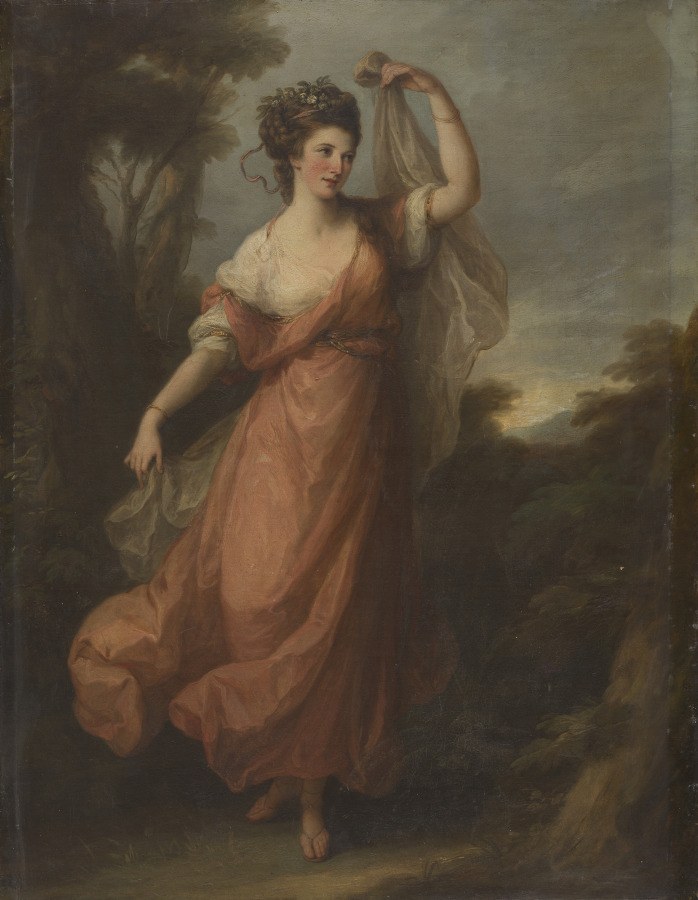
A Dancing Young Woman as Terpsichore
Angelica Kauffmann (Swiss, 1741–1807)
- Source:
- Cleveland Museum of Art
- Rights:
- Public domain — free to use, share and adapt.
- Recorded as:
- CC0 (Public Domain)
This work demonstrates how European art represented dance through mythological allegory rather than lived practice, shaping cultural ideas about who dances and what dance means. For scholars of how dance has been visualized and valued, it reveals the conventions that made certain bodies, aesthetics, and movements legible as 'dance' to educated viewers of the period.
What you are looking at
A single young woman in classical dress is depicted in an outdoor setting, posed as if in motion. She wears a loosely draped garment in cream and terracotta tones—a white chemise visible at the bodice and shoulders, with a rust-colored outer robe or peplos falling to her ankles. Her dark hair is styled up in classical fashion with ringlets framing her face. She is captured mid-gesture, one arm raised to adjust or hold fabric at her head, the other relaxed at her side, her body angled in a graceful contrapposto stance. The setting is minimal and atmospheric: dark trees frame the left side of the composition, while the background dissolves into hazy, muted tones suggesting a natural landscape. The light falls softly across her figure, emphasizing the volume and movement of the drapery. The overall effect is one of poised elegance rather than vigorous motion—a moment of classical repose performed for the viewer's regard.
The dancing
The woman stands alone, her weight appears to rest primarily on one leg in a relaxed classical pose. Her raised arm is bent at the elbow, hand near her head in a gesture suggesting adjustment of fabric or crown. The other arm hangs loosely, creating asymmetry. Her body is turned three-quarters to the viewer, creating depth and a sense of gentle turning rather than active dancing. The fabric of her garment moves with her body in soft folds, responding to her stillness rather than propelling motion.
The dance depicted
This work depicts an allegorical or mythological figure rather than a social dancer. The title identifies her as Terpsichore, the muse of dance in classical mythology. The image shows her not in the act of dancing but in a pose of classical repose—a convention for representing muses and allegorical figures in European art from the Renaissance onward. She embodies the ideal of dance through her graceful deportment, classical dress, and refined gesture rather than through any recognizable dance technique or movement vocabulary.
How it was made
This is an oil painting, evident from the soft gradation of tones, the translucent quality of the drapery, and the atmospheric handling of the background. The technique allows for the subtle modeling of the figure and the illusion of fabric weight and movement. The scale and finish suggest this was a formal easel painting intended for a patron's collection rather than a print or study, indicating a cultivated audience familiar with classical mythology and the conventions of allegorical portraiture.
About this work
This is an allegorical portrait of the muse Terpsichore, painted in oil in the neoclassical or Romantic period. Rather than depicting an actual dancer or a specific dance, it represents the classical ideal of dance through a mythological figure in idealized dress and graceful pose. The work belongs to a centuries-long European tradition of representing the muses and virtues through beautiful, classically draped female figures—a tradition that shaped how dance itself was visualized and valued in Western art.
The work sits at the intersection of portraiture, allegory, and the visual history of dance. It shows how dance was understood not primarily as popular social practice but as a refined, classical ideal—a muse to be invoked by poets and artists rather than a bodily practice to be documented. The absence of any actual dancing movement is the point: Terpsichore herself represents the principle of dance in its most elevated and abstract form.
How to look at it
Attend to the tension between stillness and implied movement. The raised arm and turning posture suggest grace and potential motion, yet the figure is fundamentally still and composed. This is deliberate: the artist is not capturing a moment of choreographed action but representing an eternal, idealized principle. The classical dress and mythological identity are signals to the educated viewer that this is allegory, not documentary. The soft, atmospheric background—quite unlike the precise settings of academic figure studies—emphasizes that this is a vision or ideal rather than a woman in a particular place.
The artist
The artist is unknown, but the style, execution, and subject matter suggest a European painter trained in academic tradition, likely active in the late 18th or 19th century. The work reflects the neoclassical revival that dominated European academies during this period, with its emphasis on classical mythology, graceful figuration, and the elevation of allegorical subjects.
The period
The late 18th and 19th centuries saw a flourishing of allegorical representations of the classical muses in European painting, particularly in academies influenced by neoclassical aesthetics. This period coincided with the rise of Romantic ballet—a theatrical form that drew heavily on classical and mythological themes. Yet paintings like this one, which show the muse in repose rather than in theatrical motion, represent an older, more literary tradition of representing dance as an abstract ideal rather than a spectacular bodily art.
Where it lives
The work is held in the Cleveland Museum of Art and is catalogued as part of the museum's collection of dance-related art, though the current record contains minimal information about artist, date, medium, and provenance.
Questions about this work
Is this a real dancer or a made-up character?
Terpsichore is a figure from classical mythology—the muse of dance and lyric poetry in ancient Greek tradition. This painting does not depict a specific historical dancer or performance, but rather an allegorical representation of the principle of dance itself, in the tradition of Renaissance and later European art.
Why isn't she actually dancing?
Classical allegorical tradition represented the muses and virtues through idealized, graceful poses rather than active movement. The artist conveys 'dance' through classical dress, mythological identity, and refined, graceful gesture—communicating the idea of dance rather than documenting its practice.
What period is this painting from?
The style, costume, and neoclassical aesthetic suggest the late 18th or 19th century, a period when European academies revived classical subjects and allegory. The exact date is unknown, but the painting reflects the era's broader engagement with Greco-Roman themes.
Who painted this?
The artist is not currently recorded in the catalogue. The execution and training visible in the work suggest an academically trained European painter, but without signatures or documentation, attribution remains unknown.
More dance artwork