49 works in this view — arrow keys or swipe to move between them.
Dance in Art
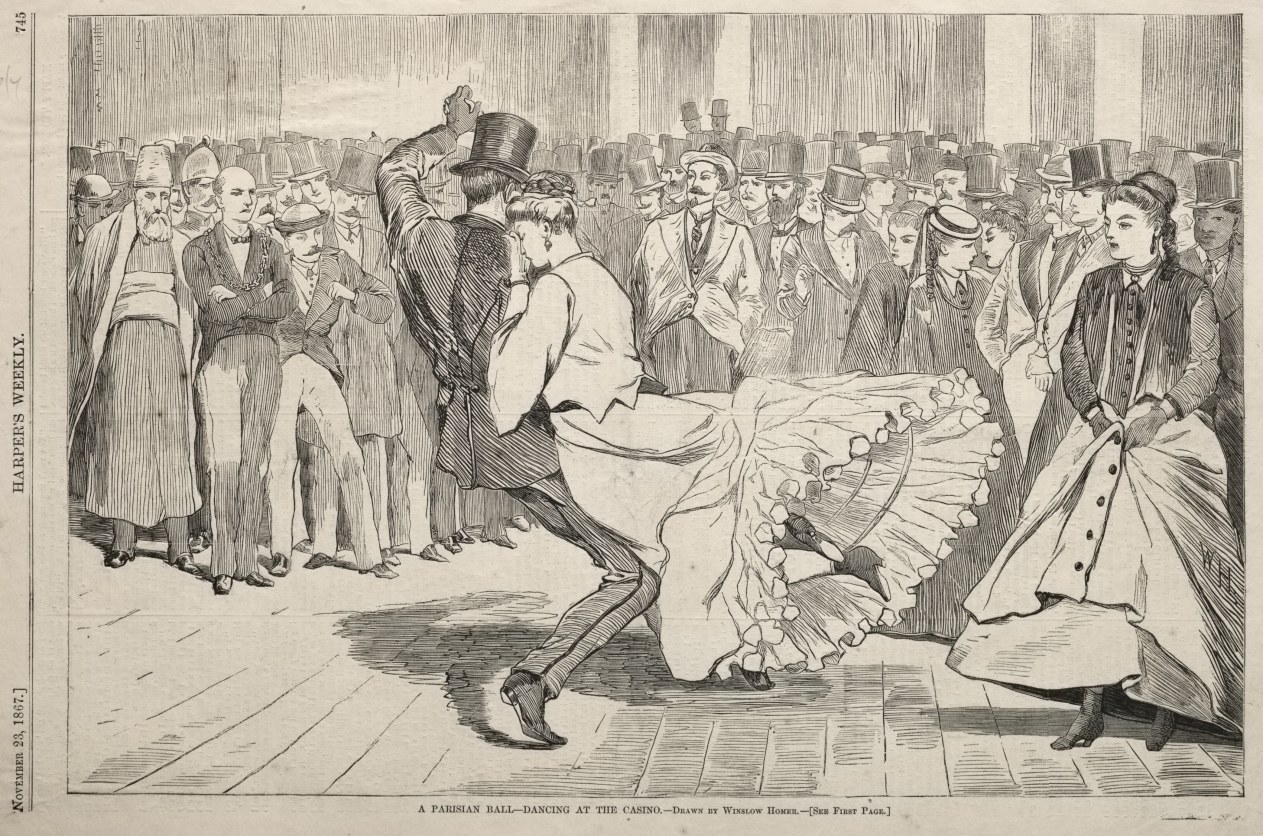
A Parisian Ball - Dancing at the Casino
Winslow Homer (American, 1836–1910)
- Source:
- Cleveland Museum of Art
- Rights:
- Public domain — free to use, share and adapt.
- Recorded as:
- CC0 (Public Domain)
This image is crucial evidence for understanding how ballroom dancing was perceived and represented in the 19th-century press—as spectacle, as satire, and as a form of public social performance worthy of illustration. For dancers and historians, it demonstrates the exaggerated, showy vocabulary of exhibition ballroom dancing in the Victorian period, where dramatic backbends and displays of skirt were deliberate features of eye-catching social dancing. The attribution to Homer, one of America's leading illustrators, confirms that dance was a subject of serious artistic attention and social commentary.
What you are looking at
A crowded indoor ballroom or casino dance floor, rendered in fine pen engraving with dense cross-hatching. The space is packed with formally dressed figures in Victorian-era clothing—top hats, tailcoats, and full skirts—arranged in loose clusters around a central dancing couple. The focal point is a woman in a white or light-colored dress with voluminous skirts and decorative trim, her body arched backward in a dramatic lean, partnered with a man in dark formal wear. He wears a top hat and appears to be executing a showy spin or turn, his body twisted dynamically. The background is filled with onlookers, their faces and forms sketched with varying detail, creating depth and a sense of social spectatorship. The floor is clearly marked with geometric patterns suggesting a ballroom parquet. The overhead space is dense with vertical line work suggesting an interior ceiling or elaborate architectural detail. The overall composition is theatrical: the central couple is composed to command attention through exaggeration of movement and the stark contrast of their white dress against the dark suits surrounding them.
The dancing
The central male dancer initiates what appears to be a vigorous turn or aerial spin, his body twisted at the torso with one leg extended or lifted, creating an off-balance silhouette. His partner leans far back, her weight apparently transferred to or supported by his body, her white skirts flaring in a broad arc around her. Her arm position cannot be determined with certainty, but her body is in an extreme backbend or dip position. The hold between them is ambiguous from this angle—it may be a single-hand support rather than a closed ballroom embrace. The surrounding figures are stationary observers, many in profile, their postures varied but all directing attention toward the dancing couple. No other dancers are actively moving; this couple dances alone for the crowd.
The dance depicted
This depicts a moment of virtuosic, demonstrative social dancing rather than choreographed theatrical dance, most likely a waltz or similar ballroom dance of the 1860s–1880s rendered with deliberate exaggeration for comic or satirical effect. The dramatic backbend and the exhibitionist quality of the gesture—the woman's skirts blown wide, the man's twisted torso—suggest either a moment of showiness within a social dance or a caricatured version of fashionable ballroom behavior. The title specifies a Paris casino, placing this in the context of fin-de-siècle entertainment venues. The style of movement and costume point to the later 19th century, when such public dancing in purpose-built venues was a feature of urban social life. The engraving's exaggeration suggests the artist was commenting on or satirizing the spectacle of fashionable dancing.
How it was made
This is a wood engraving or steel engraving, executed with fine parallel lines (cross-hatching) to create tone and volume. The technique is characteristic of illustration for periodical publication in the mid-to-late 19th century—dense, precise, and designed to reproduce clearly in print. The attribution to Winslow Homer (as stated in the caption) identifies this as a work created for circulation in a major illustrated periodical, likely Harper's Weekly, where Homer worked as a visual correspondent and satirist. The engraving technique required the artist to compose with clear, legible forms and to balance dense background detail with a legible focal point—here achieved by the stark white dress of the dancing woman and the twisted form of her partner.
About this work
A Victorian-era engraving depicting a moment of exaggerated, theatrical social dancing at a Paris casino, captured at the instant of a dramatic backbend or dip. The scene is a crowd composition built around a single dancing couple whose movement is rendered with obvious exaggeration and showiness, suggesting either satire of fashionable ballroom behavior or documentation of genuinely theatrical exhibition dancing in a commercial entertainment venue. The work belongs to a long tradition of dance imagery in periodical illustration—moments of social spectacle rendered for public commentary and consumption. It documents both a style of movement and the urban leisure culture of the late 19th century.
How to look at it
Attend first to the exaggeration of the central couple's pose: the woman's body is pushed far beyond the typical frame of a waltz or standard ballroom hold, and the man's twist and implied lift are athletic rather than merely social. Notice how the engraver has used the density of the surrounding crowd to isolate and emphasize this moment—the still, watching figures frame the motion of the two dancers. The woman's white dress is the brightest element, making her body the primary visual focus; the swirl of her skirts records the violence of the movement. Consider whether this represents actual ballroom practice, exhibition dancing, or satirical caricature—the title and the artist's practice as a social commentator suggest the image is at least partly critical or observational rather than celebratory.
The artist
Winslow Homer (1836–1910) was an American painter, printmaker, and illustrator of national significance. He worked extensively for Harper's Weekly and other periodicals during the 1860s–1870s, creating wood engravings and drawings that documented American social life, including leisure, entertainment, and gender relations. His dance illustrations are part of a larger body of work commenting on contemporary leisure culture, fashion, and social behavior. Homer's peripatetic career moved him from illustration toward fine art painting, but his illustrated works remain valuable documents of 19th-century social observation.
The period
This engraving dates to the Victorian era, when public ballroom dancing in commercial establishments (theaters, casinos, assembly halls) had become a major feature of urban entertainment and social aspiration. By the 1870s–1880s, dancing was increasingly represented in the illustrated press as a topic of social interest and satire. The rise of illustrated newspapers and magazines created a new market for dance imagery: moments of spectacle, fashion, and social interaction rendered in engravings for mass reproduction. Simultaneously, ballroom dancing was itself becoming more theatrical and exhibition-oriented, with professional dancers and teachers promoting increasingly showy and acrobatic variations on the waltz and other popular dances.
Where it lives
Held by the Cleveland Museum of Art. The work is identified as part of the museum's dance-related art collection; the source from which the image comes is listed as CMA. This is a periodical illustration or book illustration, produced for publication and mass distribution.
Dance in this work
Questions about this work
Who danced like this in the 1870s?
Professional ballroom dancers in public venues—casinos, dance halls, and theaters—performed increasingly acrobatic and showy versions of popular dances like the waltz. Exhibition dancers and ballroom professionals developed flamboyant variations that incorporated dramatic lifts, spins, and backbends to dazzle audiences. Amateur social dancers imitated these moves, and the illustrated press both documented and satirized the trend.
Is this satire or documentation?
Likely both. Winslow Homer was known for sharp social commentary, and the exaggeration of the pose suggests mockery of fashionable pretension. However, evidence from other sources confirms that actual ballroom dancing of the period included genuinely acrobatic and theatrical moves. The engraving may satirize the extremes to which fashionable dancing had gone while still documenting real behavior.
What does the crowd tell us?
The packed room of formal spectators indicates that this dancing is not a private social event but a public performance or exhibition—a dance floor in a commercial venue where the act of dancing is itself the entertainment. The stationary onlookers emphasize that the dancing couple is on display, being watched as a spectacle.
More dance artwork