49 works in this view — arrow keys or swipe to move between them.
Dance in Art
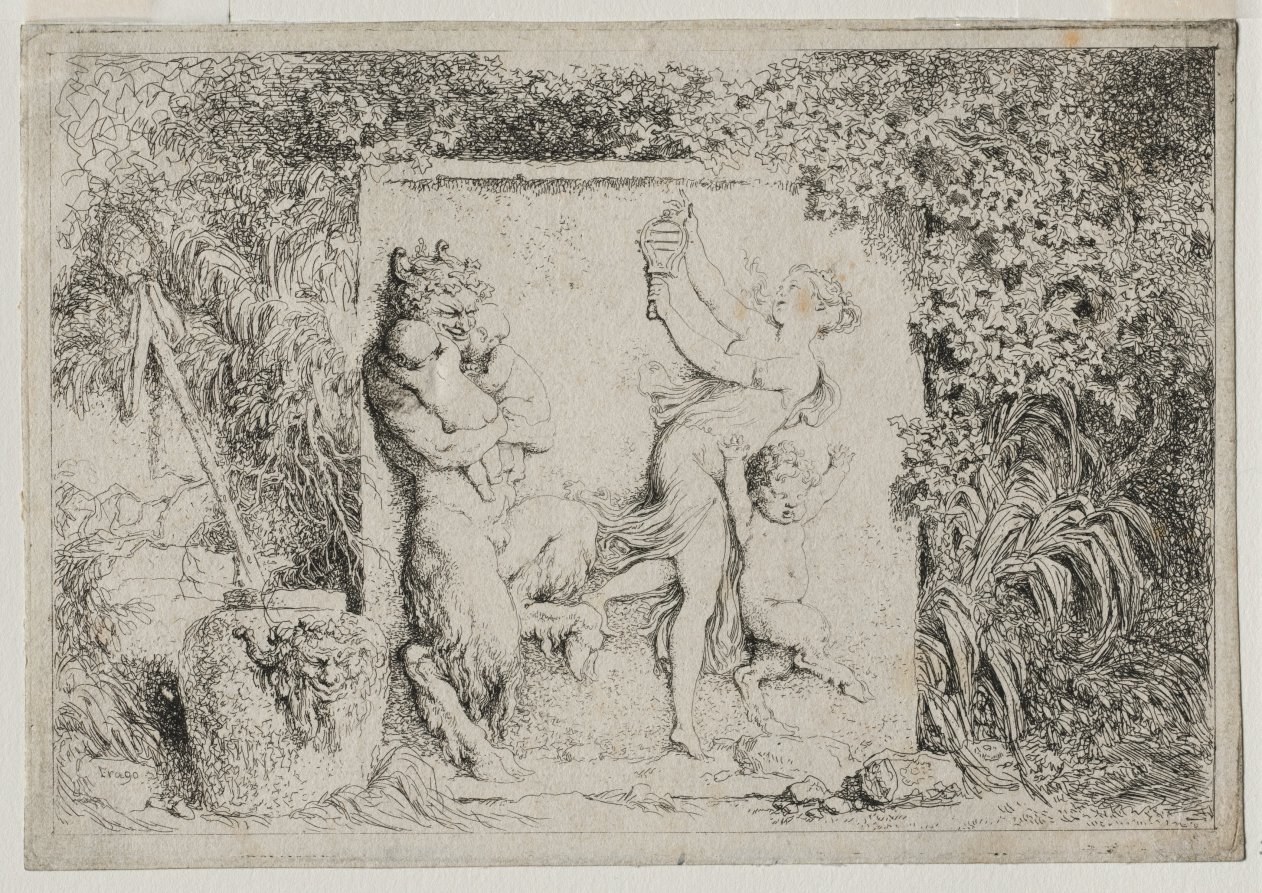
Bacchanales The Satyrs Dance
Jean-Honoré Fragonard (French, 1732–1806)
- Source:
- Cleveland Museum of Art
- Rights:
- Public domain — free to use, share and adapt.
- Recorded as:
- CC0 (Public Domain)
The work documents a persistent cultural association between dance and ecstasy, nature, and the transgression of social boundaries—an association that runs from classical antiquity through the Renaissance and into modern dance aesthetics. For historians of dance, it reveals how Renaissance artists imagined ancient ritual movement: not as spectacle or entertainment, but as a form of possession and bodily transformation. The image also shows how engraving made mythological instruction available to a broad audience, embedding ideas about dance's power into visual culture.
What you are looking at
This engraving depicts a Bacchanalian revel in a densely wooded setting. At the center stands a female figure in contrapposto, holding aloft what appears to be a thyrsus or torch, her body twisted in an energetic pose. She is accompanied by putti (cherubs) and a satyr in profile to the right. The satyr's head is characteristically goat-like, and his body conveys dynamic movement. The entire scene is framed by heavy vegetation—gnarled trees, thick foliage, and tangled undergrowth rendered in dense hatching—creating an atmosphere of untamed nature. The architectural element at left, possibly a term or herm, grounds the mythological space. The engraving technique uses line and shadow to suggest movement and ecstatic energy; the female figure's drapery clings and swirls, the satyr's form twists, and the surrounding natural world seems to pulse with life.
The dancing
The central female dancer stands in a raised, dynamic contrapposto with her weight shifted, one leg extended, arms elevated in an ecstatic gesture as she holds the torch or thyrsus aloft. Her body is twisted at the torso, creating spiraling movement through the spine. A satyr beside her leans forward in an aggressive or pursuing stance, his body angled and energized. Multiple putti are scattered throughout, some floating or suspended in the composition, their bodies in various attitudes of celebration and play. The poses suggest abandon and liberated movement rather than formal choreography; the bodies are depicted mid-gesture, captured in a moment of ritualistic frenzy.
The dance depicted
This represents a Bacchic dance or bacchanal—the ecstatic, often frenzied dancing associated with the cult of Dionysus (Bacchus) and his satyrs and maenads. The satyr and the torch-bearing female figure (likely a maenad or a representation of Bacchus's retinue) embody the mythology of ecstatic, uninhibited movement tied to wine, ritual, and wild nature. The engraving does not depict a recognizable ballroom or theatrical dance form, but rather references classical and Renaissance ideas of ancient Greek Dionysian rites—dances imagined as spontaneous, possessed, and orgiastic rather than codified. The title *Bacchanales The Satyrs Dance* confirms this iconographic reading. Such scenes were popular in Renaissance and early modern art as a way to depict transgressive joy and the power of dance to unmake social order.
How it was made
This is an engraving on paper, executed with fine parallel lines (hatching and cross-hatching) to create tone, shadow, and texture. The technique allowed the artist to achieve delicate gradations of light and dark and to render elaborate detail—the satyr's musculature, the folds of drapery, the intricate foliage. The image has been extensively worked; the density of line in the background and the precision of the figure drawing suggest a master engraver's hand. Engravings of this kind were reproductive or original artworks circulated widely as prints, making them accessible to educated patrons across Europe. The style and execution point to the Renaissance or early modern period, when mythological scenes were standard subjects for the engraver's art.
About this work
This engraving depicts the mythological subject of Bacchic revelry: a maenad or bacchante in an ecstatic pose, attended by a satyr and putti, set within a densely vegetated landscape. Rather than a specific historical or theatrical dance, it represents the Renaissance artistic imagination of ancient Dionysian rites—uninhibited, nature-centered, and opposed to the decorum of court dance. The work belongs in a gallery of dance in art because it captures a foundational Western fantasy: the idea that dance can transcend civilization, express divine possession, and manifest the power of ritual to alter human consciousness. The engraving technique and mythological subject place it within the tradition of Renaissance humanist art, which looked to classical antiquity for models of beauty and transgressive power.
How to look at it
Attend to the energy captured in the bodies: the female figure's uplifted, twisting pose conveys an instant of ecstatic abandon, not a stable or repeatable position. Notice how the engraver has used line and shadow to suggest movement through the torso and limbs—the drapery swirls, the satyr leans, the putti float. The composition is centripetal, pulling the eye inward to the central action, which intensifies the sense of frenzy. The frame of dense vegetation—rendered in obsessively fine hatching—suggests that this revelry is set apart from the ordered world, in a space of nature and myth. The moment chosen is not a moment of repose but of peak intensity, frozen mid-gesture.
The artist
The artist is not recorded in the catalogue. However, the engraving's style, technique, and subject matter are consistent with Northern Renaissance or early modern German or Flemish printmaking (approximately 16th–17th century). The dense, intricate hatching and the naturalistic rendering of foliage are characteristic of accomplished printmakers of this period. The signature or mark at lower left may indicate the maker, but it is not legible in the current record. Without further research, the attribution remains open.
The period
This work dates from an era when Renaissance artists and humanist scholars were intensely engaged with classical texts and imagery. Ovid's *Metamorphoses* and other classical sources provided detailed accounts of Bacchic rites, which artists eagerly visualized. In the 16th and 17th centuries, the satyr and maenad became stock figures in prints and paintings exploring the boundary between civilization and wildness, reason and ecstasy. At the same time, court dance was becoming increasingly formalized and codified (the Renaissance court dances, the emerging ballet de cour). Engravings of Bacchic revels thus existed in a complex dialogue with contemporary dance practice: they offered an antidote or counterpoint to courtly restraint, a vision of dance as anarchic and transformative.
Where it lives
The work is held by the Cleveland Museum of Art and is part of their dance-related art collection. It survives as a print, likely one of many impressions produced from the copper plate or stone. The exact date of creation, the printmaker's identity, and the print's provenance prior to entering the museum's collection are not recorded in the current catalogue.
Dance in this work
Questions about this work
What is a bacchanalian dance?
In classical mythology, bacchanal or Dionysian dances were ecstatic, often frenzy-like movements performed in worship of Dionysus (Bacchus), the god of wine. They were imagined as wild, uncontrolled, and sometimes violent—the opposite of orderly court dances. Renaissance artists drew on classical texts to visualize these mythical rites, and they became a popular subject in prints and paintings, representing a transgressive, nature-bound alternative to civilized society.
Why are there satyrs and cherubs in the scene?
Satyrs—creatures that are part man, part goat—were the traditional companions of Dionysus and were associated with lechery, drunkenness, and wild abandon. Putti (cherubs) appear in many Renaissance mythological scenes as emblems of divine or magical presence. Together, they populate the mythological landscape and reinforce the theme of transformation and release from ordinary restraint.
Is this a documentary image of how people actually danced?
No. This is an imaginative reconstruction of classical mythology, not a record of historical or contemporary dance practice. Renaissance artists created such images based on literary descriptions and their own artistic invention. However, the work is valuable to dance historians because it reveals how Renaissance culture understood and valued dance—as a force connected to ecstasy, nature, and the transcendence of social order.
What technique was used to make this image?
This is an engraving, a relief printmaking technique in which an image is incised into a copper plate with a burin (engraving tool). Ink is wiped across the plate, settling in the incised lines, and the image is transferred to paper under pressure. The technique allowed for fine detail and careful tonal control through hatching and cross-hatching, and permitted the creation of multiple prints from a single plate.
More dance artwork