49 works in this view — arrow keys or swipe to move between them.
Dance in Art
Black-Figure Nikosthenic Amphora Storage Vessel Dancing Y
Nikosthenes (Greek, Attic, active c. 545–510 BCE)
- Source:
- Cleveland Museum of Art
- Rights:
- Public domain — free to use, share and adapt.
- Recorded as:
- CC0 (Public Domain)
For historians of ancient Greek dance, this vessel is a primary document: it shows acrobatic or athletic male dancers in poses that would otherwise be invisible, preserved only in fragmentary written sources. For art historians, it exemplifies how the black-figure technique forced painters to render motion through silhouette and pose alone, with no color, shading, or anatomical detail—a formal constraint that shaped how movement was understood and represented. The work reminds us that dance was central to Greek civic and religious life, and that the highest-quality crafted goods in the household were decorated with images of dancers.
What you are looking at
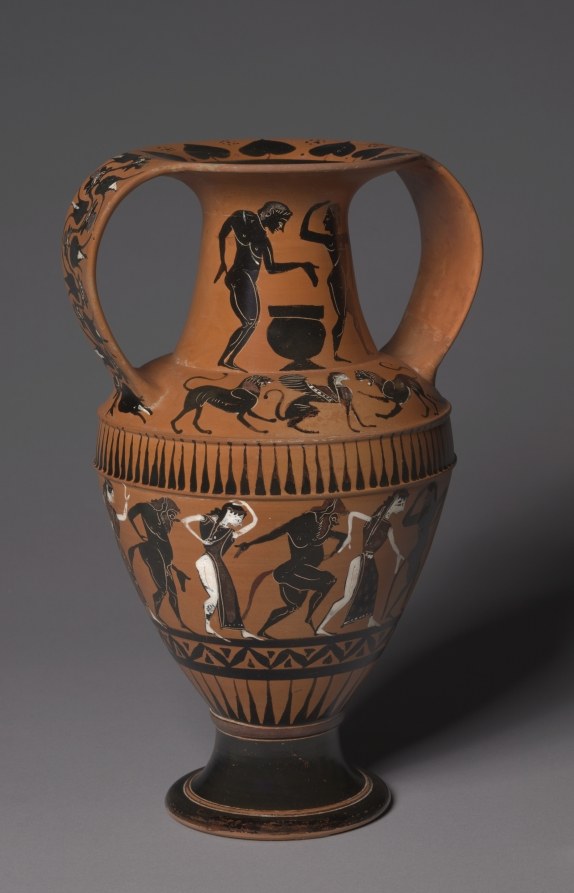
This is a black-figure amphora—a large storage vessel from ancient Greece, recognizable by its twin handles and bulbous body. The vessel is decorated with silhouette figures in black glaze against the terracotta clay. The upper register shows a frieze of dancing and acrobatic figures, while the lower register depicts additional dancers in more vigorous poses. The figures are rendered in profile or three-quarter view, with some shown in deep backward bends or inverted positions that suggest acrobatic rather than social dancing. The vessel's neck shows a band of decorative palmettes. The style and execution are consistent with Nikosthenic ware, a distinctive Athenian black-figure pottery type from around the 6th century BCE. The composition is densely packed with overlapping figures, each carefully positioned to show different moments of movement or different dance poses.
The dancing
The dancers are rendered in the characteristic black-figure silhouette style, their bodies articulated through pose alone. Several figures are captured mid-leap or in deep backward arches—one notably inverted with legs high and head low. Others stand in upright positions with limbs extended. The figures are naked or minimally draped, following Greek convention for male dancers. Their poses suggest simultaneous freezing of multiple moments rather than a single coordinated movement, implying a sequence of actions or multiple dancers performing different steps. The density of overlapping figures and the range of attitudes—some upright, some inverted, some mid-stride—conveys energetic, acrobatic movement.
The dance depicted
This appears to depict a form of ancient Greek dance, most likely a type of theatrical or athletic performance rather than a formal social dance. The emphasis on acrobatic poses—particularly the deep backward bends and inverted positions—suggests this may represent pyrrhic (warrior) dance, kordax (comic dance), or other athletic performance dance known from ancient sources. The male nude figures and their dynamic, varied postures are consistent with descriptions of Greek dithyrambic or satyr chorus performances. Without inscription or additional context, the specific genre cannot be determined with certainty, but the acrobatic content and all-male cast point to performance traditions rather than social dancing.
How it was made
This is a ceramic vessel created using the black-figure technique, in which figures were incised into a black glaze layer that had been applied to the red terracotta surface, revealing the clay beneath and creating sharp silhouette outlines. The technique required the potter to throw the vessel on a wheel and the painter-decorator to work with precision on a curved surface, meaning the design had to be composed to wrap around the three-dimensional form. Black-figure pottery was labor-intensive to produce and expensive to purchase, suggesting it was made for a market of relatively affluent households or used for symposium (drinking party) gatherings. The Nikosthenic form—a distinctive shape with sharply angled shoulders and a particular style of foot—marks this as a specialist product from a recognized workshop, indicating established craftsmanship and commercial distribution in the Athenian pottery industry.
About this work
This black-figure amphora is evidence of how ancient Greeks represented dance in their visual culture. The vessel's frieze of acrobatic dancers, rendered in the standardized silhouette technique of 6th-century-BCE Athenian pottery, captures a moment of vigorous performance—likely a type of athletic or theatrical dance rather than courtly or social movement. The density of overlapping poses and the emphasis on extreme body positions suggest the artist was documenting or celebrating male performers engaging in demanding, gravity-defying movement. As an object, it served a practical function (storage or mixing wine), but its decoration made it a prestige commodity and a record of what the Athenians valued in their visual art and physical culture. The work demonstrates that dance was not merely performed but visually documented and circulated as a subject fit for a luxury craft.
How to look at it
Examine the vessel as a three-dimensional object: the frieze wraps around the bulbous body, so the composition is meant to be read as one moves around it, with new groupings of dancers appearing as the viewer shifts position. Notice how the painter achieved a sense of continuous motion through repetition and variation—multiple figures in similar poses create a rhythmic pattern, while isolated inverted or extreme poses break the pattern and suggest climactic moments. The incised lines within the black silhouettes (indicating musculature, drapery folds, or hair) add visual interest to what might otherwise be flat shapes. Pay attention to which figures touch or overlap: these spatial relationships suggest either a coordinated group or a sequence of actions captured simultaneously rather than a moment of perfect synchronization.
The artist
The artist is not recorded, as was typical for Greek pottery of this period. The work's style identifies it as Nikosthenic ware, a product of a recognized Athenian workshop, but individual painters' hands within such workshops are rarely named in the archaeological record. The Nikosthenic workshop produced vessels distinguished by their particular shape, glaze quality, and decorative repertoire, suggesting a coordinated production system in which potter and painter may or may not have been the same person, and in which standardized designs were adapted to individual commissions or market demands.
The period
This vessel dates to the Archaic period of ancient Greece, when black-figure pottery was the dominant decorative technique in Athens (flourishing roughly 620–500 BCE). During this era, dance played a central role in religious festivals, theatrical performances, and private symposia. The acrobatic poses shown here align with descriptions in Greek literature of pyrrhic dances (military dances), dithyrambic choruses (choral performances in honor of Dionysus), and the kordax (a vigorous, often comic dance associated with satyr plays). The 6th century BCE was a period of growing urbanization, increased trade, and experimentation in visual representation—the black-figure technique itself was relatively recent and was soon to be superseded by red-figure pottery, which allowed for greater anatomical detail and linear expression. The emphasis on athletic male dancers reflects the Greek valorization of the male body and the connection between dance and physical prowess.
Where it lives
The vessel is part of the Cleveland Museum of Art's collection and is catalogued as a Nikosthenic black-figure amphora. Such vessels were produced in Athens and traded throughout the Mediterranean, making them common in museum collections. The museum's dance-related art collection includes works from many periods and cultures, placing this Greek vessel within a broad survey of dance representation across media and time.
Dance in this work
Questions about this work
What were these vessels used for?
Nikosthenic amphorae were large storage vessels, typically used to hold wine, oil, or other liquids. Despite their practical function, the finest examples—like this one—were decorated with expensive, time-consuming black-figure painting, indicating they were luxury goods. They were displayed in homes, used in symposia (drinking parties), or given as gifts, and some were exported for trade.
What kind of dance is this?
The acrobatic poses—especially the inverted positions and deep backward arches—suggest a form of athletic or theatrical performance dance rather than social dancing. In ancient Greece, this could represent pyrrhic (warrior) dances, dithyrambic choruses, or other performance traditions. Without an inscription, the specific type cannot be certain, but the vigorous, acrobatic nature marks it as a public performance genre.
Why are all the dancers male and naked?
In ancient Greek art and culture, athletic and performance dances were typically male domains, and nudity was conventional in representations of male athletes and performers. Clothed and adorned female dancers appear in Greek art, but they usually represent different contexts—courtesans, ritual performers, or mythological figures. The all-male nude representation here reflects both the actual gender composition of certain performance traditions and Greek artistic convention.
How do we know this is from ancient Greece?
The black-figure technique, the shape of the vessel (specifically the Nikosthenic form), the style of the figures, and the decorative vocabulary (palmettes, the proportions of the body) are all diagnostic of Athenian pottery from the 6th century BCE. Archaeologists and art historians recognize these features as markers of a specific time, place, and workshop tradition.
More dance artwork