49 works in this view — arrow keys or swipe to move between them.
Dance in Art
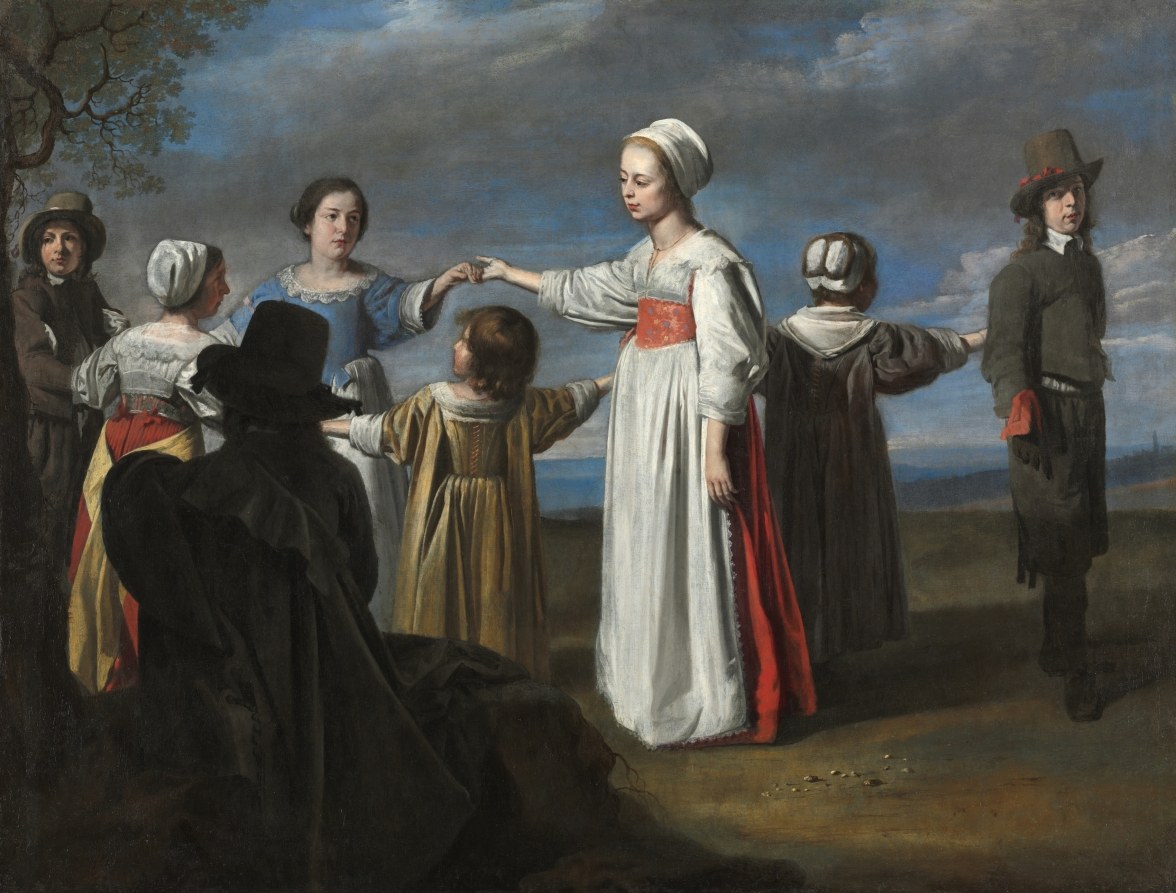
Children Dancing
Le Nain (French)
- Source:
- Cleveland Museum of Art
- Rights:
- Public domain — free to use, share and adapt.
- Recorded as:
- CC0 (Public Domain)
This work demonstrates how dance-like gesture and body position were deployed in 19th-century art not to depict social dancing but to communicate moral instruction and authority. It shows the educated viewer's expectation that the body, properly arranged, could convey virtue, teaching, and spiritual content—a legacy of Neoclassical and Romantic aesthetics that placed the human figure at the center of meaning-making.
What you are looking at
A woman in white linen dress with red underskirt stands at the center of a landscape, her arms extended in a welcoming or teaching gesture toward children gathered around her. The composition is formally arranged, almost tableau-like: a child in golden-yellow stands directly before her with arms raised; others in darker dress—browns, blacks, grays—cluster around and to the sides. The setting is rural and open, with a tree visible at upper left and a clouded sky suggesting evening or changeable weather. The woman's pose is commanding yet nurturing, her raised arm drawing the eye. The children's postures are varied—some attentive, some turning toward her, one child in the foreground shown from behind in silhouette. The overall effect is theatrical: a moment of instruction or moral teaching rather than spontaneous play.
The dancing
The central adult woman's pose is didactic: both arms extended, one higher, in a gesture of demonstration or benediction. Her body is upright and formal, her white dress and white head-covering reading as authority or purity. The child in yellow stands with arms raised in imitation or response, suggesting a teaching relationship. The other children are positioned as observers or pupils—their bodies angled toward the woman, though none are in a closed dance hold. The overall frame is one of instruction rather than peer dancing: the adult directs, the children attend.
The dance depicted
This work does not depict narrative dance but rather instruction or moral teaching through gesture and posture. The formal, symmetrical arrangement of the figures, the adult's elevated teaching pose, and the children's receptive stance suggest a pedagogical or allegorical scene rather than a specific dance style. If dance is present, it appears as a metaphor for moral guidance—the woman teaching through movement or example. The scene reads as 18th or 19th-century in its formal arrangement and the symbolic use of dress and gesture.
How it was made
The work is executed in oil on canvas, evident from the painterly handling of light and color, the subtle gradations in the drapery, and the atmospheric treatment of the sky. The technique allows for precise rendering of texture—the fine white linen of the woman's dress, the varied fabrics of the children's clothing—and for careful composition of multiple figures across a landscape. The scale and finish suggest this was made for a substantial audience, likely in a gallery or private collection context.
About this work
This is a formal allegorical or pedagogical scene in which an adult woman, dressed in symbolic white and red, instructs or blesses a group of children in a rural landscape. The composition is rigorous and deliberate, organized around the woman's central teaching gesture. While the work employs dance-like posturing and the formal language of movement, it does not depict an actual dance event but rather uses the body as a vehicle for moral or spiritual instruction. The work belongs in a dance collection as an instance of how dance, gesture, and the moving body have been used in visual art to represent pedagogy, virtue, or blessing—cultural practices in which movement carries meaning beyond entertainment.
How to look at it
Attend to the woman's raised arm and the child's imitative gesture—a moment of transmission rather than reciprocal movement. Notice how the composition is symmetrical and didactic, not candid: every figure is arranged for clarity of meaning. The woman's white dress and the child's golden yellow are symbolic colors in European art tradition, signaling purity and innocence. The rural landscape setting removes the scene from everyday social dancing and places it in an ideal or allegorical space. The careful finish and formal arrangement suggest this is a painted argument about education and virtue, not a record of actual social practice.
The artist
The artist is unknown, but the style and subject suggest a European painter of the late 18th or 19th century, trained in academic tradition. The formal composition, the allegorical use of white dress and gesture, and the careful anatomical rendering of multiple figures point to a painter of some training and ambition, likely working within or aware of Neoclassical or early Romantic conventions.
The period
This work dates stylistically to the late 18th or 19th century, a period in which gesture and the dancing body became central to debates about virtue, education, and moral development. Rousseauian ideas about nature and childhood, the rise of pedagogy as a serious intellectual discipline, and Romantic investment in the expressive body all informed how artists depicted teaching and blessing. In visual art, the formal dance-like posture signaled refinement, moral authority, and the possibility of uplift through proper training.
Where it lives
This work is held by the Cleveland Museum of Art and was catalogued as part of the museum's dance-related art collection. It is labeled in the museum's records as unknown era and general dance, reflecting both the artwork's uncertain date and the broad category under which dance-related visual culture has been collected.
Questions about this work
Is this actually a dance?
Not a social dance in the modern sense. The work uses dance-like posture and gesture—the raised arms, the formal positioning—to represent instruction or blessing. It belongs in a dance collection because it shows how the trained, expressive body was used in European visual culture to communicate authority and virtue.
What is the woman teaching the children?
The painting does not specify. The raised arm and formal posture are generic signs of instruction or blessing in European art of this period. She may be teaching deportment, morality, or spiritual principle—the image is deliberately ambiguous and symbolic rather than narrative.
Why is the woman dressed in white and red?
In European artistic tradition, white signifies purity and innocence, while red suggests vitality or passion under control. The combination, with the white garment and red underskirt, suggests virtue made visible and available for transmission to the children. The dress is symbolic, not naturalistic.
When was this made?
The style suggests late 18th or 19th century—the academic composition, the Romantic investment in childhood and nature, the use of allegorical gesture. The catalogue record does not provide a firm date, and the artist is unknown.
More dance artwork